A car with an N53 judders under load, the warning light is on, one person says “high-pressure pump”, another “injectors”. Both pieces of advice can be right, and both can be an expensive mistake. The N53 is a six-cylinder petrol engine with direct injection and piezo injectors, and many of its symptoms have several sources at once.
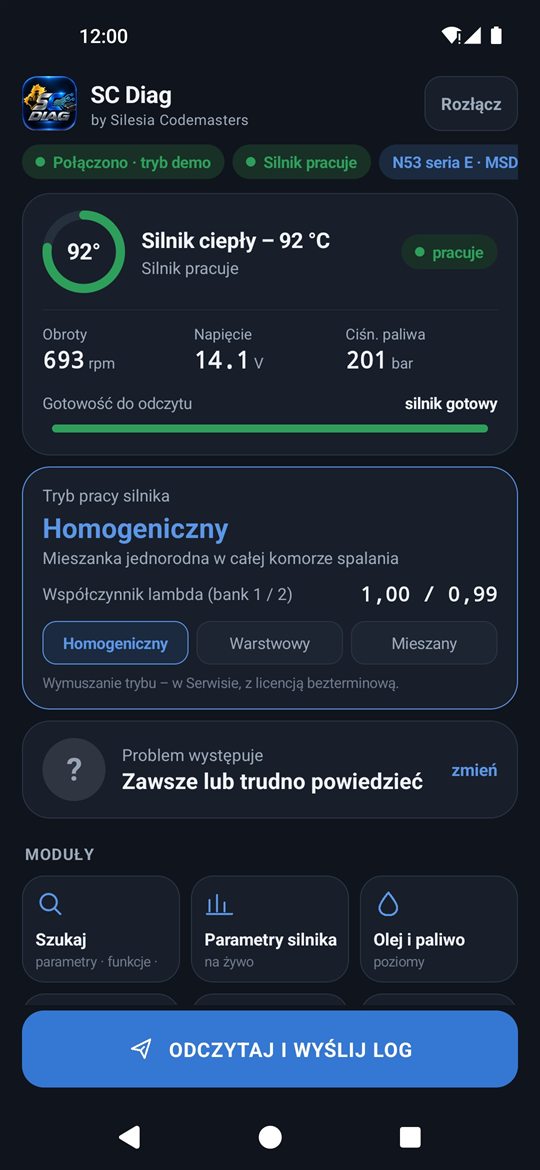
The SC Diag dashboard with the operating mode and the lambda of both banks. Demo mode, simulated data.
Below we put N53 diagnostics into one order and show where to read on. The engine works with an MSD80 or MSD81 control unit, and in newer versions also an MSD87. The range of the SC Diag reading is the fullest for it.
The short answer: we start N53 diagnostics with fault codes and freeze frames and a reading on a cold and a warm engine, then rough run, mixture trims and fuel pressure on the move. We check the NOx system and the crankcase ventilation before any decision about the pump or injectors. A fault code alone does not point to a part.
Why the N53 is so easy to misdiagnose
Low rail pressure is only a message that the control unit is not reaching its target value. The same code is produced by the high-pressure pump, a leaking injector, a clogged filter, a faulty sensor and an air-locked low-pressure circuit. On top of that comes the crankcase ventilation, whose fault gives uneven running and symptoms mistaken for an injection problem.
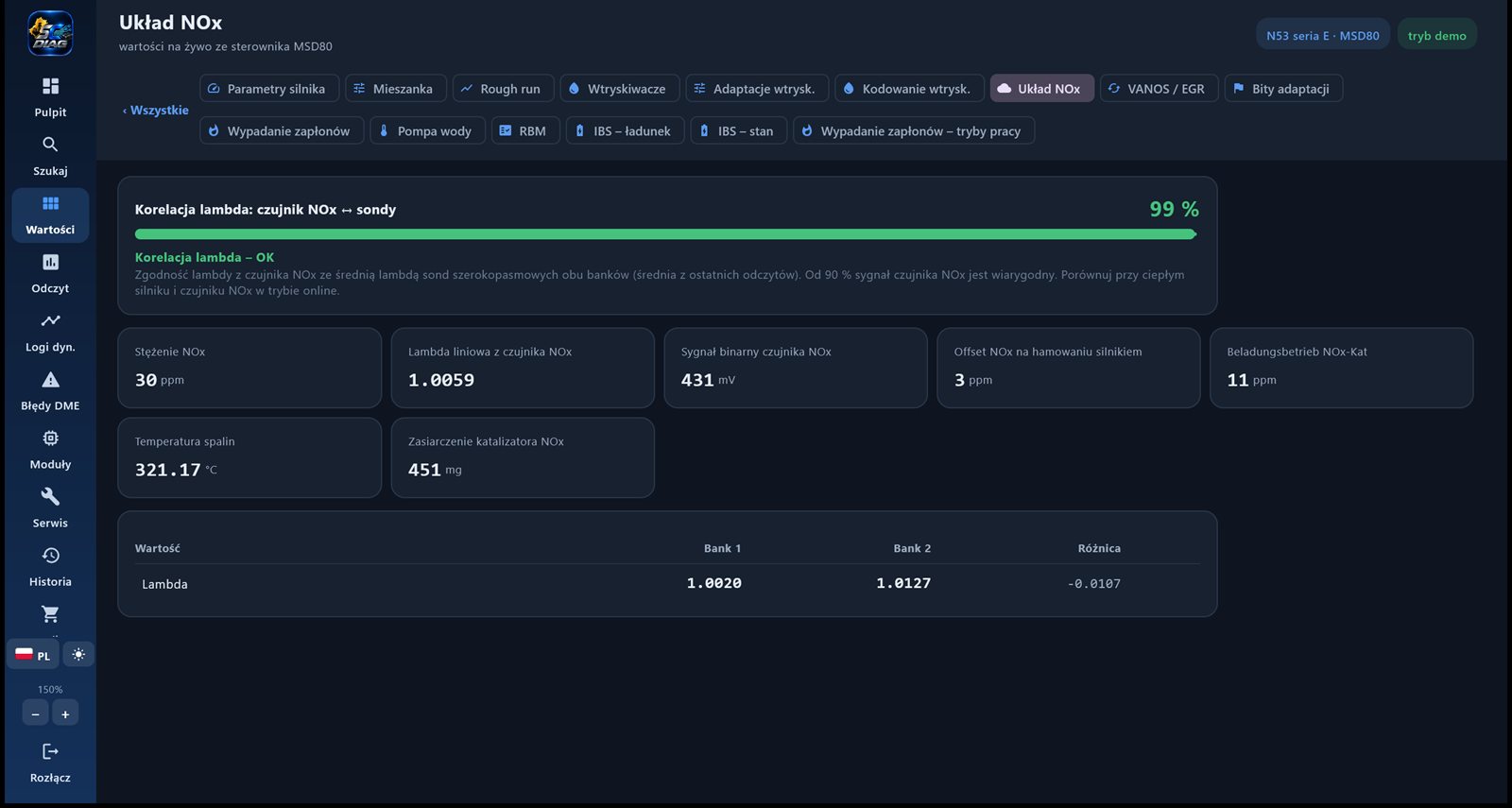
The “NOx system” tab in SC Diag for Windows. Demo mode, simulated data.
So with the N53 we first ask “which system” and only then “which part”. We write about the pump itself in the article on the HPFP and LPFP, and about the ventilation in a separate one on the N53 crankcase.
Six cylinders, two banks, one order of checks
- Fault codes with freeze frames, without clearing (how to read them).
- A reading when cold and when warm, because some faults show up in only one of them (misfires when cold).
- Rough run and misfire counters: does one cylinder stand out or the whole engine (rough run chart).
- Mixture trims of both banks and injector corrections (STFT and LTFT, wideband sensors).
- Fuel pressure on the move. Our workshop criterion for low pressure is about 5000 hPa with a spread of up to ±100 hPa, depending on the engine and the measuring conditions (how to read the value).
- NOx system and operating mode.
At idle many fuel faults are invisible. That is why we judge pressure under load, in a log taken while driving.
Piezo injectors: when suspicion is justified
We begin to suspect an injector when one cylinder stands out rather than the whole engine. Usually this shows in the corrections of that cylinder, in rough run and in misfire counters that grow in the same place. Add to that a long start after standing and pressure that drops after switching off faster than it should. Each of these symptoms also has other sources, so we put them side by side instead of judging them one by one.
Before you buy a new set, find out where it comes from. The aftermarket is full of units that only look new (counterfeit injectors).
NOx system and stratified mode
The N53 has a NOx sensor and a NOx catalytic converter, and whether the engine enters stratified mode depends on them. When the control unit does not trust them, it stays in homogeneous mode and uses more fuel. A sensor can lie without a code, and a catalytic converter looks worse if the sensors or the mixture are failing.
The order is fixed: the sensor and its data, then lambda and leaks, and only at the end the catalytic converter. We describe the procedure in the article on diagnosing the NOx system, and the individual codes in the list of NOx codes. Switching off or bypassing emission systems is not a service we offer (terms and conditions, §3 para. 3).
Mornings and after an hour of driving
The N53 behaves differently in the morning and after an hour on the road. When cold, the control unit enriches the mixture, so weak fuel delivery and leaks show up early. Once warm, the NOx sensor, the catalytic converter and stratified mode come into play, and their symptoms may not show at all at a standstill. That is why a single short reading is rarely enough. Two readings, cold and warm, plus a log from driving, give a picture that a single code does not.
Where to read next, depending on the symptom
- Judders, misfires: misfire counters, ignition coils, spark plugs.
- Suspected injectors: piezo symptoms and reading, injector corrections, counterfeit injectors.
- Higher consumption, no stratified mode: operating modes, stratified mode after a repair, NOx sensor, desulphation, lambda sensors and mixture.
- Oil, valve timing, temperature: oil pressure, VANOS, thermal management, deposits on the valves.
- Before buying and after a repair: pre-purchase check, readaptation, NOx sensor replacement on an F10, software update.
What you will see in SC Diag
The dashboard shows temperature, revs, voltage, fuel pressure, operating mode and the lambda of banks 1 and 2. Further on are rough run with misfire counters, mixture and injector adaptations, NOx system values with the correlation of the sensor's lambda to the lambda sensors, VANOS and fault codes with freeze frames. Dynamic logs record the run from a drive, and the guided reading on a cold and warm engine lays out the measurement step by step.
It is a reading, not coding, and it settles nothing on its own. It narrows down the checks. We list the parameters worth recording on the road in a separate article.
How we can help: a reading by yourself or a diagnostic with us
You can take the first step yourself. SC Diag runs on Android and on Windows (separate licences): from €9.99 for 30 days, €29.99 for a year, €69.99 for 2 years with the Service option. Demo mode shows the screens without a car, and you can send the log for analysis.
The second path is N53 diagnostics with us, in the workshop in Silesia, on site or remotely. We agree the scope by phone: 570 341 744.
Frequently asked questions
Usually the high-pressure pump, piezo injectors, the NOx system and the crankcase ventilation get replaced. Which of them is the cause is settled only by a reading, not by the symptom.
No. The same code is given by a leaking injector, an air-locked low-pressure circuit, the filter and the sensor. That is why we compare target and actual pressure on the move.
The control unit stays in homogeneous mode when it does not trust the NOx sensor, the catalytic converter, the lambda sensors or the mixture. The first step is the NOx sensor and its data.
With fault codes and freeze frames, a reading when cold and warm, rough run and trims. Only then do we judge the pump and injectors.
It will not point to a part. It shows values, correlations and the conditions in which faults were stored, which narrow down the checks, and a conclusion needs a comparison with inspection.
Start with a reading
A reading in SC Diag shows which N53 system needs attention before you buy a part. We agree a diagnostic with us by phone.
Order SC Diag