Six cylinders, two banks of three and a control unit that calculates the mixture separately for each of them. That is the best feature of the N53 for lambda diagnostics, because one bank serves as the reference for the other. So the first question is not "is the probe faulty" but "is bank 1 running differently from bank 2".
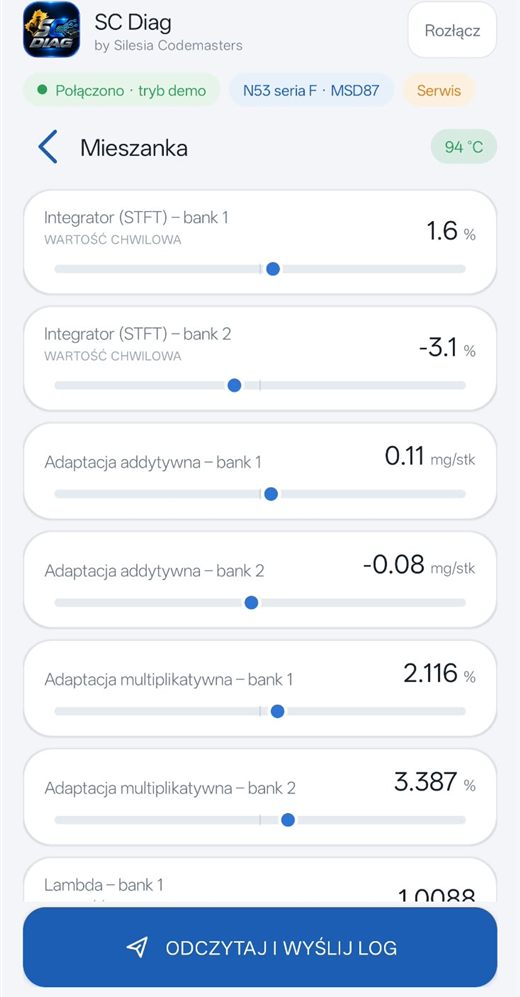
The "Mixture" screen in SC Diag on a phone. Demo mode, simulated data. Each bank has its own integrator and its own adaptations.
We do not describe how the probes are built here, that is in the article on wideband lambda probes. We deal with diagnostics: what to read, in what order and what can distort the result before anyone buys a probe.
Short answer: On the N53 every bank has a control probe upstream of the catalytic converter and a monitor probe downstream of it. We start the diagnosis by comparing the banks: trims, adaptations and lambda. A difference narrows the lead to one side of the engine. Only then do we check for leaks, misfires and the probes themselves, judging them by resistance, voltage and their reaction to a change of mixture.
Two probes per bank and a third source from the NOx sensor
The wideband probe upstream of the catalytic converter measures the mixture, and the control unit corrects the fuel quantity on that basis. The probe downstream of the converter is simpler and, according to most descriptions, assesses the work of the catalytic converter, and some descriptions add that it also serves to calibrate the wideband probe. The descriptions differ here, so we do not base conclusions on it, only on comparing readings.
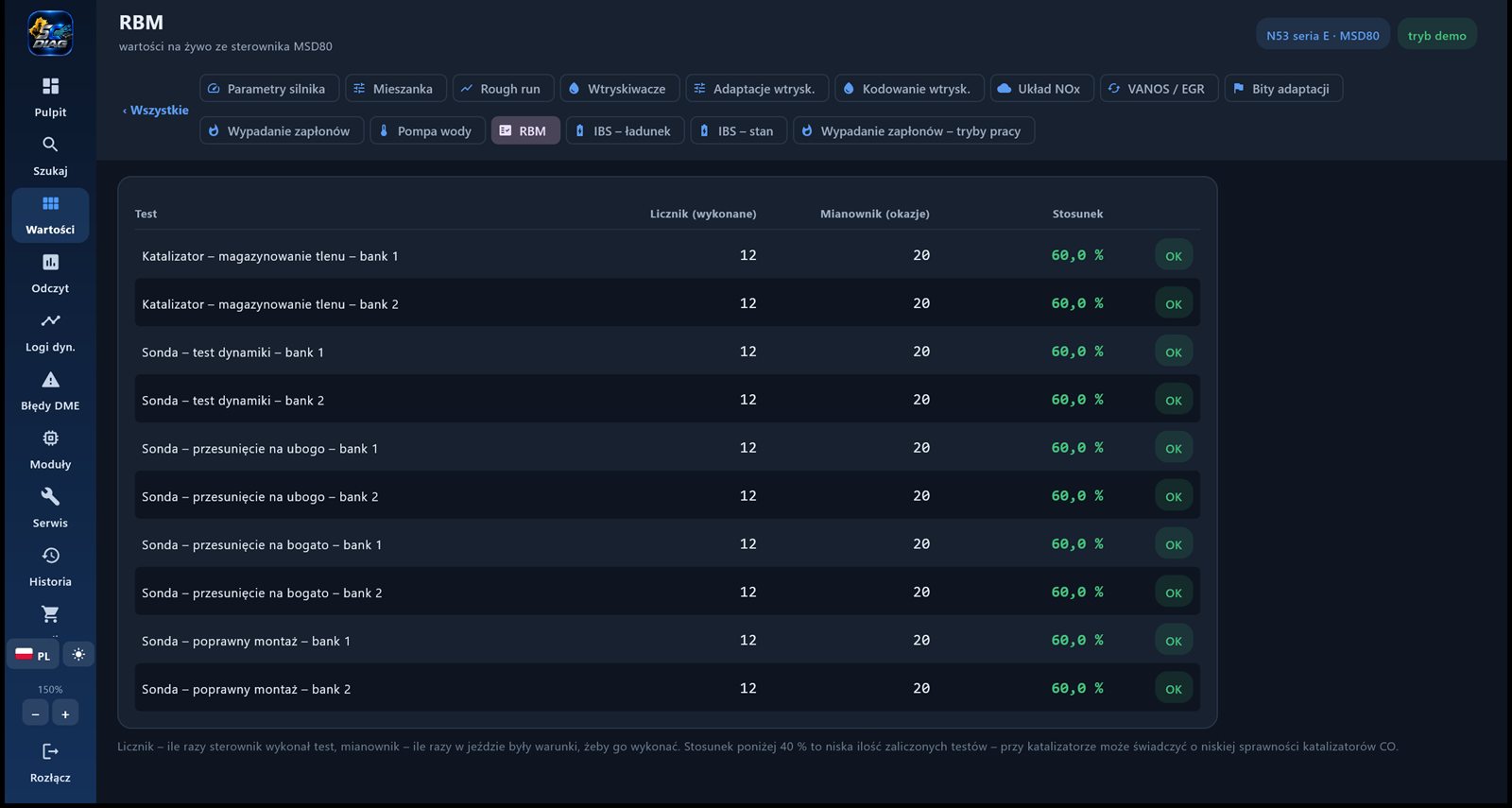
RBM tests in SC Diag on Windows: the catalytic converter and the probes of each bank separately. Demo mode, simulated data.
The N53 has yet another source of knowledge about the exhaust gas. The NOx sensor reports its own lambda, which we compare with the average of the probes of both banks (NOx sensor and lambda probes). When three independent measurements say the same, we know a lot. When one stands out, we have a suspect.
Compare the banks first
For each bank we read the control integrator (the short-term trim) and the adaptations: the additive one, which matters at idle, and the multiplicative one, which matters under load. The screen in the app shows them side by side. Two patterns mean different things.
Both banks shifted the same way usually point to something common: air drawn into the intake, fuel pressure, the airflow meter. One bank off from the other points to a side of the engine: an exhaust leak at one manifold, a probe, an injector or misfires in three cylinders. We describe the sign of the trims and how they depend on engine speed in the article on STFT and LTFT trims. We give no "good, bad" thresholds here, because they depend on the control unit version, the temperature and the operating mode.
The probe itself: resistance, voltage, reaction
Once the banks point to a suspect side, we assess the probes. According to our workshop criteria, depending on the engine and the measurement conditions, a Nernst resistance above 512 Ω on a warm probe means the probe needs replacing. With a warm engine, a control probe at about 2.0 V while the monitor probe is below 0.1 V is a serious problem.
There is one caveat that saves needless replacements. A lambda above 2.0 means stratified operation, and that is not a fault. In that state a control probe voltage above 2.5 V and a monitor probe voltage below 0.05 V are normal. That is why we apply these criteria when we know which mode the engine is actually in.
The Windows program also has RBM tests, that is, tests the control unit runs by itself while driving: for the probes dynamics, shift to lean and to rich, and correct installation, separately for each bank. It shows the counter of tests performed, the denominator and the ratio. A low ratio first says that few tests have passed, and it has to be read together with the rest of the read-out.
What distorts the picture without the probe being at fault
A probe is sometimes accused unfairly. Air drawn in upstream of the probe falsifies the measurement. Misfires put unburned fuel into the exhaust and change the lambda, and driving for long with misfires overheats the probe (rough run and misfires). Oil or coolant in the exhaust gas coats the sensing element. Sometimes it is simply a connector, a wire or the heater supply, which looks like a faulty probe.
There is one more reason that few people remember. If the NOx system has blocked stratified charge mode, the injector adaptations stop learning and the mixture drifts over time, and the probes merely show it. In that case treating the probe changes nothing, and the whole read-out falls back into place after the NOx system is repaired (NOx system diagnosis step by step).
The order of checks in the workshop
- Fault memory with freeze frames: lambda, trim, misfire and NOx system codes.
- A comparison of the banks on a warm engine: integrators and adaptations, idle and load.
- Intake and exhaust tightness upstream of the probes.
- Rough run and misfire counters, to rule out a cylinder that changes the lambda on its own.
- Probe resistance and voltage, taking the operating mode into account.
- A comparison of the lambda with the NOx sensor.
- Only then a decision about the probe. After replacing it, the mixture adaptations have to be set afresh and the reading of the same values repeated.
The limits of a read-out
A read-out will show that a bank stands out and that a probe has a high resistance. It will not show whether the cause is deposits, moisture in the connector or wear of the element. A single measurement can also mislead, because probes and adaptations change with temperature, so we take several readings, including from driving (live engine parameters). A read-out narrows down what to check and does not replace an inspection in the workshop.
How we can help
You can start on your own. In SC Diag you will find the integrators and adaptations of both banks, the lambda and voltage of the probes upstream and downstream of the catalytic converter, the resistance of the probes and the heater duty cycle, and the correlation of the lambda with the NOx sensor. The scope depends on the data the control unit provides, and the N43 and N53 are the most fully developed. A licence: €9.99 for 30 days, €29.99 for a year, €69.99 for 2 years with the Service tab, Android and Windows separately (order SC Diag).
When a read-out is not enough, we will check the system with us: in the workshop in Silesia, mobile or remote, with the scope agreed by phone (N53 diagnostics, remote diagnostics for the N43 and N53). You will find a broader picture of the engine in the N53 diagnostic guide.
Frequently asked questions
We start by comparing the banks, then we check for leaks and misfires and only then the resistance and voltage of the probe. A deviation of one bank alone does not prove that the probe is faulty.
That the cause lies on one side of the engine and not in a shared component. It may be a leak, an injector, misfires or a probe, and the read-out does not settle which.
According to our workshop criteria, a warm probe with a Nernst resistance above 512 Ω needs replacing. That is our criterion, depending on the engine and the measurement conditions, not a manufacturer's standard.
Not always. In stratified operation, at a lambda above 2.0, a control probe voltage above 2.5 V is normal. The serious problem is a warm engine on which the control probe holds about 2.0 V while the monitor probe is below 0.1 V.
It shows the probe data and the correlation with the NOx sensor, which narrows down what to check. We decide on replacement after checking exhaust tightness, misfires and connectors.
Suspect the lambda probes on your N53?
Start with a read-out in SC Diag, and if needed we will check the rest with us or remotely.
Order SC Diag