A warning light is on, there is a four-character code in the fault memory, and you want to know what it means. We have collected the BMW NOx fault codes that we come across in service descriptions: NOx sensor codes, the two catalytic converter codes (30E9 and 30EA), related codes and, as a rough guide, the F series. Each has a short description, but none of them points to the faulty part.
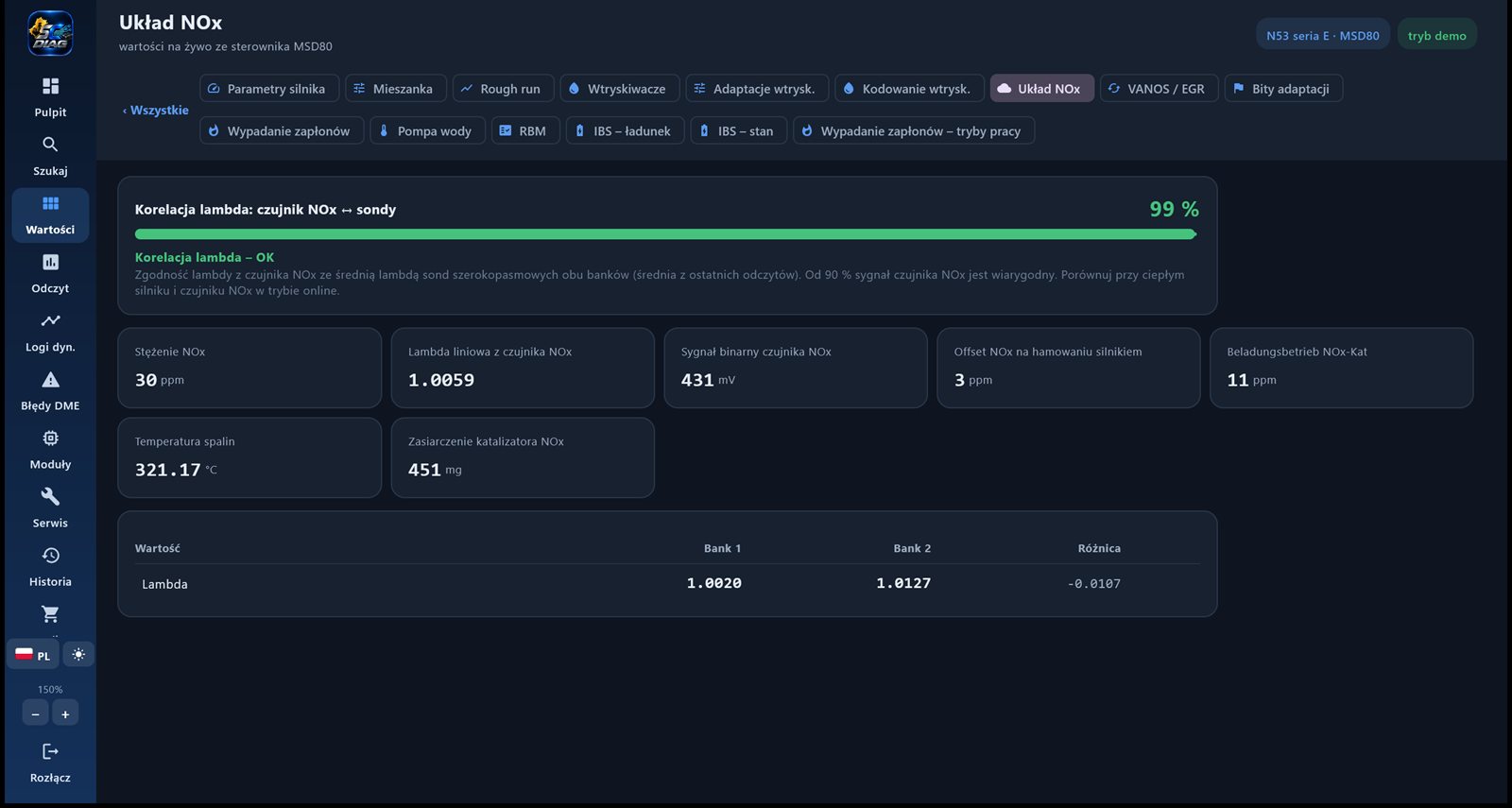
The "NOx system" tab in SC Diag for Windows. Demo mode, simulated data.
This is a guide to what a code usually means. What to do, step by step, we cover separately in BMW NOx fault codes: first steps. We talk only about diagnostics and about restoring the system to factory operation.
Short answer: a NOx code tells you which area does not meet the control unit's expectations: the sensor, its supply and signal, or the catalytic converter. It does not tell you which part to replace. The code descriptions, 30E9 and 30EA included, come from service material and differ between sources. So the code has to be set against the live data and a physical inspection.
How to read this list
On petrol N43 and N53 engines the NOx system consists of a sensor with its own electronics, the lambda sensors and a catalytic converter that stores NOx. The codes fall into three groups, and it helps to know which one you are in, because the conclusions differ.
A sensor code concerns its supply, heating, signal or plausibility. A catalytic converter code is worked out by the control unit from the measurements of that same sensor, so a healthy converter with a misleading sensor will also trigger a fault, and a faulty sensor can hide a converter problem. Related codes are misfires, mixture corrections and lambda sensors, which the NOx system can cause but which do not prove it on their own.
A sensor can also be faulty without any code at all. This is judged from the NOx reading on a warm engine: a constant or intermittent zero reading while driving raises suspicion. So treat the code as a starting point for comparing signals, not as a verdict. How to compare them is described in the text on the NOx sensor and lambda sensors.
NOx sensor codes (E series)
The table lists the codes that come up most often in the descriptions. Some descriptions appear under two or three numbers.
| Code | What it concerns | Notes |
|---|---|---|
| 2AEC | NOx sensor self-diagnosis | The sensor reports its own fault. Start with the supply and the connector. |
| 2AF0, 2B05 | Sensor heating | The circuit or operation of the sensor's heating element. |
| 2AF2, 2B06, 2B09 | Linear lambda signal of the sensor | The part of the sensor signal that works like a linear lambda sensor. |
| 2AF4, 2B07, 2B0A | Electrical fault | Usually the circuit: connector, wiring, supply. |
| 2AF6, 2AFB, 2B0B | Binary lambda signal | The second part of the sensor signal. |
| 2AF8, 2AF9 | NOx signal check in overrun mode | A check of the signal while the engine is braking with no fuel injected. |
| 2EAE | No message from the sensor | +12 V supply, ground, communication, connector and wiring. |
| 30D6 | Signal plausibility | May result from lambda fluctuations, leaking injectors or air getting in. Can appear after a sensor replacement when the sensor has not been registered in the control unit. |
| 30D8 | Sensor faulty | General description. Confirm by comparing with the lambda sensors. |
| 30DA | Sensor heating time | The description concerns the sensor's heating time. |
| 30DC | Sensor heating | General description, no details in our sources. |
| 30DE | Correlation with the pre-catalyst lambda sensor | Exhaust leak, sensors, injector adaptations. Also after a sensor replacement without registration. |
| 30E0 | Sensor offset in overrun mode | A high offset may indicate sensor wear. |
| 30E2 | Sensor test | Description incomplete in the sources. |
| 30E4 | Sensor ageing | The description concerns sensor ageing. |
| 30E6 | Sensor dynamics | The description concerns the sensor's response speed. |
The NOx sensor fault code 2AF2 and its equivalents concern the linear lambda signal, and 2AF4 an electrical fault. We usually start both with the connector and the supply, not with buying a sensor.
30E9 and 30EA: the two catalytic converter codes
30E9 is described as ageing of the NOx catalytic converter. The control unit judges efficiency from the amount of NOx measured by the sensor and how quickly it rises after regeneration. If efficiency stays below the permitted level for long enough, it stores the code. According to some descriptions the code returns after clearing, and the engine then runs only in homogeneous mode, with higher fuel consumption. A faulty NOx sensor can mask a converter problem, because then the code is not stored at all.
30EA is described as sulphation of the NOx catalytic converter. The control unit adds up the calculated and measured sulphur load, and stores the code when the limit is exceeded and regeneration (desulphation) has not taken place or is not possible. The causes listed are a driving pattern without regular stretches on which the control unit could start it, a slow response of the NOx sensor, a faulty NOx sensor and the exhaust temperature sensor.
The order of work matters: first assess the sensor, even if it has left no code, replace and register it in the control unit if necessary, and only then regenerate and adapt the engine. Desulphation before checking the sensor may treat the effect instead of the cause. After clearing, 30EA may not come back straight away, but the condition of the converter does not change.
In both cases the descriptions mention lean and stratified modes being blocked, loss of long-term corrections and, over time, uneven running and misfires. We write about the modes in the text on N43 and N53 operating modes, and about the difference between sulphation and permanent wear in the articles what damages the NOx catalytic converter and desulphation of the NOx catalytic converter.
Related codes the NOx system can trigger
We list them as ranges, without interpreting individual entries, because each needs its own check.
| Codes | Area | Notes |
|---|---|---|
| 29CC–29D2 | Misfires | Cylinder misfires, see rough run. |
| 29E0, 29E1 | No description in our sources | Check the description in your tool and the freeze frame. |
| 2A2B, 2A2C | Mixture correction | See STFT and LTFT fuel trims. |
| 29F4, 29F5 | Catalytic converter conversion | Catalytic converter efficiency as judged by the control unit. |
| 2C31, 2C32, 2C7E, 2C7F | Lambda correction | Mixture regulation based on the lambda sensors. |
When such entries appear next to a NOx code, we look for a common cause: an exhaust leak, mixture corrections (STFT and LTFT) or misfires (rough run).
F series, briefly and as a rough guide
In newer cars the entries are built differently. According to the descriptions, the family of codes 12C1xx–12CExx concerns the wiring and short circuits of the NOx sensor, its heating, plausibility, readiness, correlation, the overrun check, regeneration of the catalytic converter, dynamics after regeneration and self-diagnosis. CD8510 is described as loss of communication with NOx sensor "A", and 180401 as NOx catalytic converter efficiency below the limit. Treat this as orientation, not a table, because the exact meaning depends on the control unit and the software version.
Where these descriptions come from and why they sometimes conflict
The descriptions in this list come from service material available online and from our own workshop experience. This is not BMW documentation, and we do not claim that every description fits every car. Descriptions of the same code can differ. For 30E9, some places talk about ageing of the catalytic converter and others about a multiplicative lambda adaptation.
Most likely this is because the same number is named differently depending on the control unit and software version, and the authors of the descriptions partly rely on their own observations. That is why we give no numerical thresholds: they depend on the engine and the measuring conditions, and we have not confirmed them. If your tool shows a different description from this list, the tool's description and the freeze frame of the entry carry more weight.
What to do with it
Start with the first steps for NOx codes, and for the symptoms of the sensor itself see the article on NOx sensor failure.
In SC Diag the NOx system has its own tab: NOx concentration and linear lambda from the sensor, the binary signal, exhaust temperature, the sulphation state of the catalytic converter and the correlation of the sensor's lambda with the lambda sensors of both banks. A fault entry gets a freeze frame with the conditions it was logged under. The scope depends on the data the control unit provides, and the N43 and N53 are covered most fully (list of 97 control units).
A reading narrows the scope of checks and settles nothing on its own. It does not replace inspecting the connector, the exhaust and the mechanics in the workshop. In line with our terms and conditions we do not switch off or bypass emission systems; we repair the system so that it works as the factory intended.
Frequently asked questions
In service descriptions it is ageing of the NOx catalytic converter, meaning efficiency that the control unit has judged too low. The descriptions differ, though, and a faulty NOx sensor can hide the problem, so the code has to be compared with the live data.
30E9 is described as ageing of the catalytic converter and 30EA as its sulphation, which can in principle be reversed by regeneration. From the code alone we cannot tell which of the two states applies.
According to the descriptions it is the linear lambda signal of the NOx sensor, with equivalents 2B06 and 2B09. We start with the connector and the supply, then compare the signal with the lambda sensors.
No. The same code can result from a weak supply, moisture in the connector, an exhaust leak or a wrong mixture. The reverse also happens: a sensor can be faulty without any stored code.
No. We collected the descriptions from service material available online and from workshop experience. They can differ depending on the control unit and software version.
NOx system code?
Take a reading and send us the log, and we will narrow down what to check before you replace anything.
See SC Diag