“NOx sensor needs replacing” is a sentence that gets said far too easily once the fault codes have been read. The part is expensive, and after it has been fitted the warning light comes back more often than anyone would like. The reason is simple: the code tells you the control unit dislikes something in the sensor’s signal. It does not tell you whether the sensor is to blame.
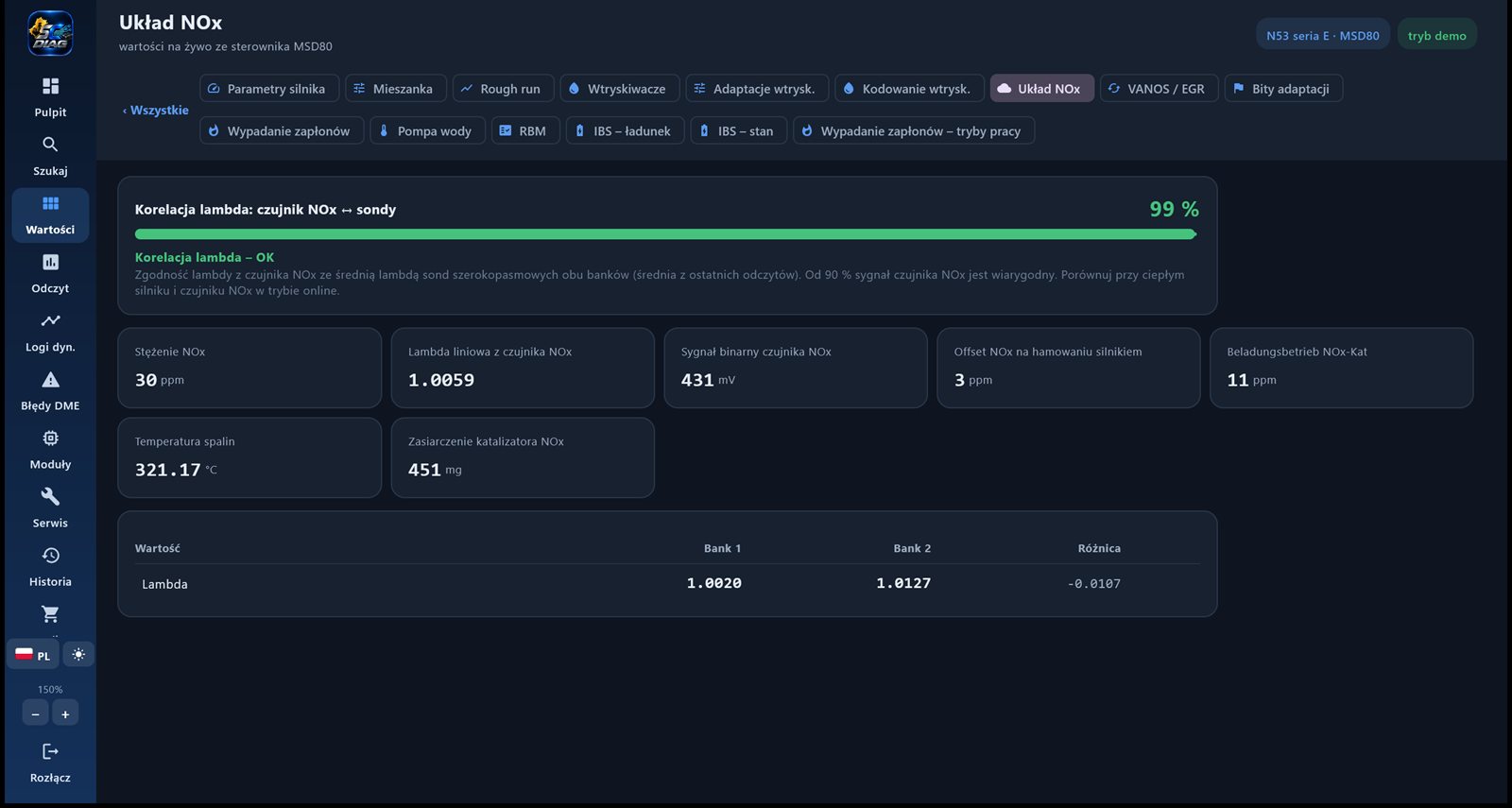
The “NOx system” tab in SC Diag for Windows. Screenshot taken in demo mode – the data is simulated and the figures do not come from a real car.
Below we describe how we check this on N53 engines, where the NOx sensor works together with the NOx storage catalyst, and how comparing its lambda value with the lambda probes helps before any part is replaced.
The short answer: on the N53 the NOx sensor reports its own lambda value as well as the NOx concentration. We compare it with the average lambda from the wideband probes of both banks, on a warm engine. If it agrees with the probes, the sensor signal is trustworthy. If it stands apart while the probes agree with each other, the sensor is suspect. Even then, we first rule out the power supply, the connector and exhaust leaks.
Why the fault code alone settles nothing
A NOx sensor is not an ordinary two-wire component. It has its own control module that talks to the engine control unit. So the fault you see can mean several things: the sensor has failed, it is not getting a proper supply, the connector has picked up moisture, or the signal is fine but does not match what the control unit expects. The first needs a new part. The others do not.
What damages these sensors (condensation, deposits, voltage spikes) is covered in our article on NOx sensor failure symptoms. But the same symptoms can come from a problem somewhere else entirely. That is why we start with a comparison and not with an order for a new part.
Where the lambda value in a NOx sensor comes from
On the N53 the NOx sensor reports more than the concentration of nitrogen oxides. It also gives a linear lambda value, which is what a wideband probe normally measures. That is a small detail with a big consequence: the exhaust has several independent sources of information about the same thing, namely the composition of the gas. If they measure the same thing, they should agree.
The SC Diag screenshot shows how this looks in the app. The “Lambda correlation: NOx sensor ↔ probes” bar compares the lambda value from the NOx sensor with the average lambda of the wideband probes of both banks, calculated from the most recent readings. The app treats the signal as trustworthy from 90 % agreement and advises comparing with a warm engine and the sensor online. Below the bar is a table with the lambda of bank 1 and bank 2 and the difference between them. That table is as important as the percentage itself, as explained below.
How we read the result
It is easiest to look at three situations.
The lambda from the NOx sensor agrees with the probes, and bank 1 and bank 2 are close to each other. For us that is a good sign that the “lambda” part of the sensor works. It does not yet follow that it measures NOx itself correctly.
The lambda from the NOx sensor stands apart, while both wideband probes agree with each other. The sensor is then the main suspect. Before replacing it, though, we look for exhaust leaks near it and check the supply and the connector.
The banks differ clearly from each other and the NOx sensor lands somewhere in between. Here the correlation percentage can mislead, because the sensor is being compared with the average of two different numbers. First you have to find out where the difference between the banks comes from (mixture, one bank’s probe, a leak), and only then return to the NOx sensor. While you are at it, see our article on wideband probes, where we describe what shortens their life.
What to check before replacing it
Before a part is ordered we go through a short list, in this order:
- Battery voltage and the condition of the sensor connector (moisture, corrosion, loose contacts).
- Exhaust leaks upstream of the sensors. Air drawn in falsifies the measurement.
- The probes themselves. According to our workshop criteria, a Nernst resistance above 512 Ω on a warmed-up probe means the probe should be replaced, and with the engine warm a control probe at about 2.0 V together with a monitor probe below 0.1 V is a serious problem. Figures like these change the picture, because we can no longer trust the probes as the reference.
- Mixture trims and adaptations for both banks, especially if the banks differ. We cover this in more detail in our article on fuel trims (STFT and LTFT).
- Only then the sensor itself.
These are our own criteria, not a manufacturer’s specification, and we treat them as a reference point, not a verdict from a single measurement.
What a reading will not settle
Matching lambda values do not prove that the sensor measures NOx correctly. Conversely, a mismatch does not say whether the cause is the ceramic element, deposits or the sensor’s own electronics. Intermittent faults that appear when cold or in damp conditions may not show up in a single reading at all, which is why with such symptoms we take several readings and look at the log. Nor can we judge absolute NOx concentrations from the reading alone, because we have no independent second measurement, so we look at whether the values are consistent and plausible. And finally, assessing the NOx catalyst itself is a separate subject, covered in our article on what damages the NOx catalyst.
After replacement
A new sensor has to be registered in the control unit, readapted, and the fault memory checked. We show an example of this work in the F10 with an N53 engine and a replaced NOx sensor. A proper repair ends with a fresh reading of the same values that made us suspect the sensor. If the correlation returns to normal, we know we got it right.
Frequently asked questions
Nitrogen oxides, formed during combustion. A NOx sensor measures their concentration in the exhaust gas, and the control unit uses this signal to judge how the exhaust treatment is working.
Most often a warning light and an entry in the fault memory, sometimes reduced power or a message about the emissions system. Other faults can cause the same symptoms, so the symptoms alone do not point to the sensor.
No. It is a strong indication, but we decide only after checking the supply, the connector, exhaust tightness and the condition of the probes themselves.
The probes and the sensor read reliably only once warmed up. When cold, the comparison can show lower agreement even though nothing is faulty.
No. It provides facts for a decision, but finding the cause and carrying out the repair need inspection and measurements that we carry out in the workshop.
Suspect the NOx sensor?
We will check the correlation with the probes and the rest of the system before you replace anything.
See how SC Diag works