The warning light is on in your N53, the fault memory holds a NOx system code and fuel consumption has gone up. On the internet you will be given two pieces of advice: replace the sensor or replace the catalytic converter. Both are sometimes right, but neither should be the first step.
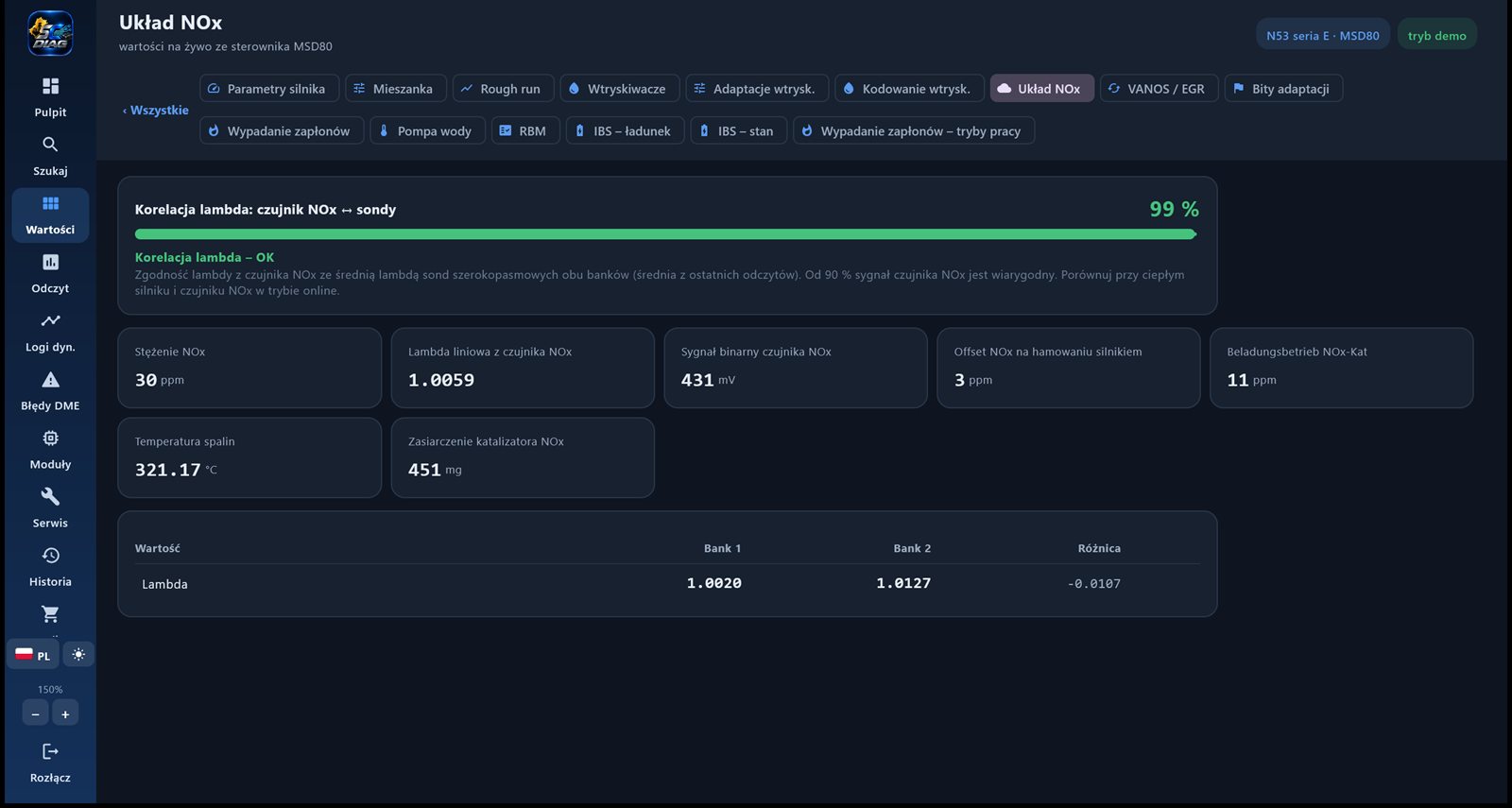
The "NOx system" tab in SC Diag for Windows. Demo mode, simulated data. Before we judge the catalytic converter, we check whether the sensor signal can be trusted.
This page is a sequence of actions, not a description of individual codes. Each code has its own article, and we point to it at the relevant step. We are talking about the N53 with an MSD80 or MSD81 control unit. The descriptions of the codes come from generally available service descriptions and from our workshop experience, not from the manufacturer's documentation, and may differ depending on the control unit and software version.
Short answer: We diagnose the N53's NOx system from the outside in. First the fault memory with freeze frames and the engine operating mode, then the supply and the NOx sensor data on a warm engine, then leaks and the lambda probes, and the catalytic converter is judged last. That order spares the most expensive part and lets you tell cause from effect.
What you can see before you plug in an adapter
The typical picture is this: higher fuel consumption than usual, an engine that rarely enters stratified charge mode, a rough run when cold and sometimes a warning light. That is not a description of a fault but a symptom of a fallback mode. According to the descriptions, a control unit that does not trust the NOx sensor or the catalytic converter switches off lean and stratified operation and stays in homogeneous mode (operating modes of the N43 and N53). It protects emissions but costs fuel.
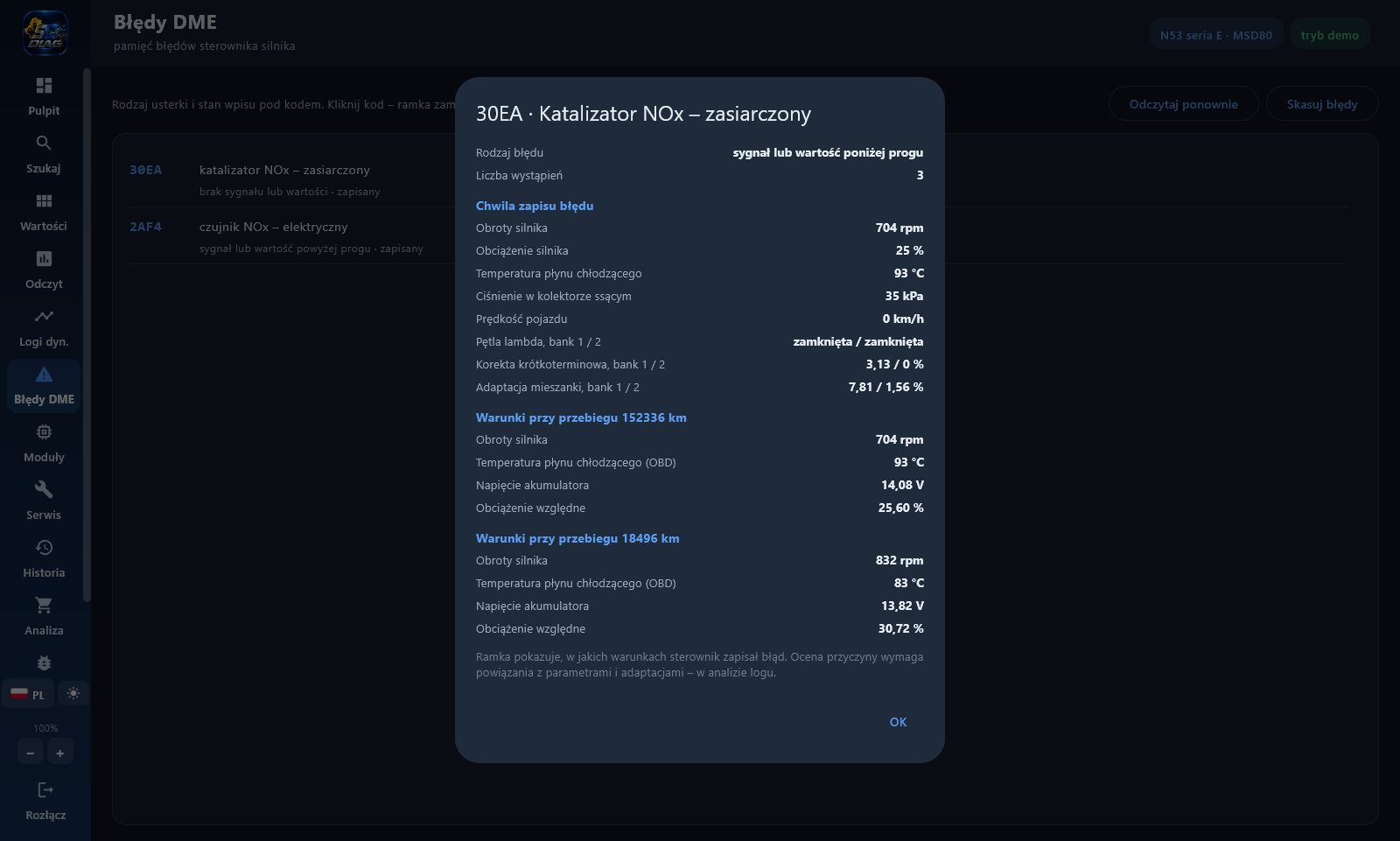
Freeze frame of a NOx fault entry in SC Diag. Demo mode, simulated data. It shows the conditions in which the control unit stored the fault.
There is also a side effect that is easy to forget. According to some descriptions, stratified charge mode is exactly when the control unit learns the differences between the injectors. If that mode stays blocked for weeks, those adaptations stand still, and over time rough running and correction faults appear. That is why on an N53 with a NOx code we do not start with coils and injectors. Their symptoms may be a result, not the cause.
Step 1. Fault memory and freeze frames
We read the whole memory, not just the NOx entries. Alongside them we look for sensor and catalytic converter codes (list with descriptions), lambda probe codes, mixture correction codes and misfires. The freeze frame tells you when the fault was stored: at what engine speed, load and temperature. A code from a cold start is a different story from a code from driving with a warm engine.
We do not clear anything yet. A cleared entry removes the evidence, and the problem comes back anyway. The first steps common to every NOx code are in the article BMW NOx fault codes: first steps.
Step 2. Supply and the sensor connector
The NOx sensor has its own electronics and does not like low voltage or moisture. We check the battery, the connector, the contacts and the wiring. It is the cheapest step and the one most often skipped. When there is no communication with the sensor, it is usually the main one, as we describe for code 2EAE.
Step 3. What the NOx sensor does on a warm engine
A cold engine gives the sensor no voice yet, so the assessment needs a warm engine, hot exhaust gas and calm driving for a good while. We look at three things. Whether the NOx value moves away from zero and stays stable, or appears and disappears. Whether the sensor reports ready or keeps waiting. And what offset it shows during engine braking, because one that is too high suggests a worn sensor.
We do not give thresholds, because they depend on the control unit and the measurement conditions. A sensor can be faulty without leaving any code, and only such a reading gives it away (more in the article NOx sensor failure symptoms).
Step 4. Lambda from the sensor, the probes and exhaust tightness
The NOx sensor also reports its own lambda. We compare it with the average lambda of the wideband probes of both banks. Before drawing any conclusion about the sensor, we look for leaks upstream of the probes, because air being drawn in spoils the picture for everything at once. Then we check the probes themselves and the corrections of both banks (a separate article: lambda probes and mixture on the N53).
We describe the comparison itself in the article on the NOx sensor and lambda probes, and the codes that concern a mismatch of signals in the description of codes 30D6 and 30DE.
Step 5. The catalytic converter only at the end
When the sensor and the lambda give a consistent picture, we look at the catalytic converter: the regeneration history, the sulphation level and whether the code returns straight after clearing. The difference matters. Sulphation can in principle be reversed (code 30EA, desulphation), while the ageing of the coating cannot (code 30E9, what damages the NOx catalytic converter). The code number alone does not tell us which of these states we have.
After the repair: registration, adaptations, check
A new sensor has to be registered in the control unit, and the reading of the same values that made you suspect it has to be repeated. We describe this in the article after replacing the NOx sensor the fault returns. Then we check whether stratified charge mode returns (stratified mode does not return after a repair) and whether the corrections settle down. Adaptations need time and several drives, so we judge the first reading after a repair with caution.
Where a read-out ends
A read-out narrows down what to check and settles nothing by itself. It will not tell you whether the sensor has deposits or a cracked ceramic element, or whether the coating of the catalytic converter is permanently worn. Intermittent faults may not show up in a single reading at all, so with such symptoms we take several. Disabling or bypassing emission systems is not a service we offer (terms and conditions, §3, para. 3). We repair the system so that it works as the factory intended.
How we can help
There are two routes, and they are often combined in this order.
The first is a read-out in SC Diag. The NOx system tab shows the NOx concentration, the linear lambda and binary signal of the sensor, the exhaust gas temperature, the sulphation level and the correlation of the lambda with the probes of both banks, and a fault entry gets a freeze frame. The scope depends on the data the control unit provides, and the N43 and N53 are the most fully developed. A licence costs €9.99 for 30 days, €29.99 for a year or €69.99 for 2 years with the Service tab, and Android and Windows are separate licences (order SC Diag).
The second is diagnostics with us: in the workshop in Silesia, mobile or remote, with the scope agreed by phone (N53 diagnostics, N43 diagnostics, remote diagnostics for the N43 and N53). The whole N53 subject is collected in the N53 diagnostic guide.
Frequently asked questions
On a warm engine we check whether the NOx value moves away from zero and stays stable, and we compare the sensor's lambda with the probes of both banks. A constant zero while driving raises suspicion.
From the fault memory with freeze frames and the engine operating mode, then the supply and the sensor connector. We judge the catalytic converter last.
The entry disappears but the cause stays, and according to the descriptions the control unit stores the code again when it next assesses the system. We clear only after the repair, so as not to lose the freeze frame with the conditions of storage.
The car will run, but according to the descriptions the engine stays in homogeneous mode with higher fuel consumption, and over time rough running and correction faults may follow. It is not worth putting the check off.
No. The read-out shows values, correlation and freeze frames, which narrows down the lead. We decide on replacement after checking the supply, the exhaust and the probes.
NOx system on your N53 to be checked?
Start with a read-out in SC Diag, and if it narrows the lead, we will check the rest with us or remotely.
Order SC Diag