The engine shakes at idle, “coughs” after a cold start, and the fault memory holds nothing specific, or just a general misfire entry. In that situation rough run is one of the first readings we look at. Drawing the graph is only half the job. The other half is knowing what you may conclude from it, and what you may not.
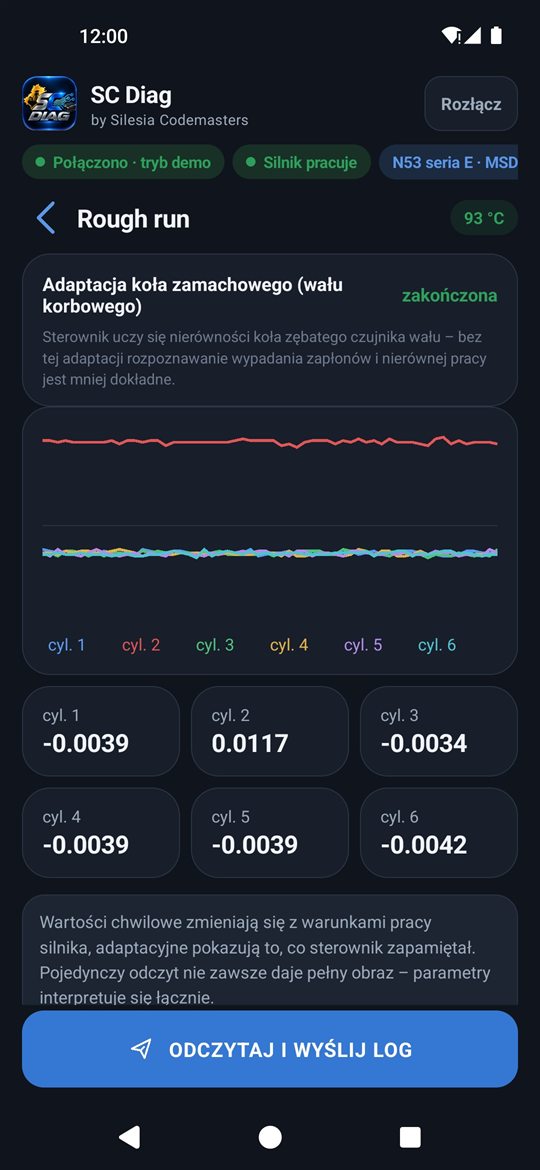
The “Rough run” screen in SC Diag on Android. Screenshot taken in demo mode, the data is simulated. Cylinder 2 can be seen standing apart from the other five.
Below we explain how to read it on N43 and N53 engines, where the control unit provides this measurement and where we see it most often.
The short answer: rough run measures how evenly each cylinder runs, calculated by the control unit from fluctuations in crankshaft speed. When one line stands apart from the others, we look for the cause at that cylinder: injector, ignition, compression. When all of them run unevenly, the cause is more often something common, such as fuel pressure or the intake.
What the graph actually draws
The engine control unit has no sensor in each cylinder. It works out roughness indirectly: it watches how crankshaft speed changes as each cylinder delivers its share of work. A cylinder that pushes weakly leaves a trace in that speed. In SC Diag each cylinder has its own colour, and the series is collected over 30 seconds on a running engine. The current values sit below the graph.
The screenshot above shows a typical picture of a single-cylinder problem: five lines lie almost on top of each other, while the red one, cylinder 2, runs clearly higher. This is demo mode, so there is no real fault in it. It simply shows what we look for. The numbers in the tiles have no unit in the app. We do not base our judgement on the sign or on a single value, only on whether one cylinder stands out from the rest and whether it does so consistently.
One cylinder or all of them at once
This distinction matters most, because it decides where we start looking.
When one cylinder stands out, suspicion falls on whatever belongs to that cylinder alone: injector, spark plug, ignition coil or compression. A good test is to swap coils between cylinders: if the problem follows the coil, the coil is at fault, and if it stays with the cylinder, we keep looking. After a spark plug or coil is replaced, SC Diag lets you reset the observation of the counters and check whether the increase has stopped. We have gathered information on the coils themselves in our article on N43 and N53 ignition coils.
When the whole engine runs unevenly, the lines spread apart with no clear leader. We then look more often at something common: fuel pressure, an intake leak, the mixture and the adaptations. According to our workshop criteria, low pressure should hold at about 5000 hPa, with each reading deviating by no more than ±100 hPa. Outside that range we treat it as unstable. How to tell a weak pump from other causes of falling pressure is covered in our article on HPFP and LPFP diagnosis.
That is a rule of thumb, though, not a verdict. A common cause can hit one cylinder harder, and a faulty injector can disturb the picture of the whole engine. That is why we set the graph beside the misfire counters, the mixture trims and the pressure from the same reading.
Cold engine, warm engine
The same engine behaves differently first thing in the morning and after an hour’s driving. Some faults show only after a night’s standing and vanish once the engine warms up, and sometimes it is the other way round. That is why SC Diag asks about the symptom and guides the reading differently on a cold and on a warm engine. In the screenshot the temperature is 93 °C, so the engine is warm.
If someone brings the car in warm, and the problem occurs only in the morning, the graph from a warm engine may be perfectly clean. You must not conclude from that that nothing is wrong. On engines with different operating modes, such as the N43, homogeneous and stratified mode can also give a different picture. Where the control unit provides counters split by mode, we look at those as well.
When we do not trust the graph
At the top of the screen there is the “Flywheel (crankshaft) adaptation” field. The control unit learns the irregularities of the sensor wheel on the crankshaft, and without this adaptation the detection of misfires and rough running is less accurate. In the screenshot its status is “completed”. If the adaptation is not completed, we treat the graph as preliminary and make no firm decisions on it. We do not give a procedure for forcing the adaptation here, because how it works depends on the control unit.
What the graph will not tell you
It will tell you that something is wrong with a cylinder or with the whole engine. It will not tell you exactly what. From the graph alone we cannot tell a worn coil from a leaking injector, or an injector from weak compression. Nor will it point to causes outside the cylinder, such as a leaking crankcase ventilation on the N53, which we cover on the page about BMW N53 diagnostics. The note below the graph in the app has exactly this meaning: parameters are interpreted together. A single reading, especially at the wrong moment, does not give the full picture.
You will find more about the function itself and the misfire counters in the description of rough run and misfires on the N43 and N53 and in the list of all SC Diag features.
Frequently asked questions
It is a measurement of how unevenly each cylinder runs, calculated by the engine control unit from fluctuations in crankshaft speed. It shows which cylinder runs worse than the others, even if it has not yet stored a fault.
No. It only shows where to look. The cause may also be a spark plug or compression, which is why we set the graph beside the misfire counters and other parameters.
Some faults show up in only one of those states. A graph from a warm engine can be clean even though the problem occurs in the morning.
We treat the graph as preliminary, because without the adaptation the detection of uneven running is less accurate.
Usually yes, it is a good first step, but the cause can lie outside the cylinders, for example in fuel pressure or the intake.
Engine running unevenly?
We will take a reading on a cold and on a warm engine and tell you where to look for the cause.
See how SC Diag works