An N53 engine software update means writing a newer version of the program to the engine control unit (DME) in a BMW with the N53 engine. We write about what the service is, when it makes sense and how we carry it out, so that you know what to expect.
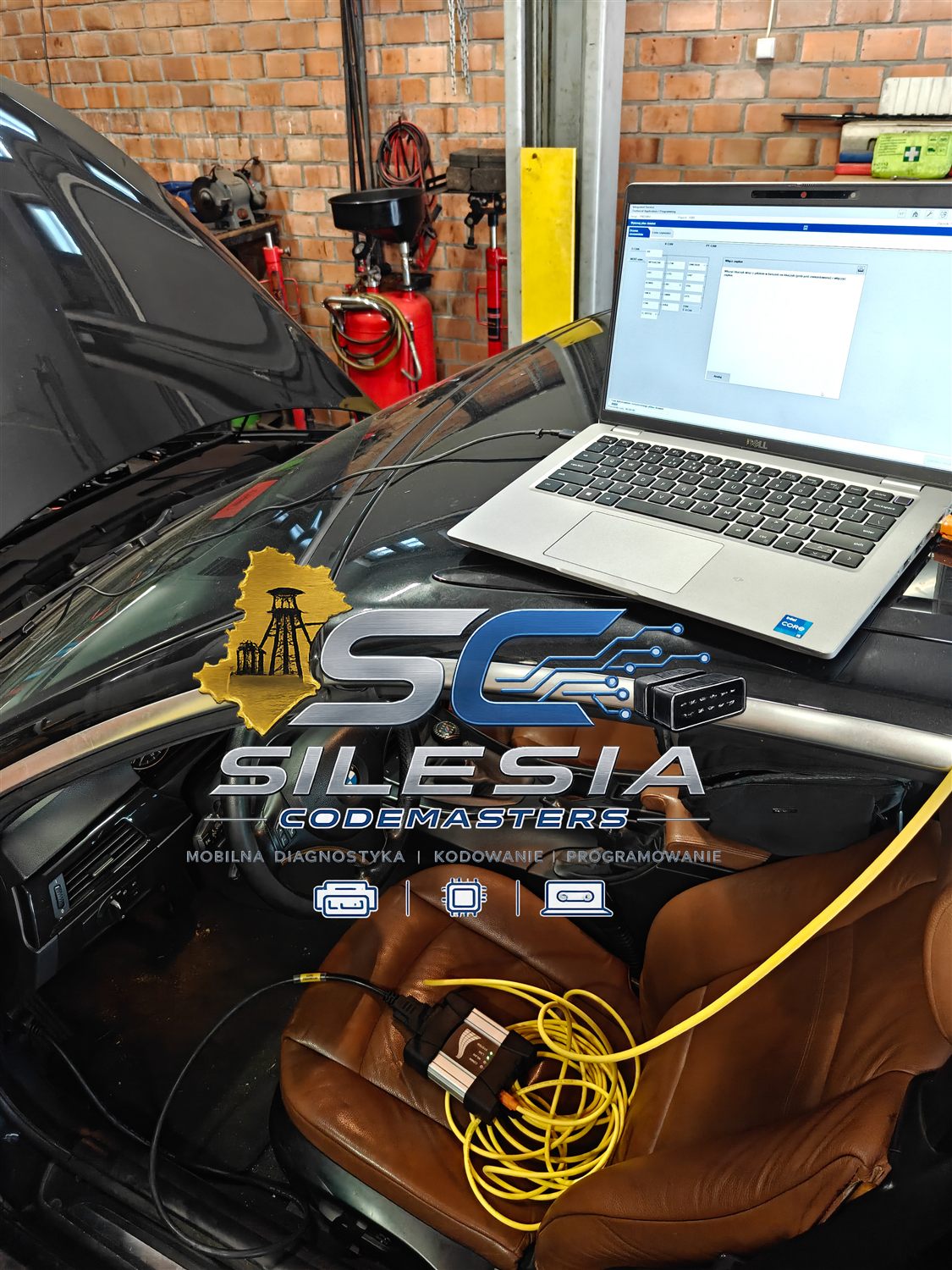
N53 engine update: laptop, interface and ENET cable in a car parked in the workshop.
Let us be clear from the start: we do not assume that an update will fix any particular fault. First we establish what is happening in the car. Only then do we say whether an update makes any sense at all.
What an engine control unit software update is
The engine control unit runs on a program stored in memory. An update means writing a newer version of that program, matched to the car the control unit works in. It is programming, not coding and not the repair of a damaged component: if the cause of the problem lies in a sensor, an injector or the wiring, a new program will not remove it.
On the N53, an engine with direct injection, the symptoms of poor running can be similar whatever the cause: jerking, uneven idle, injection faults. For that reason diagnostics must come before any decision. We describe it on the page BMW N53 diagnostics.
When an update makes sense
- when, after reading the faults and taking measurements, it is clear that the car has an outdated software version and the manufacturer has released a newer one,
- after replacing or repairing a control unit, when the correct version has to be written,
- after work that requires consistent software across the car,
- when the owner wants to bring the software versions in the car up to date.
We do not recommend an update “just in case” when the symptoms have a clear hardware cause. An example is a counterfeit injector: that fault is solved by replacement, not by a program.
What it looks like in practice
The photo shows a typical work station: a laptop with diagnostic software, an interface and a yellow ENET cable routed to the car. A wired connection is more stable than a wireless one, and when writing to a control unit stability matters more than convenience.
- Reading the car's condition: faults, software versions, battery voltage.
- Preparing the power supply: a voltage stabiliser connected for the duration of the work, unnecessary consumers switched off.
- Writing the software according to the manufacturer's procedure, without interruption and without switching the ignition during the process.
- Check after the write: faults in all control units, how the engine runs at idle and under light load.
The car's power supply during programming is just as important as the program itself. Without stable voltage we do not begin.
After the update
After programming, the fault memory may contain entries about a momentary loss of communication. We clear them and check whether they return. If they do, we look for the cause instead of ignoring them.
Sometimes, after a program change, the engine has to learn its adaptive values again. We explain the rules in the article engine readaptation after repair. On the N53 the topic of stratified mode also helps, if after the work the engine does not return to it when it should.
Where we work
We work in Ruda Śląska (ul. Pionierów 31) and on site in Silesia. Some diagnostic tasks can also be done remotely, but the write to the control unit itself requires a physical connection to the car.
Frequently asked questions
That cannot be assumed. It depends on the cause of the symptoms and on the version in the car. That is why we start with diagnostics and only then say whether an update makes sense.
No. Coding changes settings within the existing program, while an update writes a newer version of the control unit program itself.
Yes, we connect it for the duration of the write. A voltage drop during programming is one of the main risks.
Sometimes. After the work we check faults and engine behaviour, and we carry out readaptation if the test shows it is needed.
Is your N53 engine running unevenly?
Let us start with diagnostics: only then do we decide what really needs to be done.
Book diagnostics