In the morning the engine starts, but for the first few minutes it shudders at idle and sometimes lurches when pulling away. Once warm, it is smooth. This is the description most customers arrive with, and rightly so, because "only when cold" puts the checks in order.
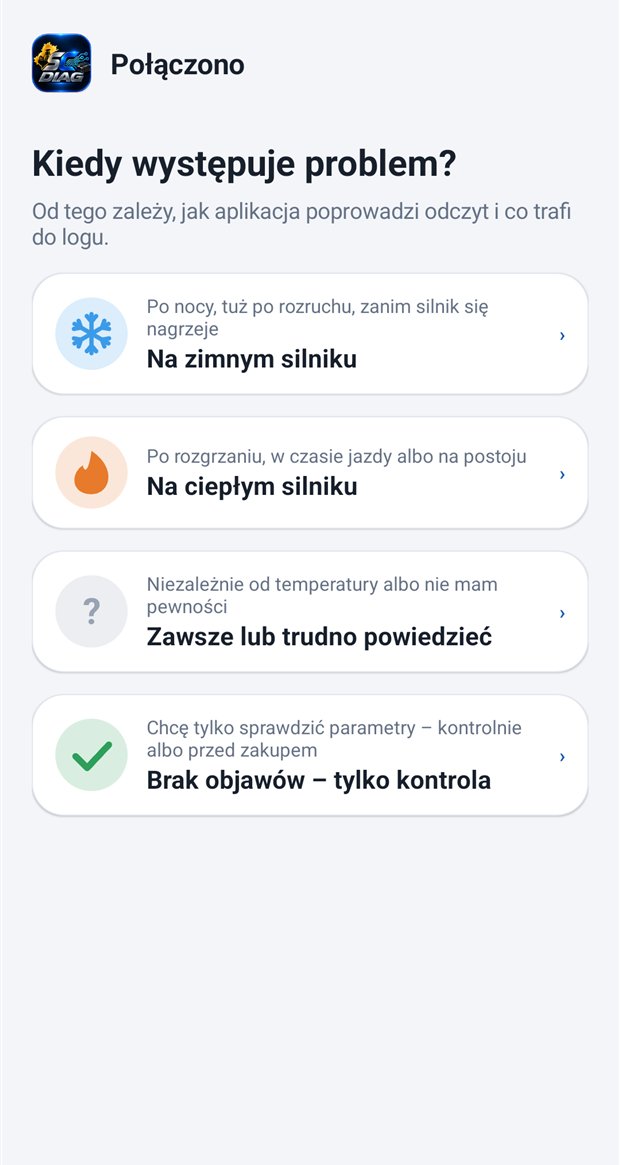
The symptom selection screen in SC Diag. Screenshot from demo mode, the data is simulated.
Below is the algorithm we follow to get from the symptom to the suspect system. It is not a list of parts to replace one after another. It is a sequence of questions that the reading and a physical inspection answer.
Short answer: cold-running jerking is narrowed down in a fixed order. First we check the conditions in which the control unit logged its faults, then whether one cylinder or all of them run unevenly, and then how the fuel trims behave from start-up to warm. Only at the end do we look at ignition, fuel and mechanics. The reading alone will not name the cause.
Four questions before you connect anything
The answers take a minute and often set the whole course of what follows.
- After how long a stand does it happen: overnight, an hour, a few minutes?
- How long does it last: tens of seconds, a few minutes, until fully warm?
- Only at idle, or also when you press the accelerator and pull away?
- What changed recently: refuelling, spark plugs, the battery, work on the intake?
Step one: fault memory with freeze frames, no clearing
We read the fault memory and clear nothing. Every entry has a freeze frame: engine speed, load, coolant temperature and fuel trims at the moment it was logged. If a fault was logged at a cold-start temperature, that suggests the problem is tied to a cold engine. If it was logged warm, we are starting in the wrong place and it is worth going back to the questions above.
In SC Diag the freeze frame appears when you tap a code. The general rules for reading codes are described in our text on BMW fault codes.
Step two: a cold reading that is genuinely cold
A cold reading only makes sense on an engine that has stood for several hours. In the app you choose "On a cold engine" and the reading guides you from start-up. In the Windows program, the cold procedure first measures the cold lambda sensors with the engine stationary, then measures from start-up. You take the same reading on a warm engine after warm-up and compare the two. The difference between them often says more than a single number.
What you will see depends on the control unit. The N43 and N53 are covered most fully, and for other engines the program shows what the control unit provides (list of 97 control units).
One cylinder or all at once
Rough run plots the work of each cylinder. When one line stands out, we look at that cylinder: spark plug, coil, injector, compression. Swapping coils between cylinders is a cheaper test than buying a new one. When all lines drift apart, the cause is more often something common: mixture, intake, fuel.
One practical note: a chart taken on a warm engine can be clean even though mornings are bad. That is not proof that everything is fine. How to read the chart itself is explained in our text on rough run, and misfire counters since new in the description of rough run and misfire counters.
Fuel trims from start-up to warm
The control unit adds fuel when the mixture is too lean and removes it when too rich. If the trims are largest right after start-up and shrink as the engine warms, that is a pattern pointing to intake leaks and crankcase ventilation, because such leaks can be more visible when cold. If they differ clearly between banks, the cause lies on one side of the engine.
We do not give thresholds here, because they depend on the engine and the control unit. What matters is the direction and whether the trim persists. More in our text on STFT and LTFT fuel trims.
Fuel and injection: pressure in the first minutes
On a cold start the control unit enriches the mixture, so a weakness in the fuel system shows up exactly then. For the N43 and N53 we use our workshop criteria: low pressure of about 5000 hPa, every reading within ±100 hPa, ignoring the first seconds after a cold start because the pressure can briefly spike there. This criterion depends on the engine and the measurement conditions and is not a manufacturer value. For other engines the value has to be established separately.
If the low pressure holds steady and the problem remains, we look further: the pump and the high-pressure circuit, and for a specific cylinder the injector. Details are in our text on fuel pressure.
Mechanics, and what a reading will not show
When ignition, mixture and fuel all look right, mechanics remain: compression, timing, phasing. On the N43 and N53, SC Diag shows the target and measured VANOS angle, which helps judge whether the camshaft keeps up. More: VANOS and rough running. A reading cannot settle compression or intake leaks, which need a physical inspection and measurements in the workshop.
Direct-injection engines (e.g. N53, N20, B48) behave differently when cold from those with port injection (e.g. N52), so the same pattern can mean something different there. That is why we first establish which engine and which control unit we are dealing with.
When to stop experimenting and bring it in
A flashing engine warning light means misfires, and unburnt fuel reaches the catalytic converter. In that case we do not keep driving to see what happens. Come to a workshop also when the code returns after clearing, when the symptom gets worse, or when replacing plugs and coils changes nothing. If you do not know where to start, send a log: a cold and warm reading reaches us together with the information about when the symptom occurs.
Frequently asked questions
When cold, the control unit enriches the mixture and works with different adaptations, so ignition, fuel and leak faults show up that are invisible when warm. "Only when cold" on its own does not point to a part, though.
Not always. A fault visible only after a night's stand may not appear at all on a warm engine, so we take a cold and a warm reading and compare them.
No. It is a common lead, but mixture, intake leaks, fuel pressure and mechanics give the same picture. The rough run chart shows whether the problem is in one cylinder or in all of them.
It narrows the scope of checks: it shows the conditions in which a fault was logged, which cylinder stands out and how the trims behave. The cause is confirmed only by inspection and measurements.
Better to record the entries with their freeze frames first. After clearing you lose the history that helps establish when and under what conditions the problem appeared.
Jerking when cold?
Take a cold and a warm reading and send the log, and we will tell you where to begin the checks.
See SC Diag