The engine light is on, the fault memory mentions a “NOx sensor”, and you wonder why a petrol BMW has a part you would normally associate with diesels. In the N43 and N53 this sensor has been at work for years and is one of the more temperamental parts of the exhaust, and when it fails it can look just like a worn-out catalytic converter.
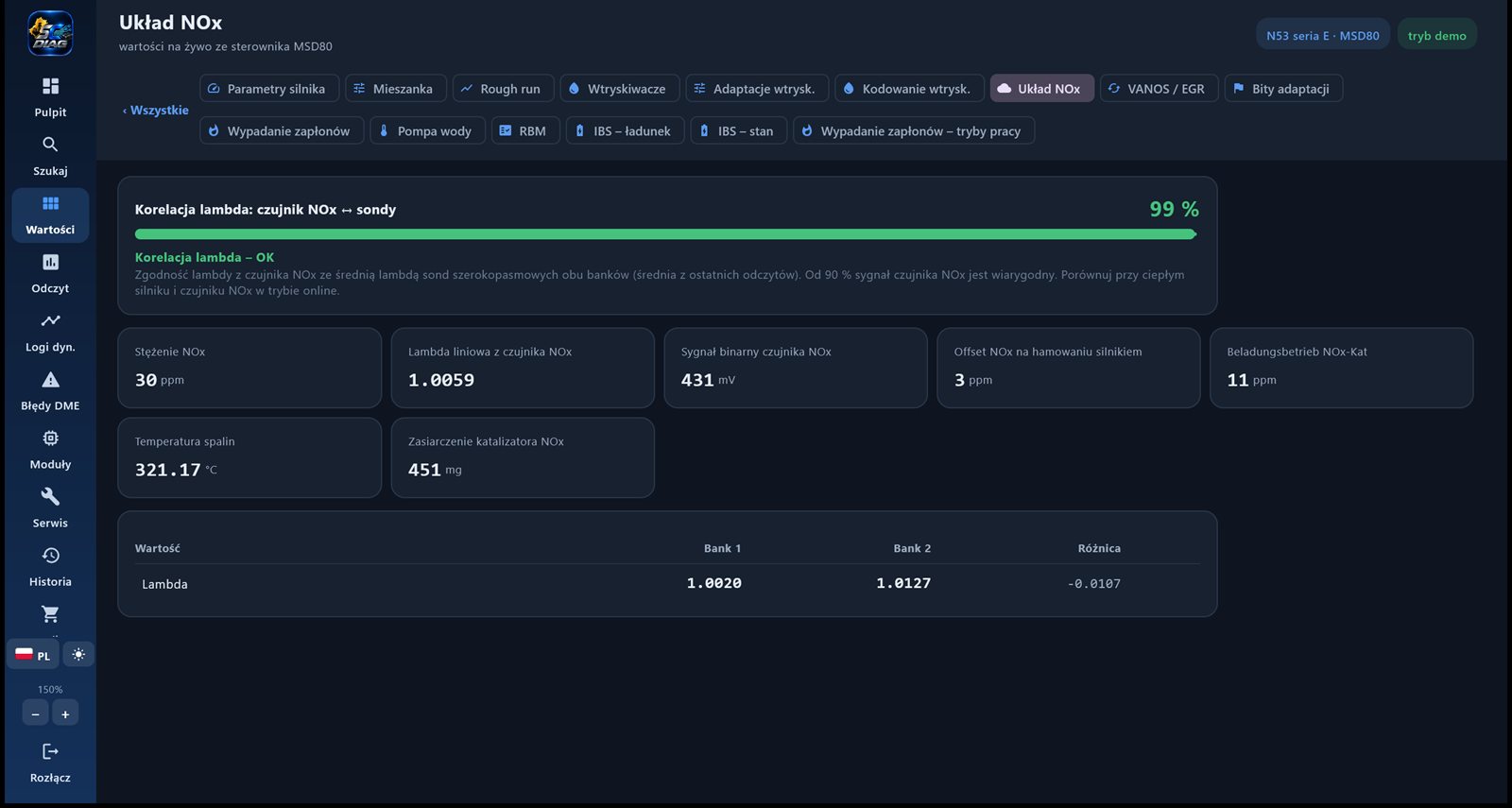
The “NOx system” tab in SC Diag for Windows. Demo mode, simulated data.
We explain what a NOx sensor is, what it measures and why the control unit trusts it so much that, when the sensor lies, the trouble shows up in how the whole engine runs. We write about diagnostics and about restoring the system to factory operation.
The short answer: the NOx sensor measures the concentration of nitrogen oxides in the exhaust and, in the N53, the lambda value as well. It passes the data through its own electronics to the control unit, which uses it to judge the NOx catalytic converter and run its regeneration. If the sensor reports false values, the control unit misjudges the converter and the engine may lose its economical operating modes.
What NOx is and what this part actually measures
NOx is the collective name for the nitrogen oxides formed during combustion. The sensor, screwed into the exhaust system, measures their concentration in the exhaust gas. In the N53 it also supplies a linear lambda value, which is what a wideband sensor normally measures, so its lambda can be compared with the sensors of both banks. We describe how we do this in the article on the NOx sensor and lambda sensors.
It is not an ordinary two-wire part. It has its own electronic module that talks to the engine control unit digitally, so the result depends on the ceramic element, but also on the power supply, earth, connector and wiring. The module is sensitive to moisture and voltage spikes. That is where some of the faults come from in which the sensor itself is fine.
Why the control unit needs the NOx concentration
In the petrol N43 and N53, nitrogen oxides are stored by the NOx catalytic converter. The control unit judges its efficiency by how much NOx the sensor sees and how quickly that value rises after regeneration. It uses the same signal during desulphation. The two codes that result from this are covered separately: 30E9 and 30EA.
When the signal is not trustworthy, the control unit neither judges the converter properly nor runs regeneration. With a faulty NOx system the engine usually runs only in homogeneous mode and uses more fuel (operating modes of the N43 and N53). In diesels with an SCR system the NOx sensors usually work as a pair, before and after the SCR catalytic converter. This article mainly concerns the petrol N43 and N53.
What a lying sensor looks like
It is simplest when the sensor leaves a code. Service descriptions distinguish codes for self-diagnosis, heating, lambda signal, electrical fault, plausibility, correlation with the lambda sensor, ageing and dynamics, as well as loss of communication with the sensor. We have collected them in the list of NOx system codes. Plausibility and correlation codes are covered in the article on 30D6 and 30DE, and loss of communication in the article on 2EAE. If the fault returns despite a new part, see after replacing a NOx sensor.
It is harder when there is no code. A sensor can be faulty without any entry, and this is judged from the NOx reading on a warm engine: a constant or intermittent zero reading while driving raises suspicion. Such a sensor can also hide a problem with the catalytic converter, because the code for its ageing will then not be stored at all. We have gathered the symptoms of a faulty sensor, such as the warning light, rough running or higher fuel consumption, in the article on NOx sensor symptoms of failure. On their own they prove nothing.
What to check, in order
The order matters, because each step affects how reliable the next one is.
- The sensor and its data. First the codes and the freeze frame, then the power supply and connector, and finally the sensor's NOx concentration and lambda reading on a warm engine. This step decides whether further comparisons make sense.
- Lambda system and exhaust. A leak upstream of the sensors distorts the measurement just like a faulty part, so we check for leaks, the lambda sensors and the mixture corrections of both banks (STFT and LTFT).
- Only then the catalytic converter. When the sensor and the lambda sensors give a consistent picture, we assess whether the converter is sulphated or permanently worn (what damages the NOx catalytic converter, desulphation of the NOx catalytic converter).
We have set out the first steps for a specific code in the article NOx fault codes: first steps.
What this reading will not settle
The reading narrows down what to check. It will not tell you whether the ceramic element, the electronics or a deposit is to blame, and it does not replace inspecting the connector and exhaust in the workshop. Intermittent faults, on a cold engine or in damp conditions, may not show up in a single reading, so with such symptoms we take several.
The code descriptions in this article come from generally available service descriptions and from workshop experience, not from the manufacturer's documentation, and they may differ depending on the control unit and software version. Switching off or bypassing emissions systems is not a service we offer (our terms and conditions, §3 para. 3). We repair the system so that it works as the factory intended.
Diagnostics with us, or a reading with SC Diag
If a code is already stored or the sensor is under suspicion, we check the NOx system as part of engine diagnostics: in person in Silesia, on site or remotely (N53 diagnostics, N43 diagnostics). You can also take a reading yourself and send the log for analysis.
In SC Diag the NOx system has its own tab: NOx concentration and linear lambda from the sensor, the binary signal, exhaust temperature, the sulphation level of the catalytic converter and the correlation of the sensor's lambda with the lambda sensors of both banks. The scope depends on the data the control unit provides, and the N43 and N53 are covered most fully (list of 97 control units). A one-off reading is free when you order diagnostics, and the licences are described on the SC Diag order page. How to read live values is explained in the article on live BMW engine data.
Frequently asked questions
It is a sensor in the exhaust system that measures the concentration of nitrogen oxides and passes it, through its own electronics, to the engine control unit. In the N53 it also supplies a linear lambda value.
For the data the control unit uses to judge the NOx catalytic converter and run its regeneration. If the sensor gives a false signal, the assessment of the converter is wrong and the engine may lose its economical operating modes.
They are nitrogen oxides, formed during combustion. The exhaust treatment system reduces their amount, and the NOx sensor lets the control unit check how well it is doing that.
It will run, but the control unit will not judge the catalytic converter or run regeneration, and the engine usually runs in homogeneous mode with higher fuel consumption. The longer you put off the check, the less likely the problem is to go away.
No. The same code can result from a weak power supply, moisture in the connector, an exhaust leak or a wrong mixture. The opposite also happens: the sensor is faulty and there is no code.
NOx system to be checked?
We will check the sensor, the lambda sensors and the catalytic converter in that order before you replace anything. You can also take a reading yourself with SC Diag.
Book diagnostics