The read-out showed some figure for fuel pressure and you do not know whether it is good or bad. It is a common question with the N43 and N53, because both engines have direct injection and two different fuel circuits, and in an app or a log “fuel pressure” may simply be one of two entirely different quantities.
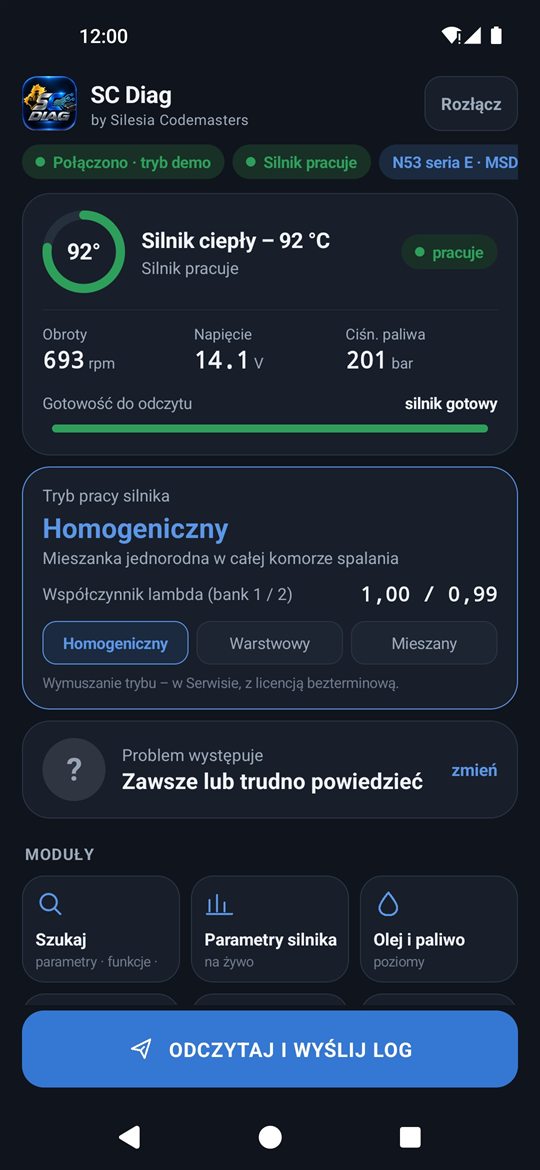
SC Diag dashboard — screenshot from demo mode (simulated data, the figures are not a reference).
In short: under our workshop criteria the low pressure should hold at about 5000 hPa, every reading within ±100 hPa, and a wider spread means an unstable circuit. High pressure cannot be judged with a single number: it depends on the engine, temperature and load. A single read-out at standstill rarely settles what is at fault.
Two pressures under one name
The pump in the tank (LPFP) feeds fuel to the pump on the engine (HPFP), and only that one builds injection pressure in the rail. The first circuit is measured in hPa or bar and the values are modest. The second is already several dozen bar, and in some systems well over a hundred. When one person writes “I have 5 bar” and another “I have several dozen bar”, both can be right.
So the first question with any read-out is: which pressure is this? On the dashboard in the photo there is a single “fuel pressure” tile with a single value; whoever reads a log should know whether it is the low circuit or the rail. In the detailed values in SC Diag both are shown separately, together with the fuel pump control.
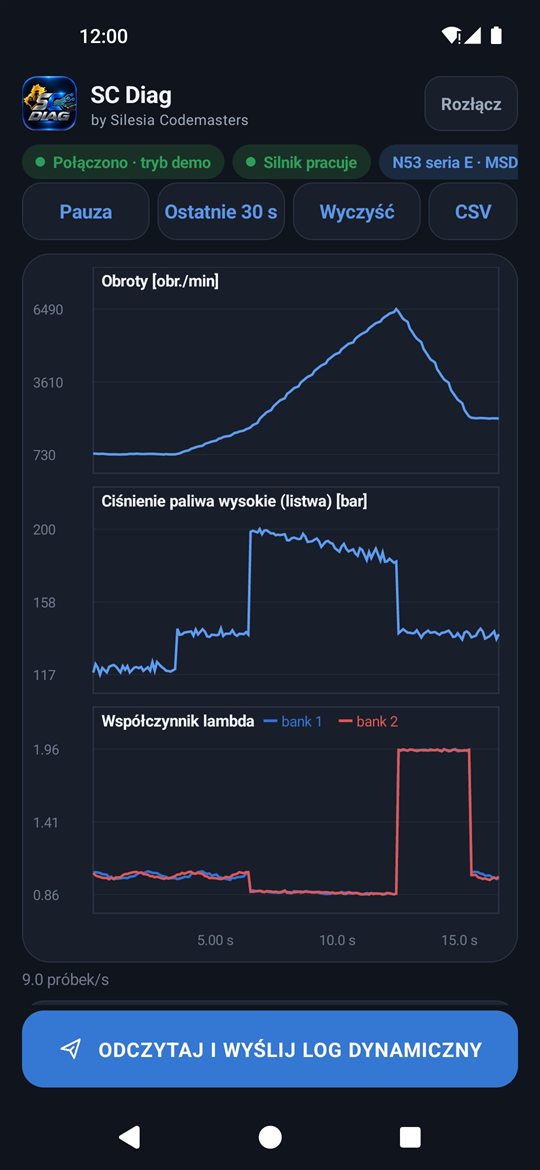
Dynamic log — screenshot from demo mode (simulated data).
The screenshots show data from demo mode. It is simulated, so do not treat the figures in the photos as a reference for any real engine.
Low pressure: where our limit is
For low pressure we have a specific criterion, developed in the workshop on the N43 and N53: a target value of about 5000 hPa, that is 5 bar, with every single reading within ±100 hPa. If the value jumps outside that band, we regard the circuit as unstable. It is our workshop criterion, not a manufacturer figure, and it depends on the control unit version and the measuring conditions.
One caveat, because it confuses people: right after a cold start the pressure can briefly spike well above the usual value. That is why, when assessing logs, we ignore the first few seconds after starting and look at what happens afterwards. Stability towards the end of a read-out tells you more than a peak at the beginning.
High pressure: why idle is not enough
The rail is harder. We do not give a single number here, because the value depends on the engine, temperature, load and the pressure the control unit is requesting at that moment. What matters is not so much how much there is, but whether the actual pressure keeps up with the requested one.
At idle the pump has the easiest job. The real question is what happens when you open the throttle sharply and demand rises. That is why we record pressure on the move, as in the second photo: three charts one below the other, engine speed, rail pressure and lambda, so you can see what changes together with what. A drive log like that shows a collapse that is not there at standstill at all.
How to tell low from high
We rely on simple logic, which we described in more detail in the article on the HPFP and LPFP fuel pump.
If the low pressure holds steady while the high pressure collapses under load, the high-pressure pump is the suspect. If the low pressure itself drops, there is no point starting at the engine. You check the tank, the filter, the pump's power supply and its wiring. When a drop in high pressure can be tied to a particular cylinder, suspicion shifts to an injector, not the pump.
What a read-out alone cannot settle
A number on the screen is not a verdict. A low rail pressure code says the control unit is not reaching the requested value, but not why. The same effect comes from a leaking injector, an air-locked low-pressure circuit, a clogged filter and a faulty sensor that simply lies. The sensor is the worst case here, because a falsified reading looks like a real pump fault.
There is one more thing: in the N53, some of the symptoms blamed on the pump or injectors come from a leaking crankcase ventilation. A pressure read-out will not show that. That is why replacing the pump “just to see” can be an expensive mistake, and why the diagnosis goes through the whole system, not one tile. The limits differ between control unit versions, so whoever assesses them should see the whole log. This is how we work in N53 diagnostics and N43 diagnostics.
When it is already a fault
A one-off glitch in a single read-out is not yet a fault. We start talking about a fault when it repeats in several situations: cold, warm, on the move. Low pressure going beyond ±100 hPa in stable conditions, high pressure not reaching the requested value under load, or a code in the fault memory that returns after clearing, is already a signal to act.
On the other hand, a stable low pressure and a correct high-pressure trace in one read-out do not rule out a fault that appears only at full load or in hot weather. In that case, another drive log instead of guessing.
Frequently asked questions
Under our workshop criteria about 5000 hPa, with every reading within ±100 hPa. The value depends on the control unit version and measuring conditions; it is not a manufacturer figure.
We do not give a single number. It depends on the engine, temperature and load, and what counts is whether the actual pressure keeps up with the one requested by the control unit.
No. The same code is produced by a leaking injector, an air-locked low-pressure circuit, a clogged filter or a faulty sensor, so we first check the low circuit and the trace under load.
Under load the demand for fuel rises, and only then does a weak pump or supply show up. At idle many faults are invisible.
It shows the pressures and traces that lead there, but it does not pass a verdict. The conclusion comes from comparing the low circuit, the high circuit and the behaviour of the cylinders.
Suspect a fuel pressure problem?
We will check the pressure in both circuits and on the move before you decide to replace the pump.
Book a diagnostic