The read-out shows a list of figures next to the injectors. Five cylinders sit close to zero and one stands clearly apart. The question we hear most often: does that mean the injector has to be replaced? The answer is “possibly”, but you cannot read that from the figure alone.
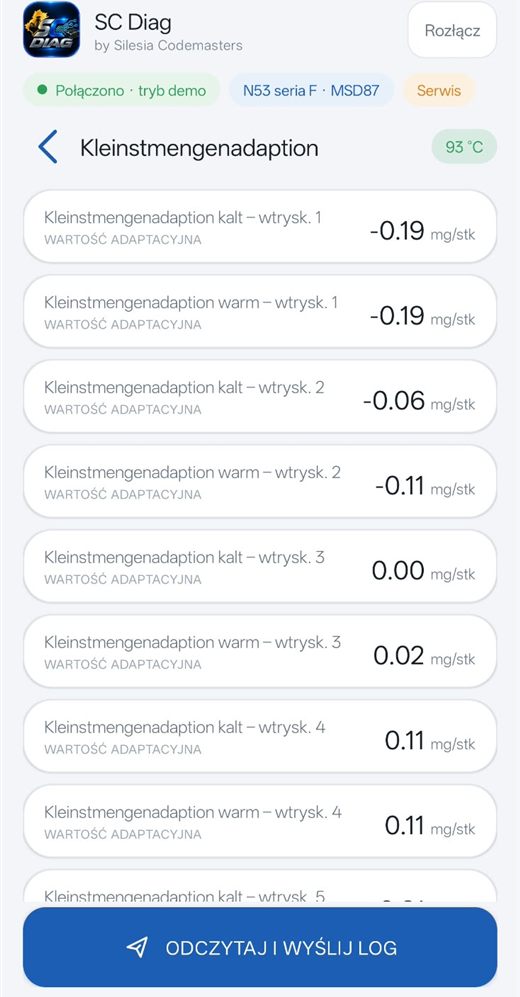
Small-quantity adaptations for individual injectors – screenshot from demo mode (simulated data, the figures are not a reference). In this version the parameter name is given in German.
In short: an injector correction is an adjustment the control unit adds to that injector's opening time so that the cylinder receives the amount of fuel it is meant to. A large correction on one cylinder says that this injector, or whatever surrounds it, differs from the rest. It does not say why. It is a reason to keep checking, not to buy parts straight away.
Why the control unit needs corrections
Injectors are not identical, and they change over time. With the very short pulses needed at idle and in stratified mode, the differences between individual units show up most. So the control unit keeps separate corrections for each cylinder and stores them as adaptations.
The piezo injectors in the N43, N53 and N54 are a precise, fast design, and that is why they get discussed separately. With the N55 BMW went back to solenoid injectors, so “piezo corrections” apply only to some engines. In all of them the principle is similar: the control unit compares what follows from the lambda control and the behaviour of the cylinder with what it commanded, and stores the remainder of the deviation as a correction.
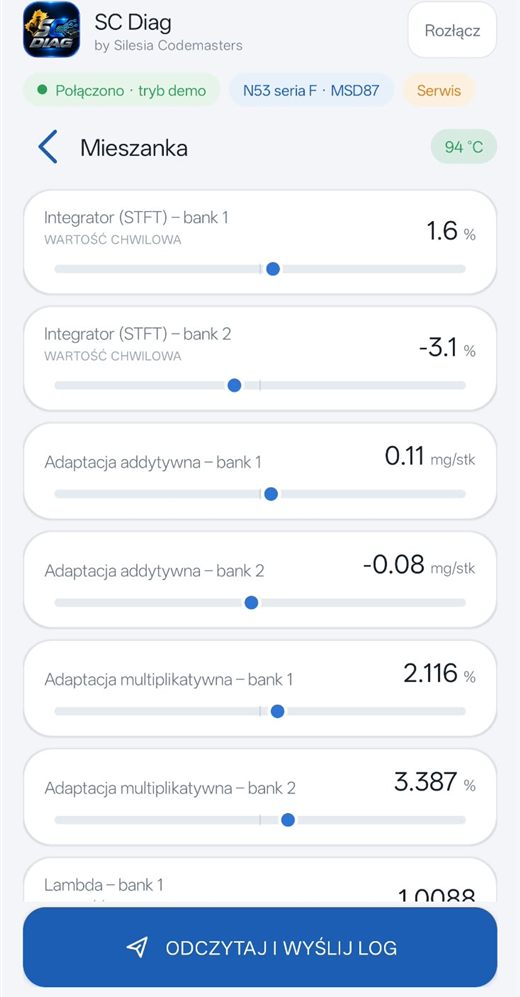
Mixture corrections for both banks – screenshot from demo mode (simulated data).
What may be behind a large correction
A correction on one cylinder does not have to mean the injector. It is rather a sign that this cylinder is being supplied differently from the others. The directions we check:
The injector itself: wear, a change in flow, leakage. A leaking unit can lose pressure after the engine is switched off and lengthen cranking; we write more about this in the article on the HPFP and LPFP fuel pump. This group also includes a non-original or poorly reconditioned injector, which has its own article on counterfeit injectors for the N43/N53.
Supply: fuel pressure, filter, pump, sensor. It usually affects several cylinders at once, but not always equally.
The rest of the cylinder: spark plug, coil, compression. Misfires change the lambda signal, and the control unit may “rewrite” that onto the injector.
The air and exhaust side: false air, an ageing sensor. This kind of deviation usually shows across a whole bank, not on a single cylinder. You tell it apart with the STFT/LTFT fuel trims.
What a read-out alone cannot settle
The figure does not say where it came from. The same result comes from an injector that delivers too little and from a coil that fails to ignite the mixture. The sign of the correction (plus or minus) depends on how the particular control unit defines it, so without the parameter description it is easy to read it the wrong way round. On top of that there is learning: right after a repair or after adaptations have been reset, the values are still settling, so we judge the first read-out more cautiously.
We do not give “good, bad” limits here. Figures from forums are not manufacturer documentation, and the acceptable range depends on the engine, the control unit version, the temperature and the operating mode. We judge how far a cylinder departs from the others and whether that repeats over several read-outs.
Cylinder numbering: the same number, a different cylinder
With injectors it is easy to make a mistake that ends in replacing the wrong part. “1” in one program may be the first cylinder from the belt end, in another from the gearbox end, and in repair descriptions someone counts by firing order. On top of that, the injector number in a table and the cylinder number do not always match, and then there are banks: on six-cylinder BMW engines a bank is usually three cylinders (1–3 and 4–6). Before you unbolt anything, check in the parameter description how the program numbers things and confirm it with a second source, for example a rough run graph or by swapping coils.
The order of checks
- The fault memory with freeze frames: are there ignition, fuel pressure or mixture codes, and under what conditions were they stored.
- Rough run and misfire counters: does the same cylinder stand out, or the whole engine.
- Fuel pressure, low and high, on the move and not only at standstill (see rail pressure: target versus actual).
- Mixture corrections for both banks and the tightness of the intake.
- Swapping coils or spark plugs between cylinders, and only then the decision about the injector.
After replacing an injector: what the coding is about
Every piezo injector has individual correction values printed on its body. According to BMW workshop instructions for the N54 and N53, after an injector is replaced the data of the new unit has to be assigned to its cylinder in the control unit, only for the cylinders where an injector was replaced. Without that, the values in the control unit may not suit the new part. This describes the principle, not a procedure: how it is done depends on the engine and the tool.
What SC Diag shows on this subject
In SC Diag, on the N43 and N53 you can read for each cylinder the injection time, the CILC correction, the adaptations in the low and high range (separately for a cold and a warm engine), the piezo injector voltage and the coding stored in the control unit. Mixture values for both banks, rough run and misfire counters come on top. The whole read-out goes into a log that we can assess together with the operating conditions.
On other petrol engines the scope depends on the data the control unit provides. A read-out does not replace an inspection in the workshop: it points to a probable direction and narrows down what to check.
Frequently asked questions
They are adjustments the control unit adds to the opening time of each injector so that the cylinders receive fuel evenly. When stored for longer they are called adaptations.
Not necessarily. It may be the injector, but also ignition, compression, fuel supply or a wrong lambda reading. The correction tells you which cylinder needs attention, not what is wrong with it.
We do not give a single figure. The range depends on the engine, the control unit version, the temperature and the operating mode, and figures from forums are not manufacturer documentation. What counts is the departure from the other cylinders and whether it repeats.
BMW workshop instructions for the N53 and N54 require the data of the new injector to be assigned to its cylinder in the control unit. This applies only to cylinders where an injector has been replaced.
It shows what the control unit provides. The N43 and N53 have the fullest scope; on other engines it depends on the control unit data.
Check what your control unit provides
A list of 97 BMW and MINI engine control units with the read-out scope and SC Diag screens.
See the list of control units