A phone shows a few dozen numbers, and with some control units a few thousand. Revs, temperatures, pressures, corrections. The first question is not “what does this number mean” but “under what conditions did I see it”. This article sorts BMW live engine data into a few groups, explains why each is worth watching, and points to where you can read more.
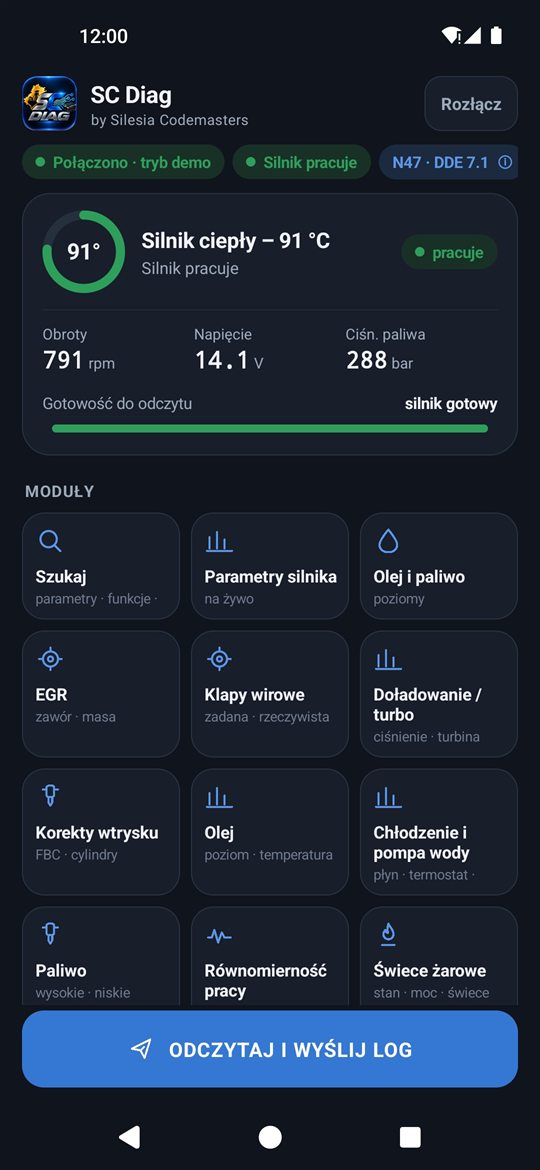
The SC Diag dashboard with module tiles: a screenshot from demo mode (simulated data).
In short: live data are values the engine control unit is measuring or calculating right now. A single number says little. What counts is the condition of the read-out (idling or driving, cold or warm engine) and how it compares with the neighbouring values. Read in groups: background, fuel, mixture, ignition, adaptations. A read-out narrows down where to look, but it does not replace an inspection.
A number without conditions means nothing
A live value comes from a sensor, from a model or from the control unit's own adaptation. A read-out is therefore a snapshot of one moment of operation, not a test result. A pressure that looks odd at idle may be fine under load. A mixture correction that looks worrying on a cold engine can return to normal once warm, without any repair.
So with every read-out we note three things: the state the engine was in, how long it had been running, and what the car was doing at that moment. Only then do we look at the numbers. Two values that look fine on their own can show a problem together. And the other way round.
Idling, driving, cold, warm
A read-out at standstill is repeatable. The engine idles, nothing changes, so comparing two read-outs is fair. It suits judging running smoothness, the fault memory and adaptations. What it cannot show is anything that needs load: how fuel pressure behaves under heavier throttle, boost, or the response to acceleration.
A read-out on the move, that is a dynamic log, catches what is missing at standstill. A fault that only appears under hard acceleration will not show up even in the longest read-out at idle. On the other hand, such a log is harder to compare with the previous one, because no two drives are identical.
Cold and warm engines are a separate axis. When cold, the control unit usually runs a warm-up programme and meters fuel differently, so some values can only be judged once the engine is warm. On the other hand, some symptoms, such as uneven running after a night, only show when cold. That is why SC Diag asks about the symptom and guides the read-out separately for a cold and for a warm engine.
Background: revs, load, temperatures, voltage
These groups rarely point to a fault on their own, but without them you cannot judge the rest. Revs and load tell you whether the engine is running calmly or whether the control unit keeps correcting something. Coolant, oil and intake air temperatures tell you whether you can already judge the mixture and whether the engine is warming up the way it should. Voltage in the electrical system affects sensors and injectors, so before you call something a fault, check that the voltage was stable. We write about the battery itself under the IBS sensor.
If the engine runs unevenly only after a night, this is the starting point. We describe the order of the next steps in the article BMW misfires when cold.
Fuel and mixture: where the leads begin
The fuel system is the group where the gap between “wanted” and “actual” says the most. Low pressure from the lift pump, pressure in the high-pressure rail, target and actual values. What counts is how far one departs from the other and whether that gap holds throughout the read-out. You will find a description in the article on rail pressure, and for the N43 and N53 separately in the text on fuel pressure.
Mixture means fuel trims and lambda sensors. The control unit constantly adds or removes fuel to keep the mixture as it should be, and the size of that correction shows how much it has to make up. A large correction that stays in one direction is a sign that something is delivering too little or too much air or fuel. Which component is responsible, the correction alone will not say: it could be an injector, a leak or a sensor. See STFT and LTFT fuel trims, as well as injector corrections on petrol engines and on N47 and N57 diesels. We cover the NOx system from the diagnosis side in the text on NOx fault codes.
Ignition, running smoothness and adaptations
When the engine judders and the fault memory is silent, rough run comes in: a chart of each cylinder's running and the misfire counters. A cylinder that stands out from the rest is a lead, not a verdict. Behind it could be ignition, injection or compression. How to read such a chart is described in the article on rough run.
Adaptations are values the control unit learns by itself and stores to compensate for wear and part tolerances. They tell you about the engine's history, not just the present moment. After a part is replaced, the interesting question is whether they returned to sensible values, and when buying a car, what they reveal about how it has been used. The second situation is developed in the text on five parameters to check before a purchase.
What you will see in SC Diag
The dashboard shows temperature, revs, voltage, fuel pressure and read-out readiness. Further on are group screens, for example mixture, boost, EGR, DPF, oil and battery, a value search, fault codes with freeze frames, rough run, misfire counters and dynamic logs from driving. We describe the full list on the app features page.
The scope depends on the control unit. The program supports 97 engine control units, and the N43 and N53 have the fullest scope of assessments and descriptions. For other engines, what appears is what the control unit provides. Values the control unit does not report are simply not on the screen, so do not hunt for them. Check your engine on the list of supported control units.
The limit is simple: the app shows data and lets you save a log for analysis, but it does not pass a verdict on the basis of a single number and does not replace an inspection in the workshop.
Frequently asked questions
It depends on the control unit: according to our descriptions, one control unit provides anything from a few dozen to more than five thousand values. Start with the background (revs, temperature, voltage), then follow the symptom: fuel, mixture, ignition.
They narrow down the scope of checks and point to a probable direction. Whether to replace a part is decided only by comparing several values with an inspection or a measurement on the car.
It usually shows generic OBD values. Data specific to a BMW engine control unit, such as adaptations or misfire counters, require a program that knows that control unit's protocol.
Reading values and sending a log change nothing in the control unit's settings. Changes are made only by procedures that you start yourself, after a warning and confirmation.
It depends on the symptom. Uneven running after a night has to be caught cold; assessing the mixture and adaptations is usually done on a warm engine.
See your engine's parameters in SC Diag
Demo mode shows the screens without a car and without a licence, on simulated data.
See SC Diag