The warning light is on, there is a code from the NOx system in the fault memory, and someone says "it's the NOx sensor". Sometimes that is true, but more often it is a shortcut that ends with an expensive part being bought and the code coming back. The NOx system is a sensor with its own electronic module, the exhaust, the lambda sensors and the catalytic converter, so a code only tells you that the control unit is unhappy with the whole picture.
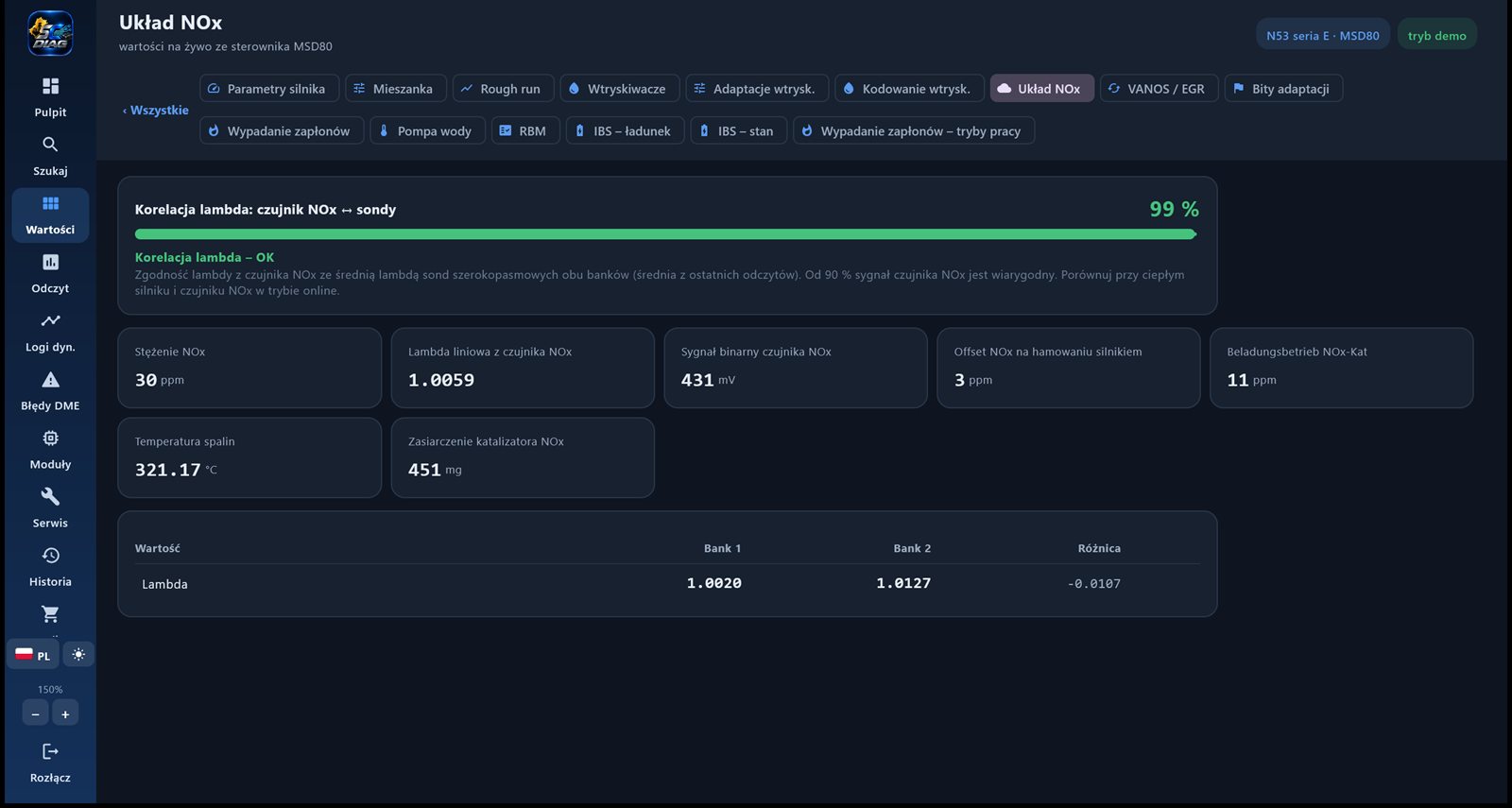
The "NOx system" tab in SC Diag for Windows. Screenshot from demo mode, the data is simulated and does not come from a real car.
Below we describe what we do first, before anyone decides to replace anything. We write only about diagnosis and repair, with the aim of restoring the system's factory operation.
Short answer: a NOx system code rarely means a failed sensor straight away. We start with the supply and the sensor connector, then check exhaust leaks, lambda sensors and fuel trims. Only at the end do we judge the sensor itself and whether the catalytic converter is sulphated or permanently worn. The order runs from cheapest to most expensive.
Why we do not list the codes one by one
It is easy to find tables online with four-character NOx codes and their "meanings". We checked, and the descriptions sometimes contradict each other and often rest on forum posts rather than manufacturer documentation. So we do not give meanings for individual codes here. Even a correct translation of a code does not tell you which part is faulty.
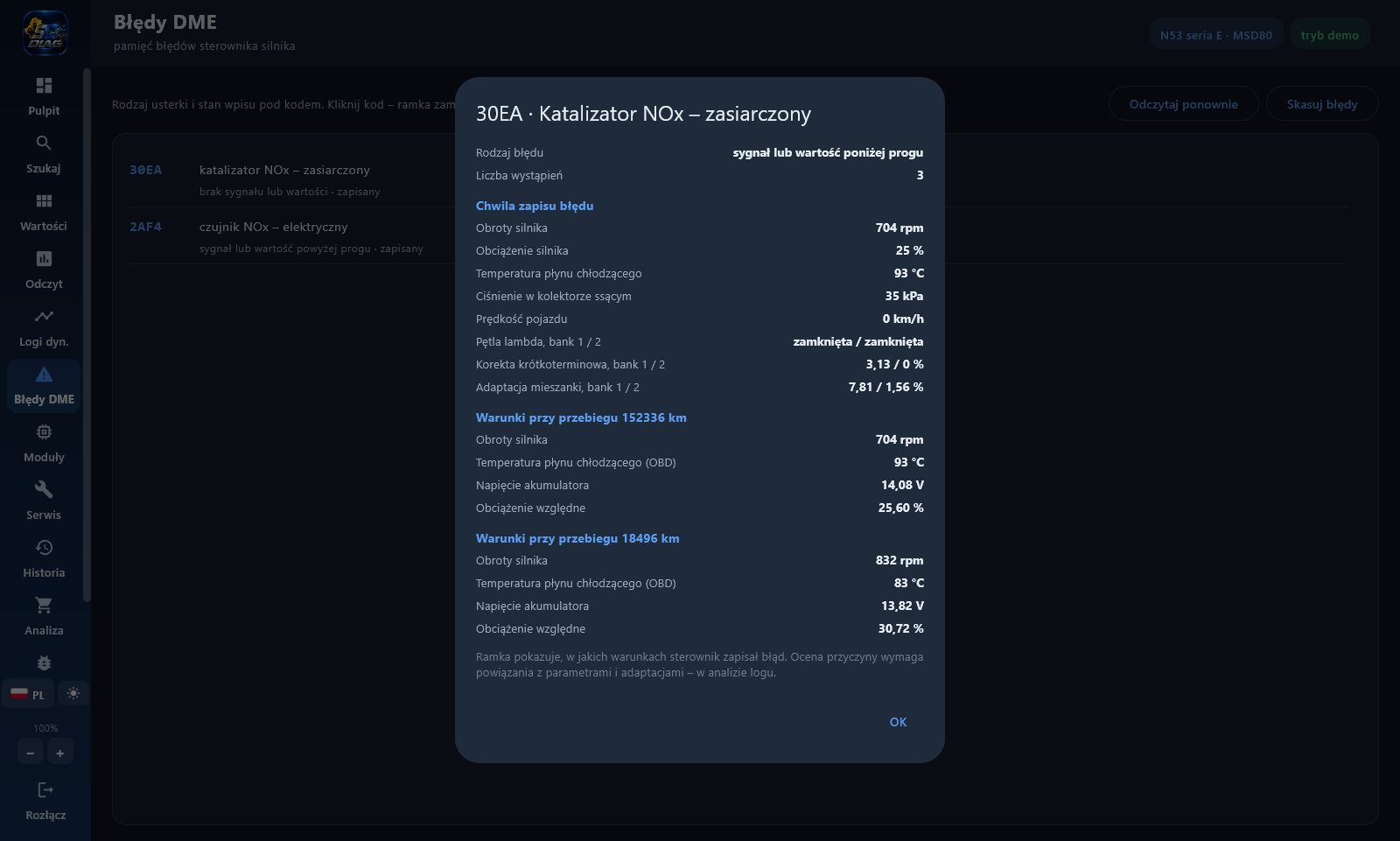
The freeze frame of a NOx system entry in SC Diag for Windows. Demo mode, simulated data. The description next to the code does not yet point to a faulty part; that comes only from comparing it with the rest of the reading.
More useful is the description of the entry in the control unit and the circumstances in which it was logged: engine speed, load, temperature, fuel trims. The app shows them in the freeze frame, and the general rules for reading codes are in our text on BMW fault codes.
The order of checks, from the simplest
When a NOx sensor is suspected, we go like this:
- Power supply. Battery voltage and condition. The sensor has its own module, sensitive to voltage fluctuations, so a weak battery can cause NOx system errors. We describe battery condition in the IBS sensor reading.
- Connector and wiring of the sensor. Moisture, corrosion, loose contacts. A cheap step, and the one most often skipped.
- Exhaust leaks upstream of the sensors. Air drawn in distorts the measurement just as a faulty element does.
- Lambda sensors. If the lambda sensors are wrong, comparing against them proves nothing.
- Fuel trims and adaptations of both banks. A large difference between banks shows that the problem lies on one side of the engine.
- Only then the sensor itself, based on comparing its signal with the rest of the system.
On the N43 and N53 we apply our workshop criteria to the lambda sensors: a heated sensor's Nernst resistance above 512 Ω means the sensor is due for replacement, and a control sensor at around 2.0 V with the monitor sensor below 0.1 V is a serious problem. These are not manufacturer values and they depend on the engine and the measurement conditions. For other engines we give no thresholds, because we do not have them confirmed.
Sensor or catalytic converter: two different faults
The NOx sensor measures, and the catalytic converter cleans. When the sensor does not give a reliable signal, the control unit cannot properly judge the catalytic converter or carry out its regeneration. Conversely, a tired catalytic converter can trigger an error even though the sensor is sound. To tell them apart you need to compare signals, not rely on a single code.
How we run that comparison on a warm engine is described in our text on the NOx sensor and lambda sensors. The symptoms of the sensor itself are collected in our article on NOx sensor failure.
Sulphation versus permanent wear
Sulphur from fuel and oil settles on the material that stores NOx in the catalytic converter and over time reduces its capacity to work. This is in principle reversible, because high temperature with a suitable exhaust composition can release the sulphur. Permanent ageing of the coating cannot be reversed by any procedure. We write about what damages the catalytic converter in what damages the NOx catalytic converter, and about regeneration in the description of NOx catalytic converter desulphation.
Desulphation makes sense when the problem is caught early. If the sulphation returns after a short time, we look for the cause: fuel, a driving style of short trips only, oil consumption, a hidden sensor fault.
What SC Diag shows here
On petrol engines with a NOx system, the app shows the NOx concentration and linear lambda from the sensor, the binary signal, exhaust temperature and the sulphation state of the catalytic converter. Alongside is the correlation of the sensor's lambda with the lambda sensors of both banks, rated OK or not OK. The Windows program adds RBM tests: counter, denominator and ratio in per cent for the catalytic converter and sensors. A fault entry gets a freeze frame with the conditions in which it was logged.
The scope depends on the control unit. The N43 and N53 are covered most fully; for other engines, diesels included, what appears is what the control unit provides (list of 97 control units). A reading will not settle whether the culprit is the sensor's ceramic element, its electronics or deposits. Intermittent faults, on a cold engine or in damp conditions, may not show up in a single reading, so we take several.
When not to wait
A message about reduced power or an approaching limit on engine starts is a signal not to postpone the repair. We do not replace the sensor on a hunch. After replacement it has to be registered in the control unit, readapted, and the same values that made us suspect it read again. Only the correlation returning to normal confirms that we hit the cause.
Frequently asked questions
With the supply and the sensor connector, then exhaust leaks, lambda sensors and fuel trims. We judge the sensor last, after comparing its signal with the rest of the system.
No. The same code can result from a weak supply, moisture in the connector, an exhaust leak or an incorrect mixture. Replacement without comparing signals often does not remove the problem.
Not from the code alone. The regeneration history, the sulphation state and a comparison of signals help, and sulphation, unlike ageing of the coating, can in principle be reversed.
It shows the correlation of the sensor's lambda with the lambda sensors, the NOx system values and the freeze frame. That narrows the scope of checks, but we decide on replacement only after checking the supply, connector and exhaust.
Briefly and at a risk. The control unit may limit power, and an ignored problem can cost more than earlier diagnosis. If a message about limitation appears, do not postpone the check.
NOx system code?
Take a reading and send the log, and we will check the correlation with the lambda sensors and the rest of the system before you replace anything.
See SC Diag