A diesel runs unevenly after a cold night, or has a code about rail pressure, and the program shows a list of cylinder corrections in which one number stands apart from the rest. The first thought is to replace the injector, because new ones are expensive. Before you decide, it is worth knowing what that figure actually describes.
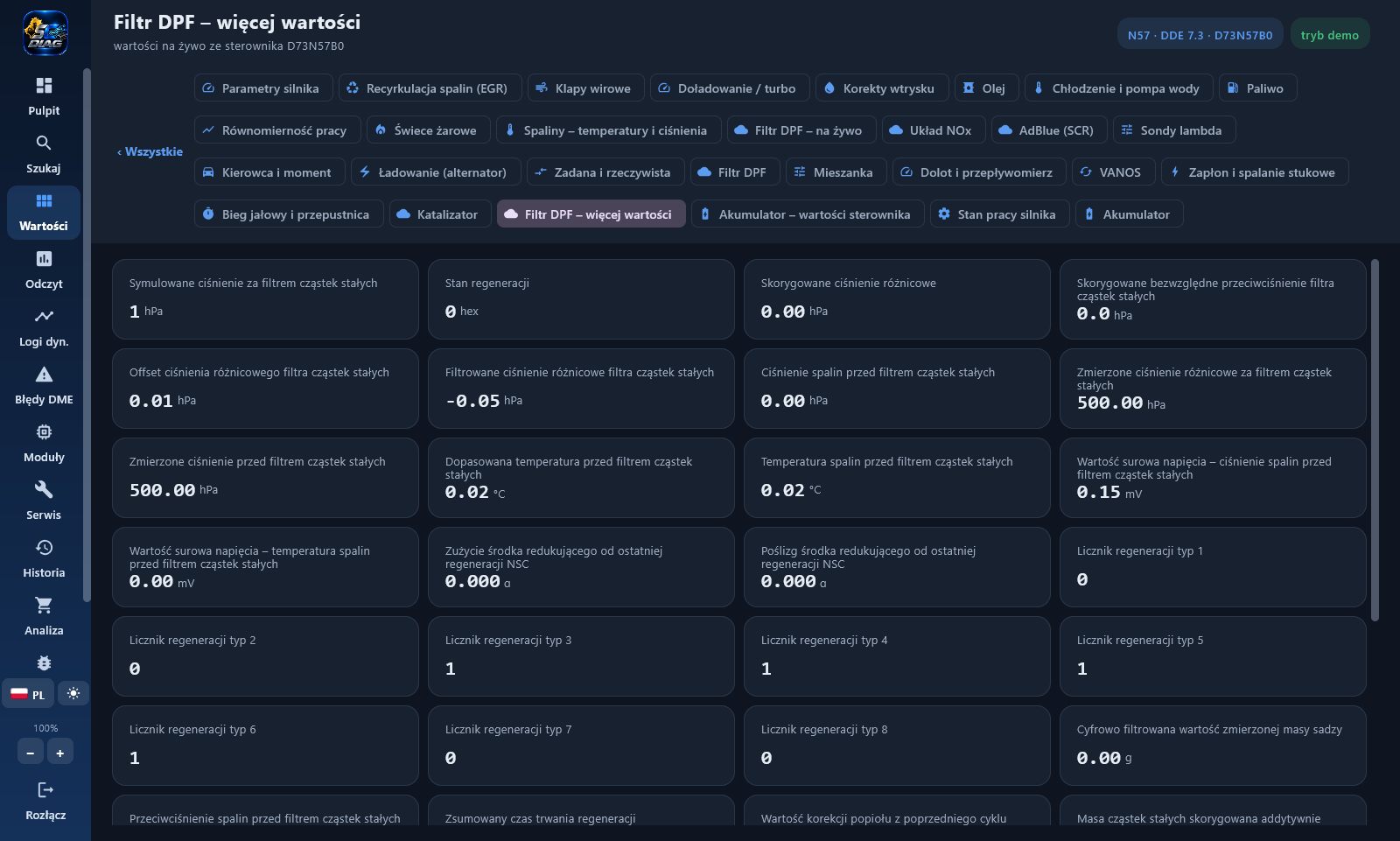
SC Diag for Windows, N57 diesel – screenshot from demo mode (simulated data). At the top are groups of values, among them “Injection corrections”; below are values the control unit provides for the particulate filter.
In short: on a common-rail diesel the control unit balances the cylinders by adding fuel where engine speed shows a weaker stroke and taking it away where the stroke is stronger. A large correction says that a cylinder needs more or less fuel than the others, but not whether the injector, the compression or the supply is at fault. It is the start of a check, not a verdict.
Two different things under one word
Talk about “corrections” on a diesel mixes up two matters. The first is the IMA code, that is, the factory correction written permanently on the injector. BMW workshop instructions for the N47 and M57 describe a code of several characters stamped on each injector and say that after replacement it has to be entered in the control unit for the cylinder in which the part was fitted. For the N57 and later versions, check this in the data for the particular engine, because the details depend on the generation.
The second is the running balancing correction: the control unit measures how crankshaft speed changes over successive strokes and adjusts the injection time so that the cylinders run evenly. It changes over time and reacts to everything that affects how a cylinder runs, not only to the injector itself.
How a diesel differs from a petrol engine
On a petrol engine the corrections rest mainly on the signal from the lambda sensors, as we describe in the article on injector corrections on petrol BMWs. On a diesel the balancing comes from crankshaft speed, not from the quantity of fuel injected. That matters, because the correction describes the torque of the cylinder, not how much fuel actually left the nozzle. A cylinder with poorer compression will deliver a weaker stroke and the control unit will add fuel to it as well, even though the injector is fine.
The control unit limits the range of such adjustments. When the deviation is too large, instead of adding more fuel it stores a fault. That is why a large correction often comes just before a code, and a code is often the last stage of a long build-up.
One more thing: the N47 and N57 came in several generations of system and control unit, so the same parameter names may have a different range and unit. That is why we compare the cylinders of one engine with each other, and not with a figure taken from someone else's car.
What a large correction on one cylinder may mean
A deviation in one number is a pointer that this cylinder is behaving differently. The directions we check, from the cheapest to the most expensive:
The injector: wear, a change in flow, leakage. An injector that lets fuel through can damage the engine, so this is not something to put off.
Cylinder mechanics: compression, sealing. A new injector will not fix that.
Air filling: a dirty or leaking exhaust gas recirculation system and the intake manifold change what reaches the cylinders. Their condition is assessed separately, as part of diagnosing the exhaust after-treatment systems.
Supply: fuel filter, air in the low-pressure circuit, the high-pressure pump. It usually affects several cylinders, but may hit one harder. See also rail pressure: target versus actual.
Cold start: glow plugs affect the first seconds of running, so compare corrections from a cold engine with those from a warm one.
What a read-out alone cannot settle
From the figure alone we cannot tell a worn injector from weak compression or from a pressure problem. We do not give a “good, bad” limit here, because the range depends on the engine, the control unit generation, the unit in which a given program shows the value, and the temperature. Figures from forums contradict each other and are not manufacturer documentation. Instead we look at how far one cylinder departs from the others and whether it repeats on a cold and a warm engine.
Simply entering new IMA codes will not repair an injector that is damaged. The code is data, not a cure.
How we check before replacing an injector
- The fault memory with freeze frames: are there codes for rail pressure, ignition or smooth running, and under what conditions did they arise.
- Cylinder corrections and smooth running on a cold and on a warm engine.
- Rail pressure, target and actual, at standstill and on the move.
- The state of the low-pressure supply: filter, lines, air.
- In the workshop: a compression check and an injector return-flow test and, where needed, swapping injectors between cylinders to see whether the problem follows the part.
What SC Diag shows on BMW diesels
In SC Diag, for diesel control units such as the N57, the dashboard has tiles for groups of values: “Injection corrections”, “Smooth running”, “Fuel” and “Target and actual”. The app recognises the control unit by itself and shows what it provides, so the scope differs between versions. Values the control unit does not provide simply do not appear. A read-out points to a probable direction and narrows down what to check, but it does not replace an inspection of the engine.
Frequently asked questions
It is the factory correction recorded on the injector. BMW workshop instructions for the N47 and M57 require the code of the new injector to be entered in the control unit for its cylinder after replacement.
Not necessarily. The correction describes the torque of the cylinder, so the same result can come from weaker compression, air filling or the fuel supply.
We do not give a single figure. It depends on the engine, the control unit, the unit and the temperature, and figures from forums contradict each other. We judge the departure from the other cylinders and whether it repeats.
It shows what the control unit provides. On the N57 the screenshots include an “Injection corrections” group, but the scope depends on the control unit version.
No. A read-out narrows down the check, and confirmation is done in the workshop: compression, injector return flow, rail pressure.
See what your diesel's control unit provides
SC Diag features, screens and read-out scope for individual engines.
See SC Diag features