A warning light has come on in a plug-in hybrid and the car behaves differently from usual. The first question is always the same: is it the combustion engine or the electric drive? In such a car two drives work under one bonnet and one dashboard, so traces of a fault can be left in both places.
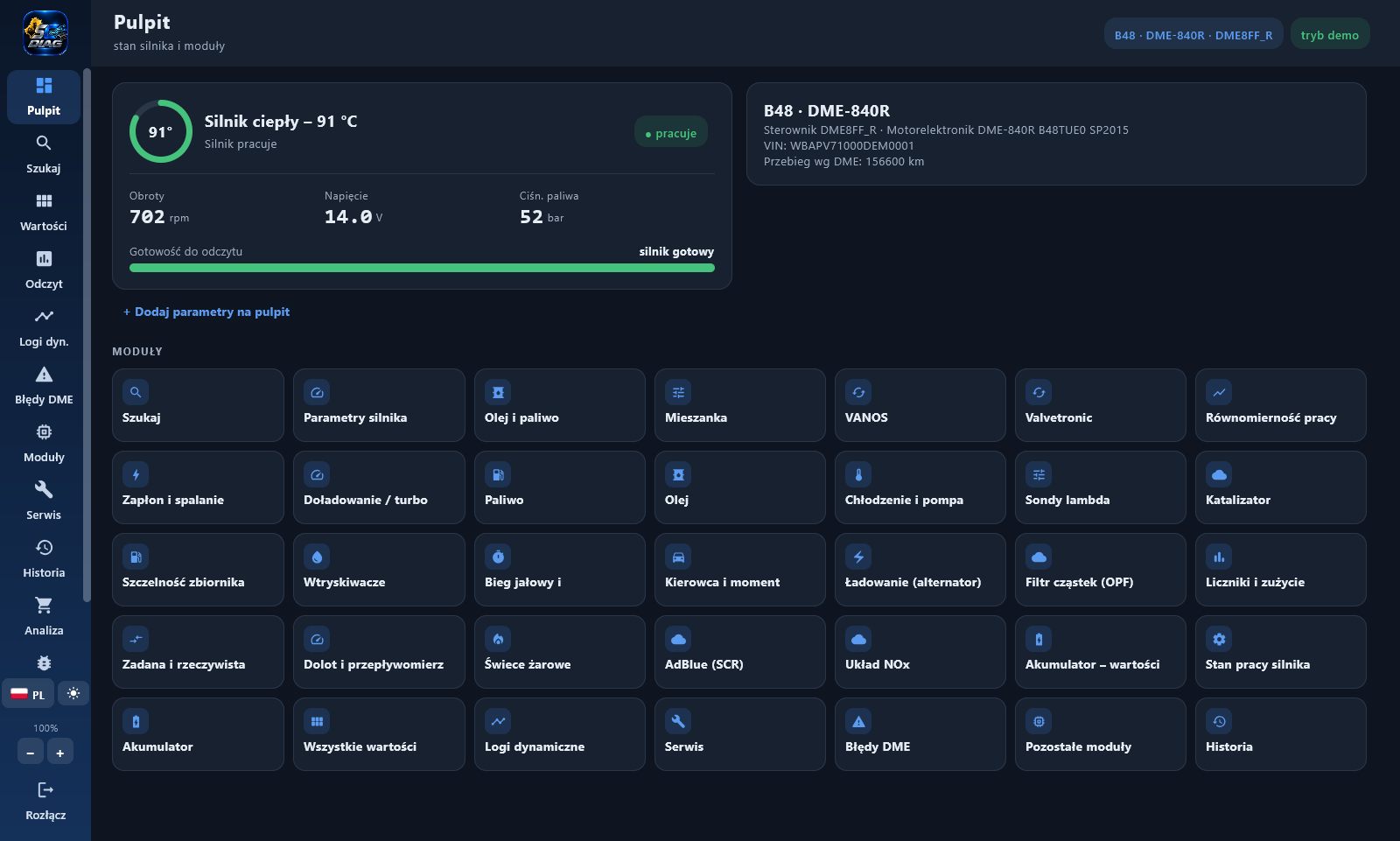
The combustion engine dashboard in SC Diag for Windows. The “Other modules” tile leads to the module overview. Demo mode, simulated data; the screenshot does not show a hybrid.
SC Diag reads both sides. From version 1.0.9 on Android and 1.0.33 on Windows (22 November 2026), alongside the engine control unit it also checks the electric drive modules. Below we describe what such a reading looks like and how to read it without drawing too much from the entries alone.
The short answer: in a hybrid SC Diag reads two sides: the combustion engine control unit (dashboard, engine faults, rough run, logs) and the fault memory of the electric drive modules from the “Electric drive and charging” group. You read the two results together, because entries on one side can explain symptoms on the other. A reading narrows down the checks; it does not point to the culprit.
The scope on real electric cars and hybrids is still being checked. The result depends on the model, the model year and the adapter.
Two drives, two places for faults
The combustion engine has its own control unit and its own fault memory. The electric drive has its own modules: the high-voltage battery, the drive, the charger and, in some cars, a range extender too. They are separate devices that talk to each other and to the rest of the car. That is why a message on the dashboard does not say where the cause is, and a scanner that reads only the engine will show only half the picture.
The combustion engine first
In a hybrid SC Diag reads the engine control unit in the same way as in a car without an electric drive, within the scope described on the page of all supported engines, petrol and diesel. The list of control units also includes ones marked as hybrid. The app recognises the control unit by itself and shows what it provides: live values, faults with a freeze frame, rough run and a log from driving. The scope depends on the data the control unit provides.
A full engine reading relies on a running engine. In a hybrid it is the car that decides when the combustion engine runs, so whether it can be kept running for the duration of the reading only becomes clear on a particular car. We discuss the parameters in the text on reading live values.
Then the electric drive modules
Alongside the engine there is the “Other modules” overview. SC Diag checks the high-voltage battery module and, when that responds, also the drive, the charger and, if present, the range extender. The modules that report in go into the “Electric drive and charging” group, and the module map shows the ones that responded, in a colour that depends on their entries. We have collected the details of this function on the page about electric cars and hybrids in SC Diag.
How to read both results together
There is no recipe here, only a way of thinking. We look at which side has the active entries and what links them.
If the active entries are in the engine and the electric drive modules have none, we start with the engine, that is, with the checks you know from combustion cars. If it is the other way round, the matter belongs to a workshop that deals with the high-voltage system. When there are entries on both sides, we look for a common cause. Many entries in many modules at once are often a sign of a power supply or communication problem rather than of several separate faults. For engine entries the freeze frame helps: it shows the engine speed, load and temperature at the moment the fault was stored.
A reading only narrows things down. The entries alone do not tell you what is faulty, and when in doubt, inspection and further checks in a workshop decide.
What the log is for in an analysis
You send us the log from the combustion engine reading with a single button, and we send back a PDF report with the analysis by e-mail. This concerns the engine: parameters, faults with a freeze frame and data from driving. How to record such a log so that it is worth something is described in the text on how to record an engine log and send it for analysis, and the scope of the analyses in the description of log analysis.
You view the entries from the module overview on the screen. If you want to show them to a workshop, take a screenshot of the module map and the list of entries.
What this reading will not settle
SC Diag is a reading, not coding and not the manufacturer’s service procedures. It does not give battery health, capacity or cell voltages, and it does not show charging, range or live drive data. It does not replace inspection and a specialist’s assessment. When buying a used hybrid it helps as one element of assessing the car (pre-purchase check), not as a substitute for it.
Safety around the high-voltage system
Work on the high-voltage system may only be carried out by people with the proper qualifications. SC Diag only reads the fault memory and does not require touching the high-voltage installation. If a high-voltage warning light comes on, or a “stop” message appears, do not carry on driving and contact a workshop. We write more about this situation in the text on a high voltage battery fault.
How we can help
There are two ways. The first is taking the reading yourself in SC Diag: the 30-day licence costs €9.99, the annual one €29.99 and the two-year one with the Service option €69.99, separately for Android and for Windows (order). The functions are described in the overview of functions, and the computer version in SC Diag for Windows.
The second way concerns the combustion engine in a hybrid: we carry out engine diagnostics at our workshop, and for a particular car we agree the scope by phone before the visit (N53 diagnostics). We do not describe work on the high-voltage battery here. You will find the latest releases of the app in the change history.
Frequently asked questions
Yes, in two parts: the combustion engine control unit, as in any other car, and the fault memory of the electric drive modules, if they respond. The scope depends on the model, the model year and the adapter.
The entries in the fault memory of the combustion engine and of the electric drive modules that responded: the high-voltage battery, the drive, the charger and the range extender, if the car has one. How they are described depends on the module and on what the app assigns to a given code.
No. The app reads the fault memory of the modules and does not give battery health, capacity or cell voltages.
You send the log from the combustion engine reading for analysis with a single button. The entries of the electric drive modules you view on the screen and can show to a workshop in a screenshot.
No. You plug the adapter into the diagnostic socket, and work on the high-voltage system may only be carried out by people with the proper qualifications.
A plug-in hybrid to read?
SC Diag reads the combustion engine and the electric drive modules in one overview. The scope depends on the car.
Order SC Diag