A code from the NOx system is stored, the engine runs unevenly and the misfire counters are climbing. What is the cause here and what is the effect? On the N53 the two often affect each other, so treating symptom after symptom can become a vicious circle.
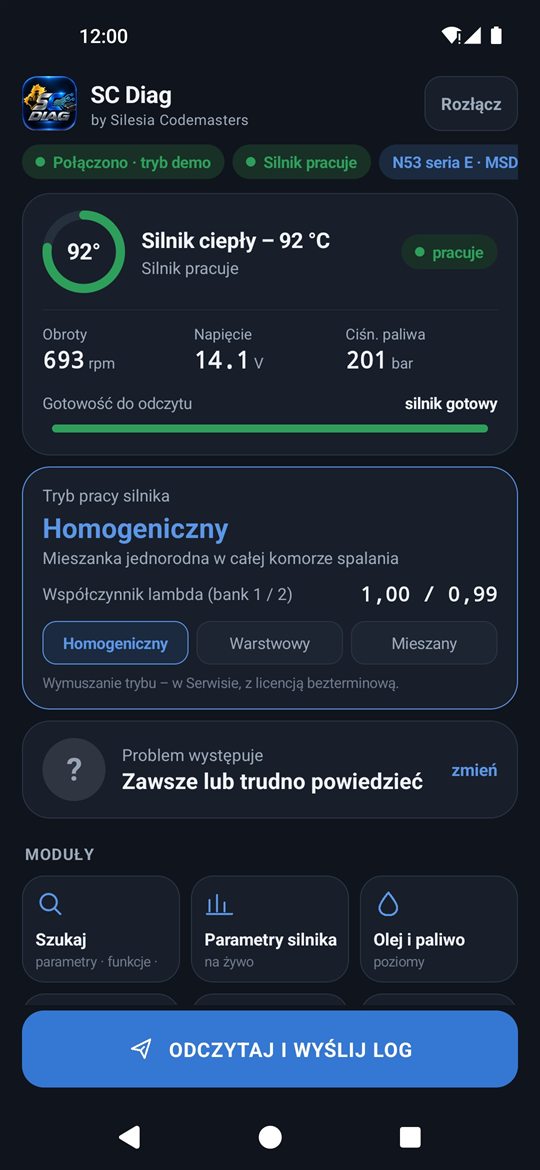
The SC Diag dashboard with the operating mode and the lambda of both banks. Demo mode, simulated data.
We describe this with care. The descriptions of NOx codes come from generally available service descriptions and from workshop experience, not from the manufacturer's documentation, and they differ depending on the control unit and software version. We are talking about the N53 with an MSD80 or MSD81 control unit.
The screenshots come from demo mode, and the sequence described is a scenario, not an account of a repair.
The short answer: misfires and NOx system faults on the N53 affect each other in both directions. A control unit that does not trust the NOx system switches off stratified mode, while uneven running and a poor mixture spoil the data used to judge the sensor and the catalytic converter. That is why we read the symptoms together and leave the decision about a part until last.
Two directions, one vicious circle
The first direction: NOx affects misfires and corrections. According to descriptions, a control unit that does not trust the NOx sensor or the catalytic converter switches off the lean and stratified mixture and stays with the homogeneous one. According to some descriptions it is in stratified mode that it learns the differences between the injectors. When the mode is blocked for weeks, those adaptations stand still, and over time uneven running, misfires and correction faults appear.
The second direction: misfires and the mixture affect NOx. Lambda swings, leaking injectors, an exhaust leak and drawn-in air spoil the picture for everything at once. The reliability and correlation codes of the NOx sensor can come from exactly that, and also from replacing the sensor without coding it (codes 30D6 and 30DE). So uneven running does not prove an injector, and a NOx code does not prove the sensor.
That is why on an N53 with a NOx code we do not start with the coils and injectors: their symptoms may be an effect, not the cause. On the other hand, a cylinder that stands out from the start and repeatedly deserves its own cheap check. The pattern of symptoms decides, not a single rule.
How to read the symptoms together
- One cylinder, repeatedly, counters and rough run agree, no NOx codes: ignition and the injector, as in the article on misfires in SC Diag.
- Several cylinders or all of them, higher consumption, stratified mode will not engage: the NOx system and the mixture, before you reach for the coils.
- A NOx code and one cylinder standing out: both leads at once. Swapping coils is cheap, but it does not replace checking the NOx sensor.
- Misfires in one operating mode only: compare the counters divided by mode, where the control unit supplies them, and check whether the NOx system allows stratified mode (operating modes).
- NOx codes appeared after the sensor was replaced: check that the sensor has been registered in the control unit (after replacing a NOx sensor).
Order of checks
- Fault codes with the freeze frame, without clearing. The freeze frame says under what conditions the control unit stored the code (how to read them).
- The picture of the symptom: which cylinder, a cold or a warm engine, one cylinder or several.
- Operating mode on the dashboard and the lambda of both banks.
- Power supply and connector of the NOx sensor, then its data on a warm engine and the correlation with the lambda sensors (NOx sensor and lambda sensors).
- Leaks, lambda sensors, mixture corrections and injector adaptations, and after them fuel pressure.
- The catalytic converter last. Sulphur poisoning can in principle be reversed, ageing of the coating cannot, and the code number does not tell you which of the two states you have (code 30EA, code 30E9, desulphurisation).
After the repair a new sensor has to be registered and the reading repeated for the same values that made you suspect it. Then we check whether stratified mode returns and whether the corrections settle down (stratified mode does not return after a repair). The adaptations need time and several drives, so we judge the first reading after a repair with caution.
The full procedure is in the article on diagnosing the NOx system step by step, and we have collected the codes in the list with descriptions and in the first steps.
What you will see in SC Diag
In the dashboard screenshot the operating mode is homogeneous, with the lambda of banks 1 and 2. The misfires screen shows two sets of bars: the increase during the observation and the counters since new. In the scenario cylinder 2 has an increase of 10 and 51 since new.
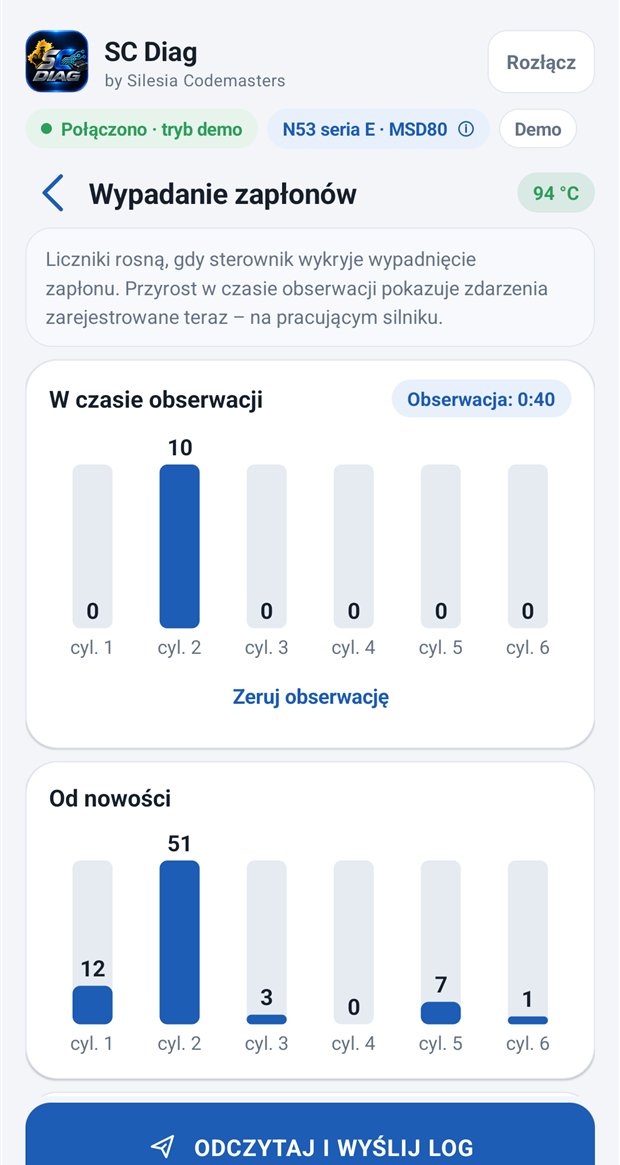
Misfire counters: during the observation and since new. Demo mode, simulated data.
A fault entry has a freeze frame. In the screenshot below, entry 30EA (NOx catalytic converter, sulphur poisoned) shows revs, load, coolant temperature and the mixture corrections and adaptations of both banks from the moment of storage, and next to it is entry 2AF4 (NOx sensor, electrical). It is an example of the data, not proof that these codes go together with misfires.
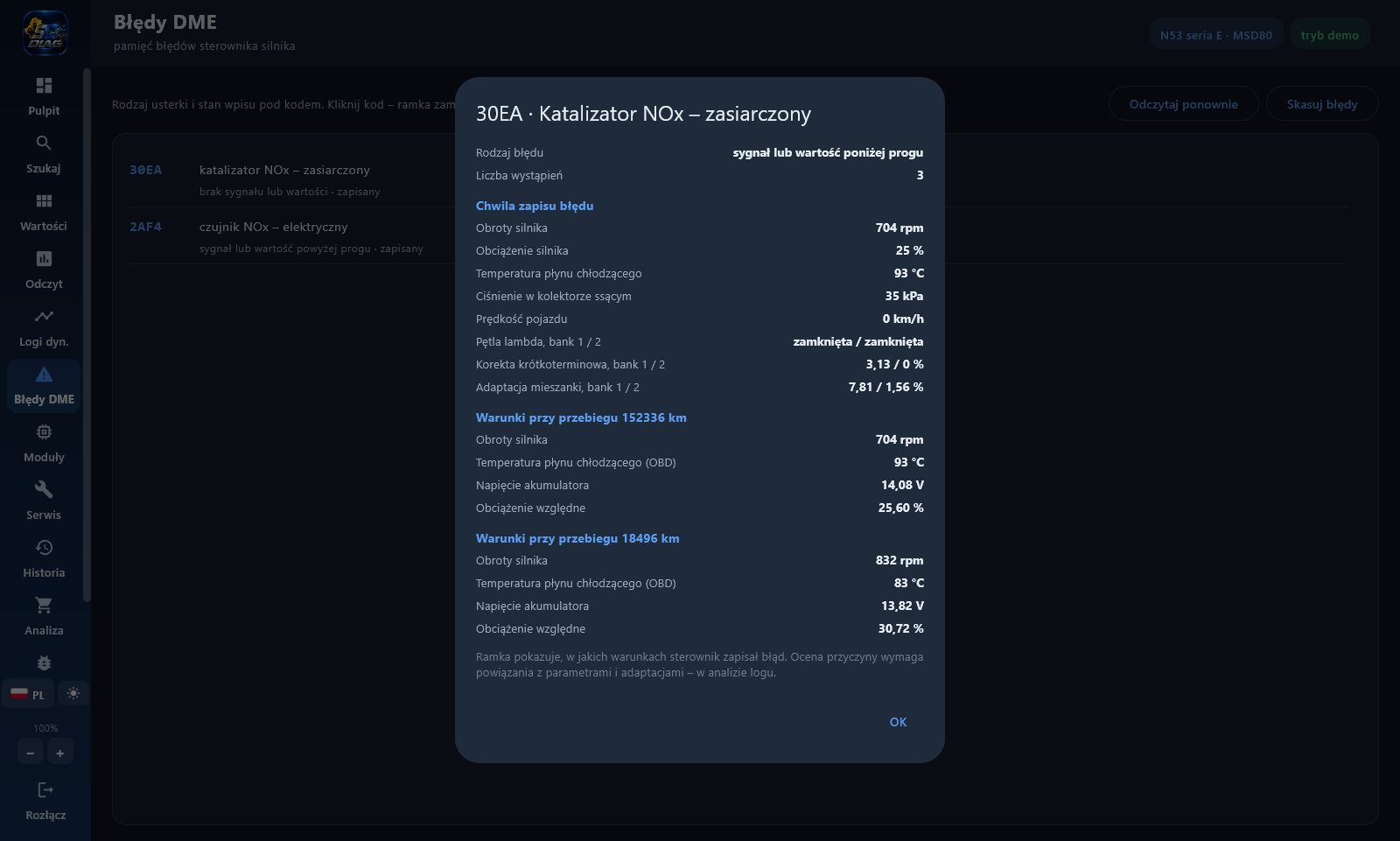
Freeze frame of a NOx system fault entry. Demo mode, simulated data.
The NOx system tab in the Windows program shows the NOx concentration, the sensor's linear lambda and the correlation with the lambda sensors, depending on the data the control unit supplies.
Where a reading ends
A flashing engine warning light means misfires, and unburnt fuel reaches the catalytic converter. Then we do not carry on with a test drive. In other situations a reading narrows down the checks. It will not decide whether the sensor, the catalytic converter, a coil or an injector is at fault, because different faults give a similar picture. Disabling or bypassing emission control systems is not a service we offer (terms and conditions, §3, para. 3). We repair the system so that it works as the factory intended.
How we can help
You can do the first step yourself in SC Diag, on Android or Windows (Windows version). These are separate licences: €9.99 for 30 days, €29.99 for a year, €69.99 for 2 years (with the Service option). The N53 has the fullest coverage.
The second path is N53 diagnostics with us: in Silesia, on site or remotely. We agree the scope by phone, 570 341 744. When you order a diagnostic, one-off access to the app is free of charge.
Frequently asked questions
According to descriptions, indirectly yes: a blocked stratified mode stops the injector adaptations, and over time uneven running and correction faults appear. Misfires alone do not prove, however, that the cause lies in the NOx system.
Yes. The reliability and correlation codes of the sensor can come from lambda swings, an exhaust leak or leaking injectors, so we do not replace the sensor before we have examined the mixture and the exhaust.
With the fault codes and their freeze frames, without clearing, and by establishing whether one cylinder stands out or several. Then the operating mode, the NOx sensor data on a warm engine, and the catalytic converter last.
No. The entry disappears, the cause stays, and the freeze frame with the storage conditions disappears with it. We clear after the repair.
No. It is demo mode with simulated data, and the description is a scenario, not an account of a repair.
Misfires and NOx on the N53 to check?
A reading in SC Diag shows the misfires, the operating mode and the NOx system data in one place.
Order SC Diag