30E9 is sitting in the fault memory, and somebody online has written that the NOx catalytic converter needs replacing. It is one of the more expensive parts of the N43 and N53, so before you reach for your wallet you need to know what this code really says, and what it does not.
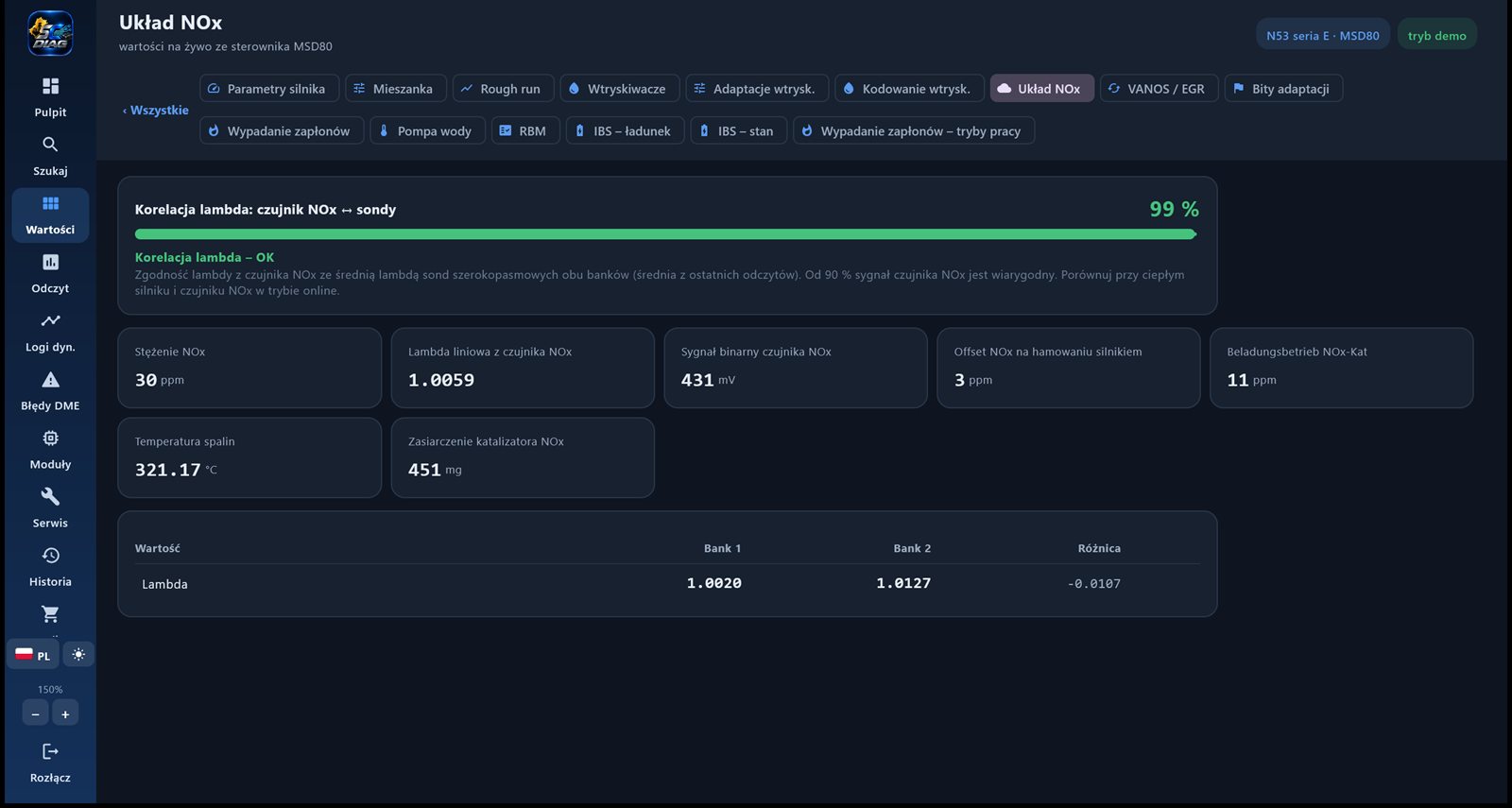
The “NOx system” tab in SC Diag for Windows. Demo mode, simulated data. Before we judge the catalytic converter, we check whether the sensor signal can be trusted.
Below we describe how the control unit arrives at code 30E9, why its descriptions differ and in what order we check the system before a decision is made about the converter. We write about diagnostics and about restoring factory operation.
The short answer: 30E9 is described as ageing of the NOx catalytic converter: the control unit has concluded that its efficiency has stayed below the permitted level for a long time. Descriptions of this code online do differ, though, and a faulty NOx sensor can hide the problem or cause it. So we check the sensor and the lambda system first and only then judge the converter.
Where the control unit gets “ageing” from
The NOx catalytic converter stores nitrogen oxides, and the NOx sensor shows how much gets through. The control unit judges efficiency from the amount of NOx and from how quickly it rises after regeneration. If efficiency stays below the permitted level for long enough, it stores 30E9.
Ageing is a permanent loss of the coating's ability to work. That differs from sulphation, which can in principle be reversed, as we explain under code 30EA. The number alone does not tell us which of the two states we are dealing with, so we treat the code as a reason to investigate, not as a verdict. Only a comparison with the data from the sensor, the lambda sensors and the regeneration history lets us say more.
Why the descriptions of code 30E9 diverge
In some service descriptions 30E9 is ageing of the NOx catalytic converter, and that is how we treat it here. Elsewhere the same number is linked to the multiplicative lambda adaptation. This probably depends on the control unit and software version, and the authors of such descriptions partly rely on their own observations.
Our descriptions come from generally available service descriptions and from workshop experience, not from the manufacturer's documentation. If the tool in your car shows a different name for the code, the one from the tool and the freeze frame of the entry matter more. The rest of the NOx system codes are in the list with descriptions.
What happens to the engine while the code is stored
According to the descriptions the code returns straight away after clearing. The engine then runs only in homogeneous mode, because the lean homogeneous and stratified modes are blocked, so fuel consumption rises (operating modes of the N43 and N53). Over time rough running, misfires and fuel trim faults appear. This is not something to put off.
There is also a trap in the other direction. A faulty NOx sensor can hide a problem with the converter, and then 30E9 will not be stored at all. The absence of this code therefore does not mean the converter is healthy. The code can also come from a sensor that is lying, with a converter that is still coping.
What to check, in order
- The NOx sensor and its data. The code is calculated from the sensor's measurements, so we start with its codes, power supply and connector, and then with the NOx concentration and lambda reading on a warm engine. A constant or intermittent zero reading while driving raises suspicion.
- Lambda system and exhaust. Leaks upstream of the sensors, the lambda sensors and the mixture corrections of both banks. Air being drawn in or a wrong mixture distorts the picture so that the converter looks worse than it is. The same goes for misfires, which themselves speed up its ageing (rough run).
- Only then the catalytic converter. When the sensor and lambda give a consistent picture, we compare the regeneration history and the sulphation level to tell sulphation from permanent ageing. The decision to replace is then based on data, not on the code alone.
We described how we compare the sensor's lambda with the lambda sensors in the article on the NOx sensor and lambda sensors, and the first steps for any NOx code in the article NOx fault codes: first steps.
The limits of the reading and of our service
The reading narrows down what to check and settles nothing on its own. It will not tell you whether the coating is permanently worn, and we decide on replacement after comparing the signals and inspecting the car. Desulphation helps with sulphation but will not reverse ageing of the coating (desulphation of the NOx catalytic converter, what damages the NOx catalytic converter). Switching off or bypassing emissions systems is not a service we offer (our terms and conditions, §3 para. 3).
Diagnostics with us, or a reading with SC Diag
We check the NOx system as part of engine diagnostics: in person in Silesia, on site or remotely (N43 diagnostics, N53 diagnostics, remote N43 and N53 diagnostics).
In SC Diag the NOx tab shows NOx concentration, linear lambda from the sensor, the sulphation level of the catalytic converter and the correlation of lambda with the lambda sensors, and a fault entry comes with a freeze frame showing the conditions when it was stored. The scope depends on the data the control unit provides, and the N43 and N53 are covered most fully (SC Diag order page).
Frequently asked questions
In service descriptions it is ageing of the NOx catalytic converter, meaning efficiency judged by the control unit to be too low for a long time. Descriptions of this code online differ, so it has to be compared with the readings.
Not from the code alone. A faulty sensor or a wrong mixture can give a picture worse than the actual state of the converter, so we check the sensor and the lambda system first.
According to the descriptions the control unit judges efficiency continuously and stores the code again for as long as the condition persists. Clearing the entry changes neither the converter nor the cause.
30E9 is described as ageing of the catalytic converter and 30EA as its sulphation, which can in principle be reversed by regeneration. From the code alone we cannot tell which state applies.
The car will run, but according to the descriptions the engine runs in homogeneous mode with higher fuel consumption, and over time misfires and fuel trim faults may follow. It is not worth putting the check off.
Code 30E9 in the fault memory?
We will check the sensor, the lambda system and only then the catalytic converter before any decision about a part. You can also take a reading yourself with SC Diag.
Book diagnostics