The NOx sensor is replaced, the faults are cleared, and a few days later the warning light is on again. The first question is usually: did we get a faulty part? That happens, but it is not the first suspicion. Sometimes the sensor is perfectly sound and the reason lies in what was going on around it.
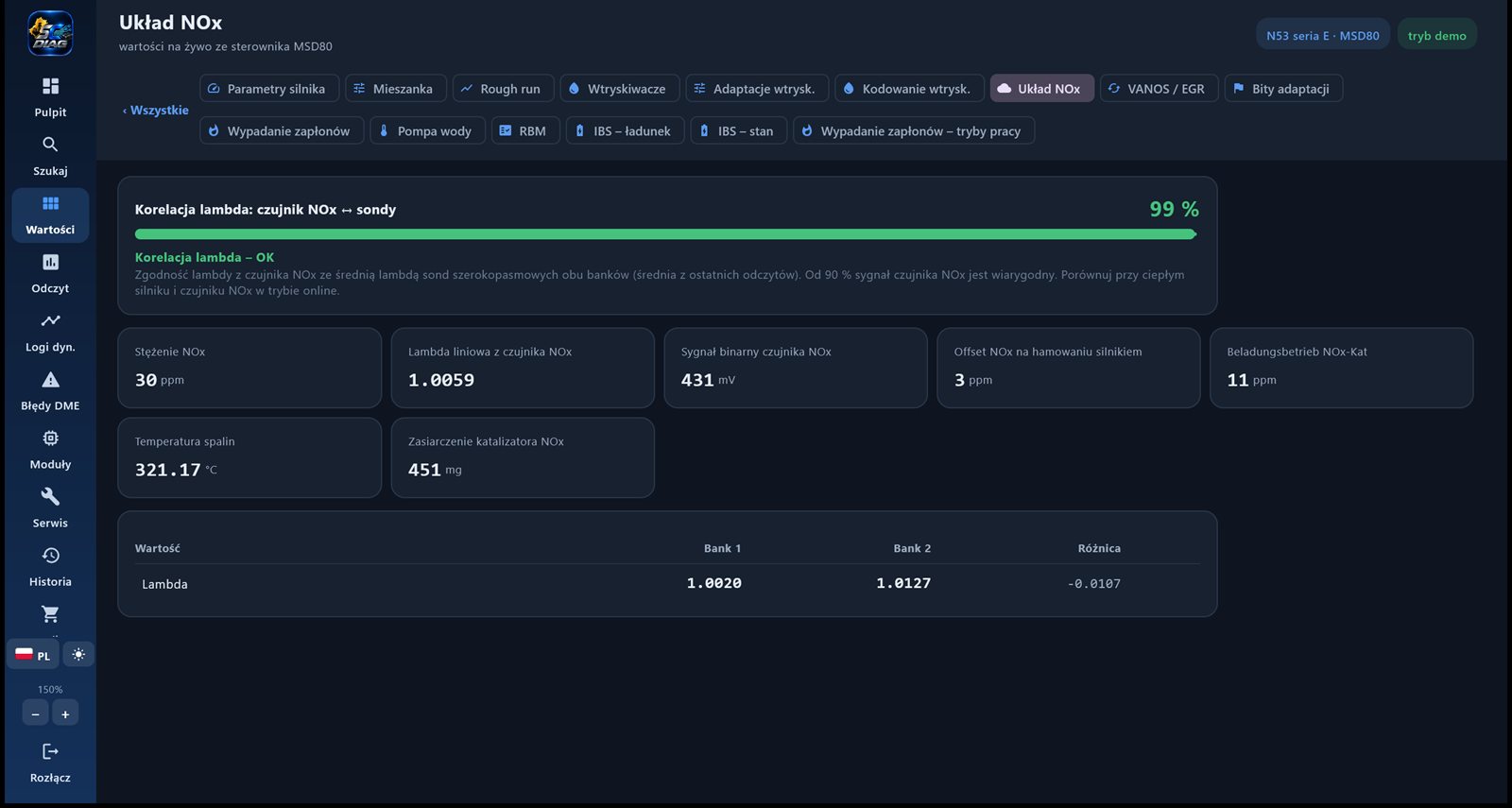
The "NOx system" tab in SC Diag for Windows, showing the same values for comparing before and after the replacement. Demo mode, simulated data.
We write about where a fault after replacing a NOx sensor on a BMW comes from and where we start when it returns. We talk only about diagnostics and restoring factory operation, without step-by-step coding instructions. The code descriptions come from generally available service descriptions and from workshop experience, not from the manufacturer's documentation, and may differ depending on the control unit and software version.
Short answer: a fault returns after replacing a NOx sensor most often for three reasons: the new sensor was not coded to the control unit, the real cause lay elsewhere (exhaust, lambda sensors, adaptations, supply), or the old sensor was hiding a catalytic converter problem. Codes 30D6 and 30DE are described as possible precisely after a replacement without coding.
Before we blame the new part
Replacing a sensor is a decision usually taken after a code that said "something is wrong with the signal". Yet the codes of this system describe a comparison of signals, not a specific part. If someone replaced the sensor without checking why the signals had drifted apart, the new part is put to work under the same conditions that wrecked, or at least called into question, the previous one.
So when the light returns we go through three possibilities, in this order: the sensor is not registered in the control unit, the cause was elsewhere, or the sensor was covering for another fault. A faulty new part comes last.
A new sensor, but old data in the control unit
The NOx sensor has its own electronics and after replacement it has to be registered, that is coded, in the control unit. Without that the control unit keeps using values learned on the old element. In service descriptions, codes 30D6 (signal plausibility) and 30DE (correlation with the lambda sensor upstream of the catalytic converter) are named precisely as a possible result of replacement without coding.
The control unit then compares the new sensor's signal with the lambda sensors and, when they do not agree, stores a code. Clearing the entry does not cure this, because the comparison repeats and the code returns. The details of the procedure depend on the car and the control unit version, which is why we carry it out in the workshop. How to read both codes is described in the text codes 30D6 and 30DE.
The sensor was innocent
The second situation is just as real. If there is an exhaust leak upstream of the sensors, air gets into the exhaust gas and the sensor's lambda drifts away from the lambda sensors however new the sensor is. Tired lambda sensors or disturbed injector adaptations work the same way. All three causes are named in the descriptions of these codes.
Then there are the supply and the connector. A damp connector or a weak battery can cause errors across the whole NOx system, so a new sensor plugged into the old, damp connector goes back to the same symptoms. We describe this in more detail in the text on the first steps for NOx codes.
The sensor was covering for the converter
The third possibility is the least obvious. A faulty NOx sensor can hide a catalytic converter problem, because then the converter code may not be stored at all. After the replacement the sensor starts measuring honestly and the control unit has the data for the first time to assess the condition of the converter. Then 30E9 (ageing) or 30EA (sulphation) may appear in the fault memory.
That does not mean the replacement broke anything. The state that was covered up is finally visible. In the case of sulphation the next step is regeneration and adapting the engine, and whether that makes sense is decided by assessing the condition of the converter. We write about the difference in the articles desulphation of the NOx catalytic converter and what damages the NOx catalytic converter.
What to check, in order
When the fault has returned after the replacement, we go in this order:
- The sensor and its data. Whether the sensor is registered in the control unit, whether it is properly powered and connected, and what its values look like on a warm engine. A constant or intermittent zero reading while driving raises suspicion.
- The connector and the supply. Moisture, corrosion, loose contacts, battery voltage.
- The lambda system and leaks. The exhaust upstream of the sensors, the condition of the lambda sensors, mixture corrections and adaptations of both banks.
- Only then the NOx catalytic converter. Assessing sulphation and ageing and, if needed, regeneration and readaptation.
- A fresh reading of the same values that made us suspect the sensor. Only the correlation returning to normal confirms that the repair hit the mark.
We give no numerical thresholds, because they depend on the engine and the measuring conditions. Steps 1 to 3 are helped by the texts on the NOx sensor and lambda sensors and on the symptoms of NOx sensor failure.
What SC Diag shows here
It helps to have a reading from before the replacement and after it. In SC Diag the NOx system tab shows the NOx concentration, linear lambda, binary signal, exhaust temperature and sulphation of the catalytic converter, and the correlation bar rates how well the sensor's lambda agrees with the average lambda of the wideband sensors of both banks. A fault entry that has returned has a freeze frame with the conditions at the time it was stored.
That narrows down what to check, but a workshop inspection is still needed. The app will not settle whether the new part is faulty, and intermittent faults may not show up in a single reading, so we take several. The scope depends on the data the control unit supplies, most completely for N43 and N53. Live values are discussed in the text on BMW engine parameters.
Limits
We cannot tell from a distance whether the culprit is the missing coding, the exhaust or the new part. Disabling or bypassing emission systems is not a service we offer (terms and conditions, §3, para. 3). We repair the system so that it works as the factory intended, and we check the result with the same reading that made us suspect it.
How we can help
If the sensor has already been replaced and the fault has returned, book engine diagnostics for the N53 or N43, with us in Silesia or remotely. If you would rather take a reading yourself first and send a log for analysis, choose SC Diag.
Frequently asked questions
Most often because the new sensor was not coded to the control unit, the cause lay in the exhaust, lambda sensors or adaptations, or the earlier sensor was hiding a catalytic converter problem. A faulty new part is the last suspicion.
According to service descriptions, yes: after replacement the sensor has to be registered (coded) in the control unit. Without that, codes 30D6 and 30DE may appear. The details depend on the car, which is why we do it in the workshop.
No. Clearing removes the entry but not the cause. The control unit compares the signals again and, if the problem persists, stores the code again.
It may, if the old sensor was hiding a catalytic converter problem. The new one then shows the real state, and only an assessment of the converter decides what comes next.
It shows the correlation of the sensor's lambda with the lambda sensors, the NOx system values and the freeze frame of the entry. That narrows down what to check, but we decide after checking the supply, the connector and the exhaust.
The fault is back after replacing the NOx sensor?
We will check the sensor's registration, the connector, the exhaust and the lambda sensors before you buy another part. Want to start with a reading? You can take it yourself in SC Diag and send the log for analysis.
Book diagnostics