You cleared code 30EA, the warning light went out and everything looks fine. Meanwhile the engine still uses more fuel than it should and seems to run differently. With this code that is possible, because clearing the entry changes nothing in the catalytic converter.
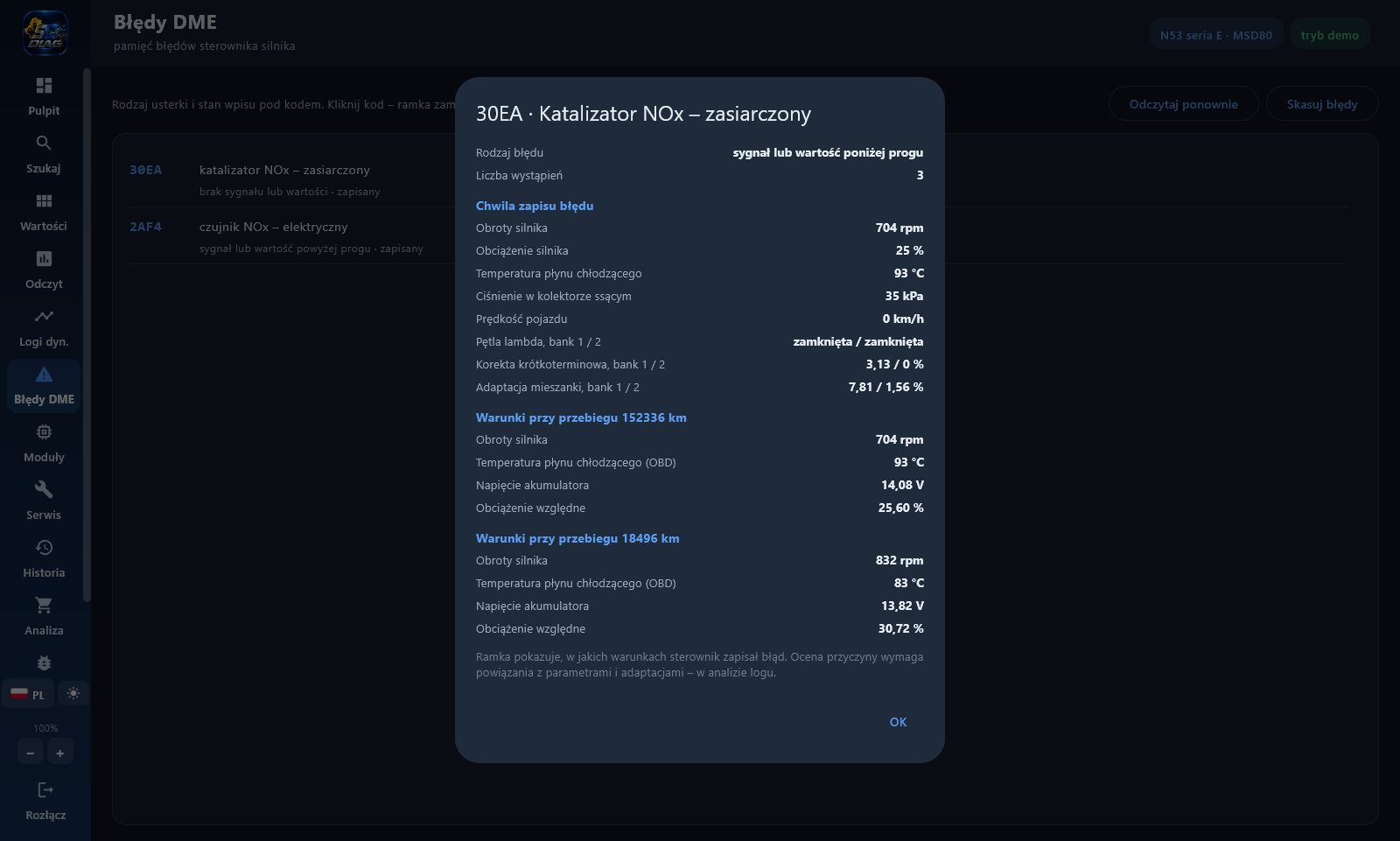
Freeze frame of a 30EA entry in SC Diag for Windows. Demo mode, simulated data. It shows the conditions in which the control unit stored the fault, but it does not point to the faulty part.
We describe what sulphation of the NOx catalytic converter means, where it comes from and in what order we check it. We write about diagnostics and about restoring the system to factory operation.
The short answer: 30EA is described as sulphation of the NOx catalytic converter. The control unit stores the code when the sulphur load exceeds a limit and regeneration has not taken place or is not possible. The causes listed include a driving pattern without regular regeneration and a faulty NOx sensor. So we start with the sensor, and only then think about desulphation.
How the control unit calculates sulphation
Sulphur from the fuel and oil settles on the material that stores NOx in the catalytic converter and reduces its ability to work. The control unit adds up the calculated and measured sulphur load. When the limit is exceeded and regeneration, that is desulphation, has not taken place or is not possible, it stores 30EA.
The control unit starts regeneration by itself, given a suitable driving pattern. What exactly happens inside the converter and when it makes sense is described in the article on desulphation of the NOx catalytic converter.
Clearing does not cure it
After clearing, 30EA may not return to the fault memory, but the condition of the converter remains. The descriptions speak of the lean and stratified modes being blocked, loss of long-term corrections, and, in time, rough running, misfires and faults in the fuel system, catalytic converter and lambda sensors (operating modes of the N43 and N53).
That is why with this code we do not trust a quiet fault memory. We look at the sulphation level in the reading and at how the engine behaves, not only at whether an entry appears.
What usually lies behind it
The descriptions list three groups of causes. The first is the driving pattern: a car used for short trips, without regular longer runs on which the control unit could start regeneration. The second is a NOx sensor that responds slowly and leaves no code, or that is faulty. The third is the exhaust temperature sensor, on which the control unit depends when running regeneration.
Fuel quality and oil consumption also load the converter, as we explain in the article what damages the NOx catalytic converter. The first cause is changed by habit, the other two by repair. To know which applies to your car, you first have to look at the data.
What to check, in order
- The NOx sensor, even if it left no code. Power supply, connector, then the NOx concentration and lambda reading on a warm engine. A slow or faulty sensor is one of the main causes, and regeneration without a reliable signal makes no sense (NOx sensor: what it is and how it works).
- The exhaust temperature sensor, lambda system and exhaust. Plausibility of the exhaust temperature, exhaust leaks, lambda sensors and the mixture corrections of both banks. Without this we do not know whether the data from which the control unit calculates sulphation is true.
- Only then the catalytic converter. When the data is consistent, we assess the sulphation level and whether regeneration has a chance of succeeding.
The order matters. If the sensor has to be replaced, the new one is registered in the control unit, and only then do regeneration and engine adaptation follow. Desulphation before the sensor has been checked treats the symptom instead of the cause. Why an error can return after replacement is explained in the article after replacing a NOx sensor.
Desulphation: when it makes sense
According to the descriptions, activating desulphation from a diagnostic tool may increase how often the converter is cleaned, but it guarantees nothing. It makes sense when the problem is caught early and the sensor is working. If sulphation returns after a short time, we look for the cause, meaning driving style, fuel, oil or a hidden sensor fault.
Desulphation will not reverse permanent ageing of the coating, and that is described by a different code: 30E9. From the number alone we cannot tell whether we have sulphation or ageing.
The limits of the reading and of our service
The reading narrows down what to check. It will not tell you whether sulphation can be reversed, and it does not replace inspecting the connector and exhaust in the workshop. The code descriptions in this article come from generally available service descriptions and from workshop experience, not from the manufacturer's documentation, and they may differ depending on the control unit and software version. Switching off or bypassing emissions systems is not a service we offer (our terms and conditions, §3 para. 3).
Diagnostics with us, or a reading with SC Diag
We check the NOx system as part of engine diagnostics: in person in Silesia, on site or remotely (remote N43 and N53 diagnostics, N53 diagnostics, N43 diagnostics).
In SC Diag the 30EA entry comes with a freeze frame showing the conditions when it was stored, and the NOx tab shows the sulphation level of the catalytic converter, the NOx concentration and the correlation of the sensor's lambda with the lambda sensors. The scope depends on the data the control unit provides, and the N43 and N53 are covered most fully (SC Diag order page). You will find the remaining system codes in the list with descriptions.
Frequently asked questions
In service descriptions it is sulphation of the NOx catalytic converter: the control unit has concluded that the sulphur load has exceeded the limit and regeneration has not taken place or is not possible.
No. The code may not return to the fault memory, but the condition of the converter remains, so the engine may carry on running in restricted modes with higher fuel consumption.
Sulphation can in principle be reversed, but without a working NOx sensor regeneration will not run properly, and it will not reverse permanent ageing of the coating. There is no guarantee of the result.
The causes most often listed are a driving pattern without regular regeneration, a slow or faulty NOx sensor and the exhaust temperature sensor. Desulphation without removing the cause only postpones the problem.
30EA is described as sulphation and 30E9 as ageing of the catalytic converter. The first can in principle be reversed, the second cannot, but from the code alone we do not know which state we have.
Code 30EA in the fault memory?
We will start with the NOx sensor, before anyone thinks about desulphation or replacement. You can also take a reading yourself with SC Diag.
Book diagnostics