The control unit has stored 30D6 or 30DE, the warning light is on, and the NOx sensor is either freshly replaced or looks fine. These two codes are easily taken as a verdict on the sensor, yet they describe something subtler: the sensor's signal does not agree with what the control unit knows about the exhaust gas from other sources.
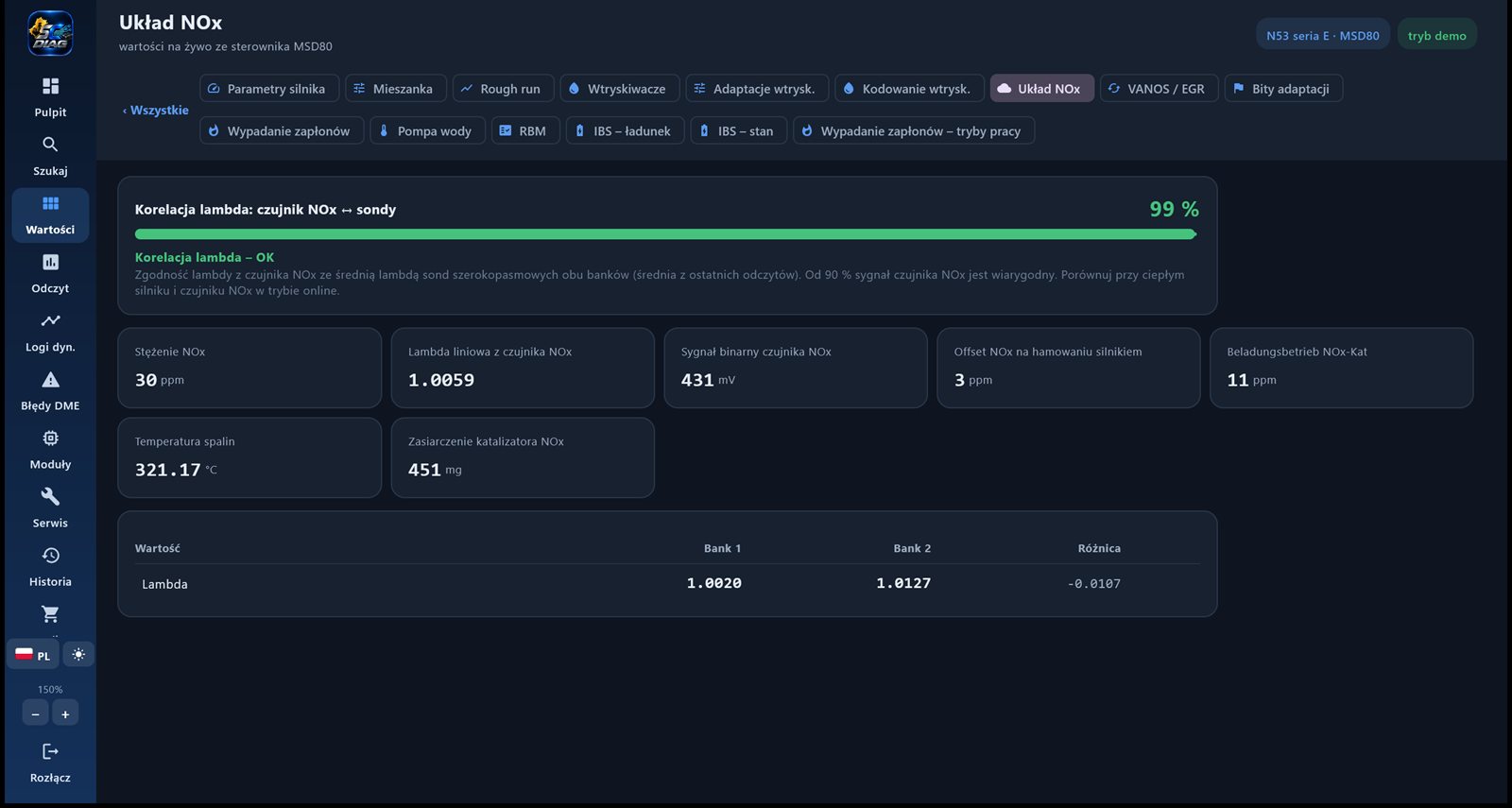
The "NOx system" tab in SC Diag for Windows. Demo mode, simulated data.
Below we describe what these codes usually mean and the order in which we check the system. We talk only about diagnostics and restoring factory operation. The code descriptions come from generally available service descriptions and from our workshop experience, not from the manufacturer's documentation, and they may differ depending on the control unit and software version.
Short answer: code 30D6 is described as a lack of plausibility in the NOx sensor signal, and 30DE as a lack of agreement with the lambda sensor upstream of the catalytic converter. Both say that the signals do not match, not that the sensor is definitely faulty. The causes listed include an exhaust leak, the lambda sensors, injector adaptations and a sensor replaced without being coded.
A sensor that gets cross-checked
On petrol N43 and N53 engines the NOx sensor supplies not only the nitrogen oxide concentration but also its own lambda value. The control unit therefore has several independent sources of knowledge about the same thing: the lambda sensors see the composition of the exhaust gas, and so does the NOx sensor. If they all measure the same thing, their readings should agree.
The code appears when they stop agreeing for a while and the control unit concludes that the sensor cannot be trusted. This is an important distinction: codes of this kind speak about a comparison, not about a part. We get the same entry when the sensor is lying, but also when the lambda sensors give a false picture of the exhaust or when air is getting into the exhaust.
30D6 and 30DE: how they differ
30D6 is, in the descriptions, signal plausibility. The control unit judges whether the signal makes sense under the given operating conditions. The causes listed are lambda fluctuations, leaking injectors and air entering the exhaust gas.
30DE is correlation with the lambda sensor upstream of the catalytic converter. Here the sensor's lambda has drifted away from the value the lambda sensor reports. The causes mentioned include an exhaust leak, the lambda sensors themselves and injector adaptations.
Note that the lists overlap, so we treat both codes together and look for a common cause. Both are also described as possible after replacing the sensor if the new one has not been coded to the control unit. We have given that situation a text of its own: the fault returns after replacing a NOx sensor.
What to check, in order
The order matters, because it runs from the cheapest check to the most expensive:
- The NOx sensor and its data. First the supply and the connector (moisture, corrosion, loose contacts), then a reading of the values on a warm engine: do the concentration and lambda look sensible and change along with engine operation. A constant or intermittent zero reading while driving raises suspicion.
- The sensor's history. Whether it was replaced recently and whether it was registered in the control unit. If not, we have a likely explanation.
- Exhaust leaks upstream of the sensors. Air drawn in distorts the lambda value exactly as a faulty component would.
- The lambda sensors. When the reference lies, comparing against it proves nothing.
- Mixture corrections and adaptations of both banks. A large difference between the banks shows that the problem lies on one side of the engine. The principles of reading them are described in the text on STFT and LTFT corrections.
- Only then the assessment of the NOx catalytic converter. When the sensor is not reliable, the control unit cannot assess the converter or run its regeneration. That is why we leave the converter until last. How to tell it apart from the sensor is described in the list of NOx system codes.
We give no numerical thresholds here. They depend on the engine and the measuring conditions, and we have not confirmed them for every control unit.
Why we do not buy a sensor on spec
It is an expensive part, and replacing it without comparing the signals often does not clear the code. It works the other way too: a sensor can be faulty without any entry in the fault memory, so its condition is decided by reading the values, not by the presence or absence of 30D6. We have collected the symptoms of the sensor itself in the article on NOx sensor failure, and the first steps for any code from this system in the text BMW NOx fault codes: first steps.
What SC Diag shows here
In the Windows program the NOx system has its own tab. The correlation bar compares the lambda from the NOx sensor with the average lambda of the wideband sensors of both banks and rates it OK or not OK. Next to it are tiles with the NOx concentration, linear lambda, binary signal, exhaust temperature and sulphation of the catalytic converter, and below them a table of the lambda of bank 1 and bank 2 with the difference between them. That table matters as much as the percentage itself, because when the banks drift apart the average can mislead.
In SC Diag a fault entry gets a freeze frame: engine speed, load, temperature, mixture corrections and adaptations, and the conditions at the time it was stored. The scope depends on the data the control unit supplies, and N43 and N53 are covered most completely. For a broader look at live values see the text on live BMW engine parameters, and for how to compare the signals the description of the NOx sensor and lambda sensors.
What a reading will not settle
A reading narrows down what to check and settles nothing on its own. It will not say whether the ceramic of the sensor, its electronics or deposits are to blame, and intermittent faults, on a cold engine or in damp conditions, may not show up in a single measurement. So we take several readings and compare them with a visual inspection of the connector, the exhaust and the mechanics in the workshop. Disabling or bypassing emission systems is not a service we offer (terms and conditions, §3, para. 3). We repair the system so that it works as the factory intended.
How we can help
If you prefer to hand the car over for checking, book engine diagnostics for the N53 or N43, with us in Silesia or remotely. If you want to see the correlation yourself and send a log for analysis, choose SC Diag.
Frequently asked questions
It is described in service material as a lack of plausibility in the NOx sensor signal. The cause may be lambda fluctuations, leaking injectors, air in the exhaust gas or a sensor replaced without being coded.
It is described as a lack of correlation between the NOx sensor and the lambda sensor upstream of the catalytic converter. The cause may be an exhaust leak, the lambda sensors or injector adaptations, and also replacing the sensor without coding it.
No. Both codes speak of signals that disagree, not of a specific part. Before we blame the sensor, we check the connector, the exhaust, the lambda sensors and the adaptations.
Usually not. If the cause is not removed, the control unit compares the signals again and may store the same code again.
No. We gathered the descriptions from generally available service material and from workshop experience. They may differ depending on the control unit and software version.
Codes 30D6 or 30DE on your BMW?
Take a reading in SC Diag and send the log, and we will check the sensor's correlation with the lambda sensors before you replace anything. Prefer to hand it over for checking? Book diagnostics with us at the workshop, on site or remotely.
See SC Diag