A cold N53 shakes at idle and settles down once warm, and someone says: “it's the injectors”. Before you spend money on a part, it is worth seeing what can be read on a phone. The screenshot shows one cylinder standing out from the rest. It is SC Diag in demo mode, and the data is simulated.
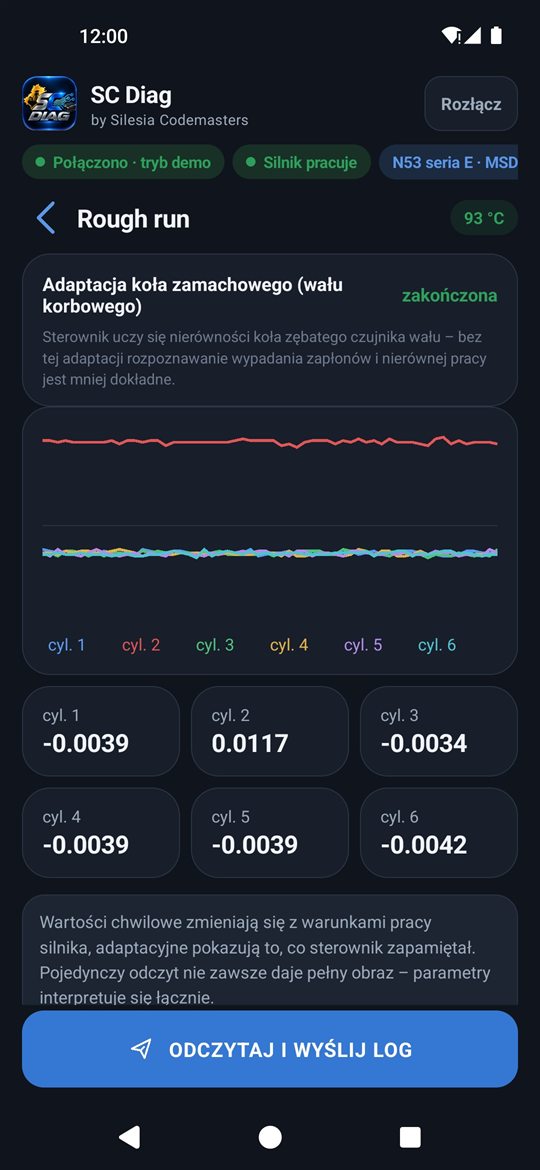
Rough run in SC Diag on Android. Demo mode, simulated data. Cylinder 2 stands out from the other five.
This article is a guide to the screens, not an account of a repair. The sequence described is a scenario built on demo data: no real car or customer stands behind it. You will find the background on piezo injectors in the article on symptoms and readings of piezo injectors, and the logic of the corrections in the piece on injector corrections in petrol BMWs. What matters here is something else: what you will see and on which screen.
The short answer: on the N53, SC Diag shows injector corrections and adaptations for each cylinder, rough run and misfire counters. The reading shows which cylinder stands out, on a cold and a warm engine. It does not settle whether the injector, the ignition or the fuel supply is at fault. It narrows the checks and is no verdict.
Scenario: cold engine, one cylinder higher than the rest
After connecting, the app asks when the problem occurs. You pick “On a cold engine”, because the shaking only happens in the morning. The reading runs from the start, and during a full reading the app makes sure the engine is running and reminds you not to touch the accelerator.
The first screen you look at is rough run. In the scenario five lines lie almost on top of each other, while the line for cylinder 2 runs clearly higher. Below the graph are the values: 0.0117 for cylinder 2, and from −0.0034 to −0.0042 for the others. The app gives them without a unit and they are not a norm. What counts is that one cylinder stands out, and whether it does so consistently.
Above the graph is the status of the flywheel adaptation. When it reads “completed”, we take the graph seriously; without that adaptation we treat it as preliminary. How to read the graph itself is explained in the article on rough run.
Second screen: small-quantity adaptations
Now the injectors. On the phone this is a list in which each injector has two rows: the value stored on a cold engine and on a warm one, in mg/stk (milligrams per stroke).
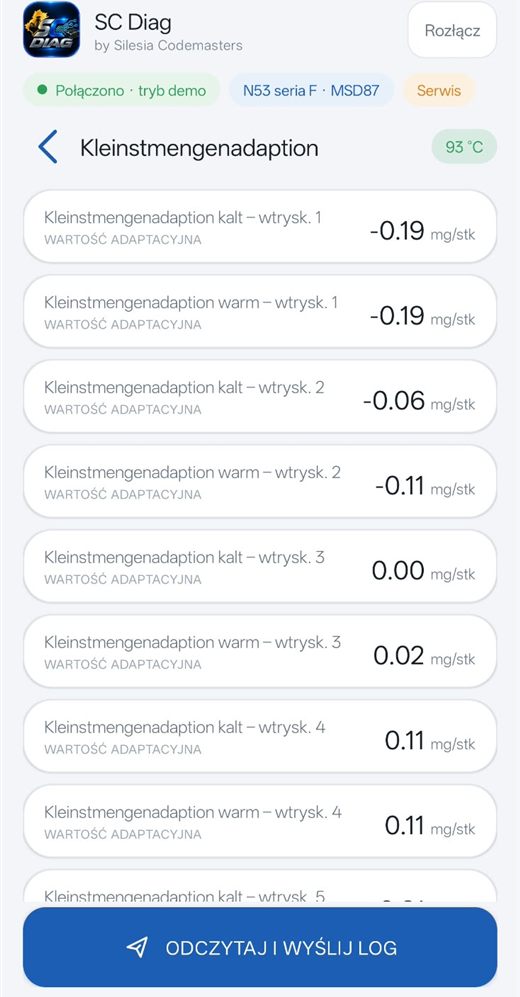
Small-quantity adaptations: a cold and a warm row for each injector. Demo mode, simulated data.
The parameter name is in German in this version, and the screenshot comes from another demo session (an N53 of the F series), so we do not link its numbers to cylinder 2 from the previous screen.
You compare the injectors with one another, not with a number from the internet. There are three questions: does one stand out, do the cold and warm values tell the same story, and does the result come back in a second reading. We give no thresholds, because they depend on the engine, the control unit and the temperature.
You take the second reading on a warm engine. A cylinder that stands out only in the morning can fall back in line once warm, and the other way round. One reading on a warmed-up engine therefore does not close the matter, and the difference between the cold and the warm row is often more telling than the value itself.
Where the rest of the injector data is
In the Windows program the tabs sit side by side: Rough run, Injectors, Injector adaptations, Stratified adaptations and Injector coding. Injectors covers the injection time, the control duty, the charge and voltage of the piezo injector and the CILC correction. The stratified adaptations concern stratified operation at idle, and the coding is the data stored in the control unit. The range depends on what the particular control unit supplies.
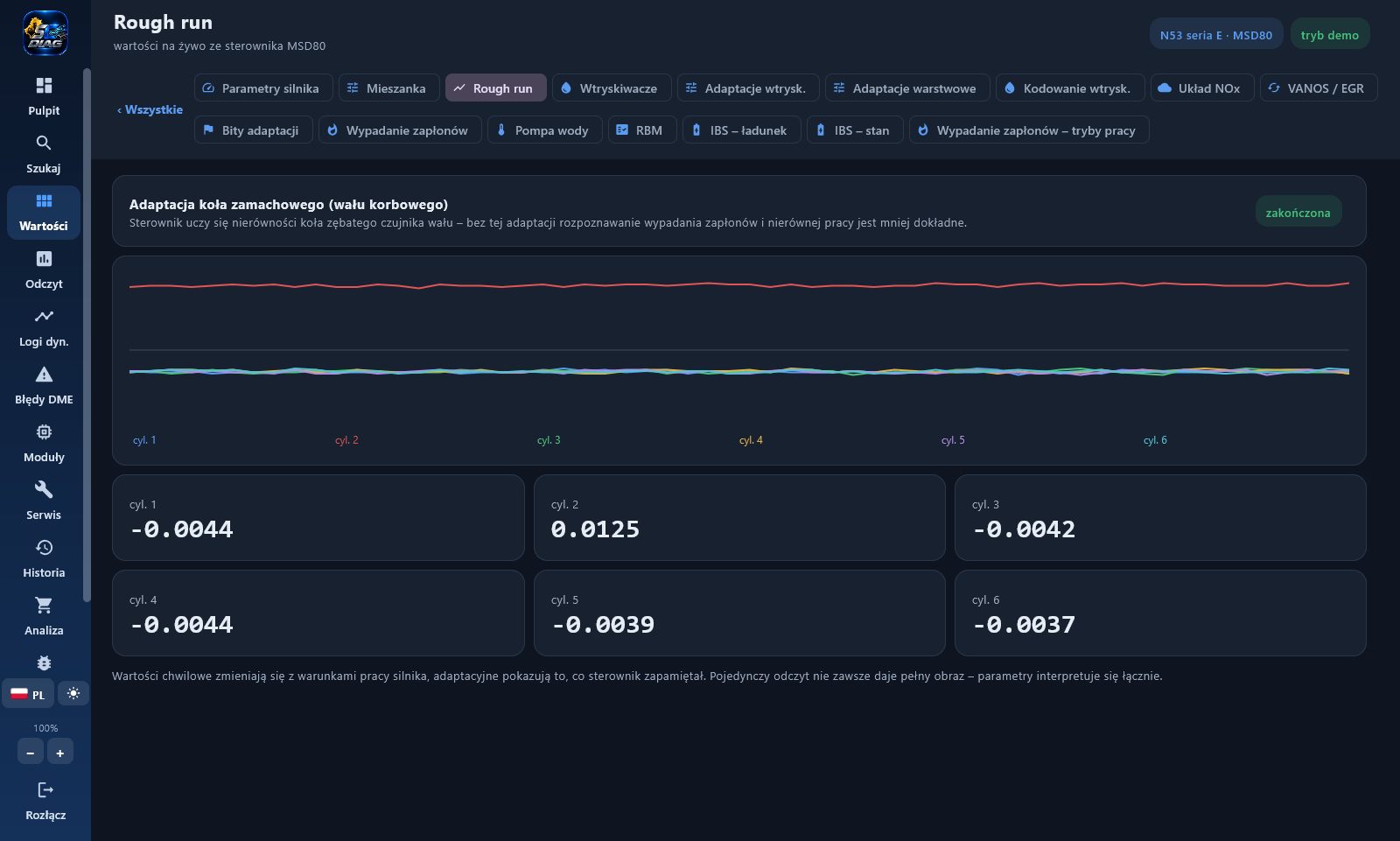
The injector tabs next to rough run in SC Diag for Windows. Demo mode, simulated data.
What else you check in the same reading
An injector does not work in a vacuum. The Mixture screen shows the corrections for both banks. If all the values are shifted, not just one cylinder, we look for a common cause instead: fuel pressure, the intake or the lambda sensors (sensors and mixture on the N53). Errors with a freeze frame show the conditions in which the control unit stored an entry: engine speed, load, coolant temperature. We clear nothing in the process, because the freeze frame is part of the evidence.
What these screens cannot settle
Cylinder 2 stands out. Why? A spark plug, a coil, compression and fuel pressure give a similar picture, and the reading will not separate them. According to descriptions online, a blocked stratified mode can also produce corrections that look like faulty injectors, so we check the NOx system before buying an injector. The descriptions differ, so we treat this as a lead, not a rule.
A note on numbering: cylinder 2 in the app is sometimes counted differently from a repair description. Before you unscrew anything, confirm the cylinder a second way, for example by swapping coils.
What next after such a reading
- Misfire counters: does cylinder 2 collect them live as well (misfires in SC Diag).
- Swap coils or spark plugs between cylinders and watch whether the fault follows them (coils, spark plugs).
- Fuel pressure on the move, low and high (fuel pressure, high-pressure pump in SC Diag).
- NOx system and operating mode.
- Only then the injector. When buying, watch out for counterfeits.
After the repair you take a second reading and put it next to the first. Readings stay in the history on the device.
How we can help
You can take the first step yourself in SC Diag, on Android or Windows (features, Windows version). These are separate licences: €9.99 for 30 days, €29.99 for a year, €69.99 for 2 years (with the Service option). The N53 has the fullest range, and a reading narrows down the checks and does not replace an inspection in the workshop.
The second path is N53 diagnostics with us: in Silesia, on site or remotely. We agree the scope by phone, 570 341 744. When you order a diagnostic, one-off access to the app is free of charge.
If the result is unclear, you can send us the reading as an encrypted log for analysis. You decide whether it is sent, and the PDF report arrives by e-mail (log analysis). This is a separate diagnostic service.
Frequently asked questions
Injection time, corrections and small-quantity adaptations for a cold and a warm engine separately, the piezo injector voltage and the stored coding, to the extent the control unit supplies them. Alongside are rough run and the misfire counters.
It will show the cylinder that stands out, but not the cause. A coil, a spark plug, compression and the fuel supply give the same picture, so the reading narrows the checks and does not make a diagnosis.
No. It is demo mode with simulated data, and the sequence described is a scenario for learning to read the screens, not an account of a repair.
We do not give a single number. We compare the injectors with one another, the cold value with the warm one, and check repeatability across readings.
No. You can take readings on a phone with an ELM327 adapter. The Windows program is a separate licence for those who prefer a big screen.
N53 injectors to check?
A reading in SC Diag will show the cylinders side by side, on a cold and a warm engine, before you buy a part.
Order SC Diag