The N43 has four cylinders, so a reading shows four injectors. The screenshot shows the first four on the adaptations list, each with two values, cold and warm. It comes from demo mode with an N53 engine (simulated data). On the N43 the screens are the same, there are four cylinders, and the set of values depends on the control unit.
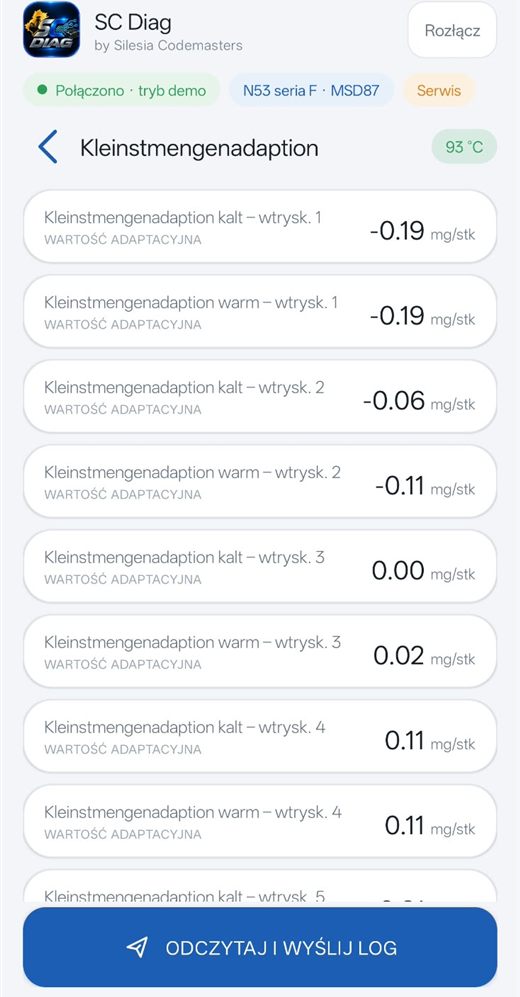
Small-quantity adaptations: the first four injectors on the list, a cold and a warm row. Demo mode with an N53 engine, simulated data.
This article walks you through the screens; it does not describe a real repair. The sequence below is a scenario on demo data. The substance of N43 corrections is taken apart in the guide to N43 injector corrections, and the general principle is covered in the article on corrections in petrol BMWs. Here we go tap by tap.
The short answer: on the N43, SC Diag shows the injection time, corrections and adaptations of each injector, cold and warm, and next to them the mixture of both banks and rough run. The reading narrows the checks to a cylinder or a system. Injector, ignition or fuel supply is settled only by the checks that follow.
Step one: tell the app when the problem happens
After connecting, the app asks when the problem occurs. You have four answers: on a cold engine, on a warm one, always or hard to say, or no symptoms and just a check. It is not a formality. The choice sets the order and range of the measurements, and the log goes to analysis with the right context. For an N43 that coughs after a night, you choose cold, and take the warm reading later and compare the two.
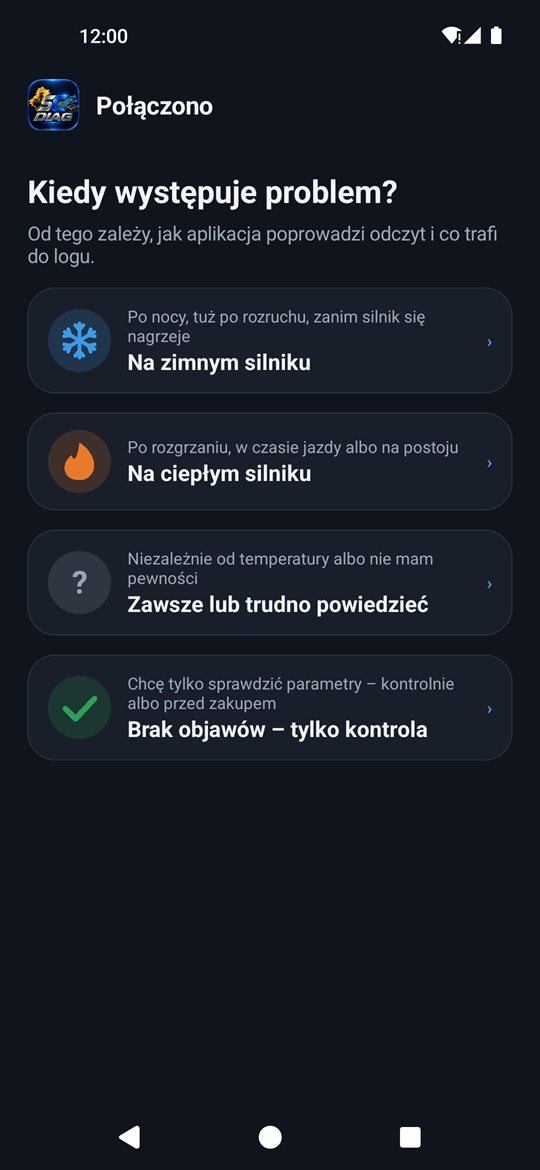
Choosing the symptom before the reading. Demo mode, simulated data.
A cold reading only makes sense on an engine that has stood for several hours. A car that has just been driven will not give you cold conditions, even if the coolant temperature has already dropped. If you arrive in the morning, take the reading before the first drive.
The engine has to be running, and the app will remind you not to touch the accelerator. For readings alone an ELM327 adapter is enough, and in older E-series cars a K+DCAN cable works better.
Step two: four injectors, eight values
In the small-quantity adaptations each injector has a “kalt” (cold) and a “warm” row, in mg/stk. In the screenshot at the top the first has −0.19 in both rows, the second −0.06 and −0.11, the third 0.00 and 0.02, the fourth 0.11 and 0.11. This is simulated data, not a benchmark. It only shows what to look at: whether the cold and warm rows agree and whether one injector is far from the others.
With four cylinders the comparison is simple: three injectors testify against one. A deviation only when cold and one only when warm point to different leads, described in the N43 guide. We give no thresholds, because they depend on the engine, the control unit and the temperature.
Besides the adaptations, the app's functions cover the injection time, the control duty, the piezo injector voltage and the CILC correction. What you see depends on the control unit, so the list will not be the same on every N43.
Step three: the mixture next to the injectors
An injector never works alone. The Mixture screen shows the lambda control integrators and the additive and multiplicative adaptations, separately for bank 1 and 2.
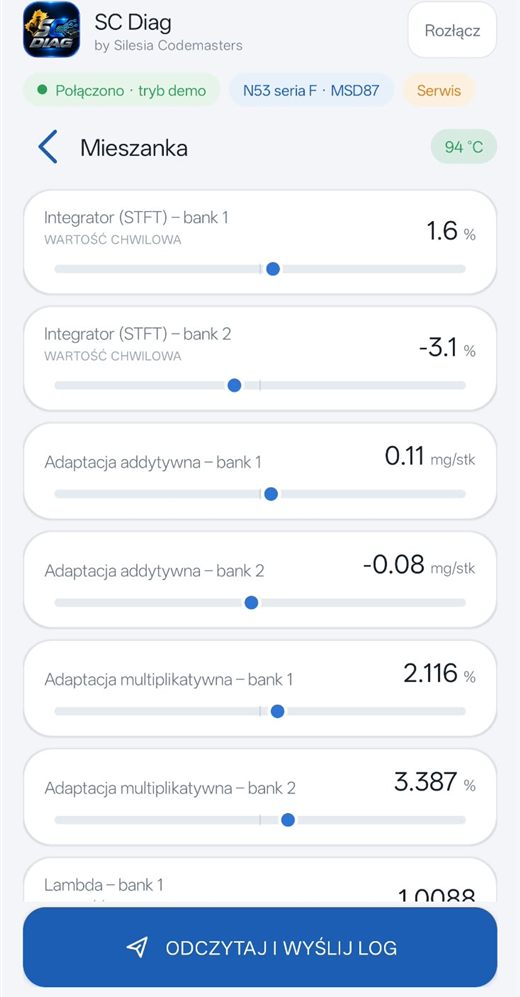
The Mixture screen: corrections of both banks. Demo mode, simulated data.
If all the injectors and both mixture values shift the same way, we suspect the intake, the fuel or the sensors rather than a single injector. When one cylinder stands out, we check it on the rough run graph and in the misfire counters (misfires in SC Diag).
Where it all sits in the Windows program
On the dashboard all these screens are tiles: Mixture, Rough run, Injectors, Injector adaptations, Stratified adaptations, Injector coding and Misfires. The dashboard also shows the engine operating mode, and on the N43 it is worth a glance, because stratified operation affects the reading (operating modes).
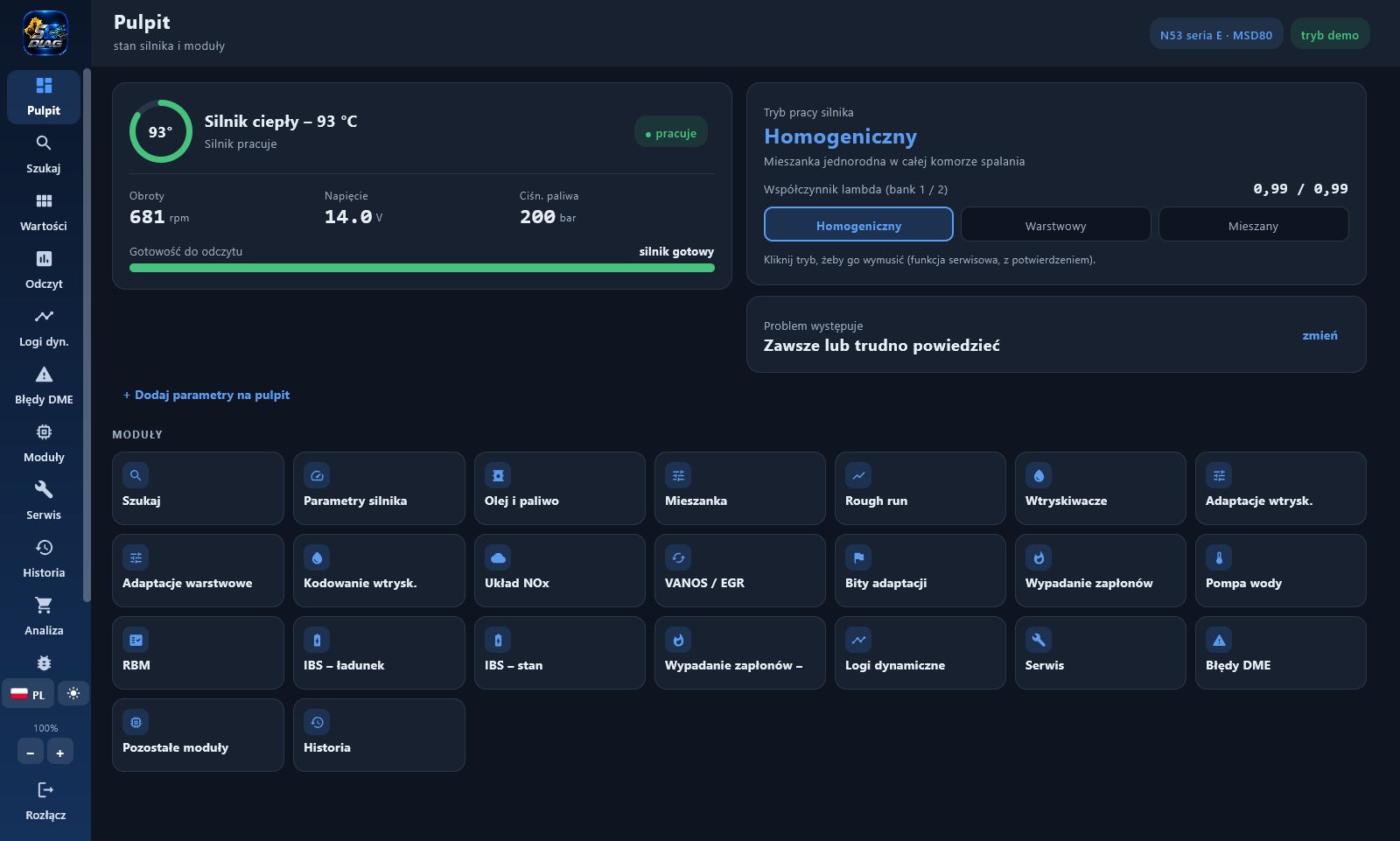
The dashboard in SC Diag on Windows with the screen tiles. Demo mode, simulated data.
Errors and the log at the end
At the end look at the errors. Each entry has a freeze frame with engine speed, load and temperature at the time of storage, so clear nothing before you have seen it (how to interpret errors). If the result is unclear, you can send us the reading as an encrypted log. You decide whether it is sent, and the PDF report arrives by e-mail (log analysis).
What to write down after the reading
- The cold and warm values of each cylinder, plus the date and mileage.
- What has changed in the car since last time: fuel, spark plugs, coils, injector.
- Which cylinder stands out and whether the same one returns in a second reading.
Readings stay in the history on the device. After the repair you take a second one and put it next to the first. If the deviation moved to another cylinder or shrank, something changed. If it stayed where it was, the part may not have been the cause.
What the app will not tell you
It will not tell you why a cylinder stands out. A coil, a spark plug, fuel pressure and an injector give the same picture, so after the reading we check them in order (fuel pressure, coils, spark plugs). The NOx system can also muddy the picture, because according to descriptions a blocked stratified mode stops the adaptations from learning (NOx sensor). The descriptions online differ. When buying an injector, watch out for counterfeits.
After a replacement, the data of the new injector has to be assigned to its cylinder. In SC Diag you see the stored coding as a reading. If the spread stays despite the new part, start by checking that the coding matches the cylinder, and only then look further.
How we can help
You can take the reading yourself in SC Diag, on Android or Windows. These are separate licences: €9.99 for 30 days, €29.99 for a year, €69.99 for 2 years (with the Service option). The N43 has the fullest range, and a reading does not replace an inspection in the workshop (all features).
The second path is N43 diagnostics with us: in Silesia, on site or remotely. We agree the scope by phone, 570 341 744. When you order a diagnostic, one-off access to the app is free of charge.
Frequently asked questions
Injection time, corrections and small-quantity adaptations for a cold and a warm engine separately, the piezo injector voltage and the stored coding, to the extent the control unit supplies them. Alongside are the mixture, rough run and the misfire counters.
No. It is demo mode with an N53 engine and simulated data. On the N43 the screens are the same, but there are four cylinders and the set of values depends on the control unit.
With the choice of symptom: cold engine, warm engine or always. Then the injector adaptations, the mixture and rough run, to set the cylinder against the rest.
Probably not. Such a shift more often points to the intake, the fuel or the sensors. A single outlying cylinder leads to the ignition, compression or the injector itself.
It narrows the checks, but a part is bought after checking the ignition and the fuel pressure. A reading does not replace an inspection in the workshop.
Four N43 injectors side by side
A reading in SC Diag will show them on a cold and a warm engine before you decide on a part.
Order SC Diag