The engine jerks, one cylinder misfires, someone says: "it's the injectors". And the injector is often the first part people buy, because it seems the obvious one. Replacing blindly costs twice: once for the part, and again for the time during which the fault stays exactly where it was.
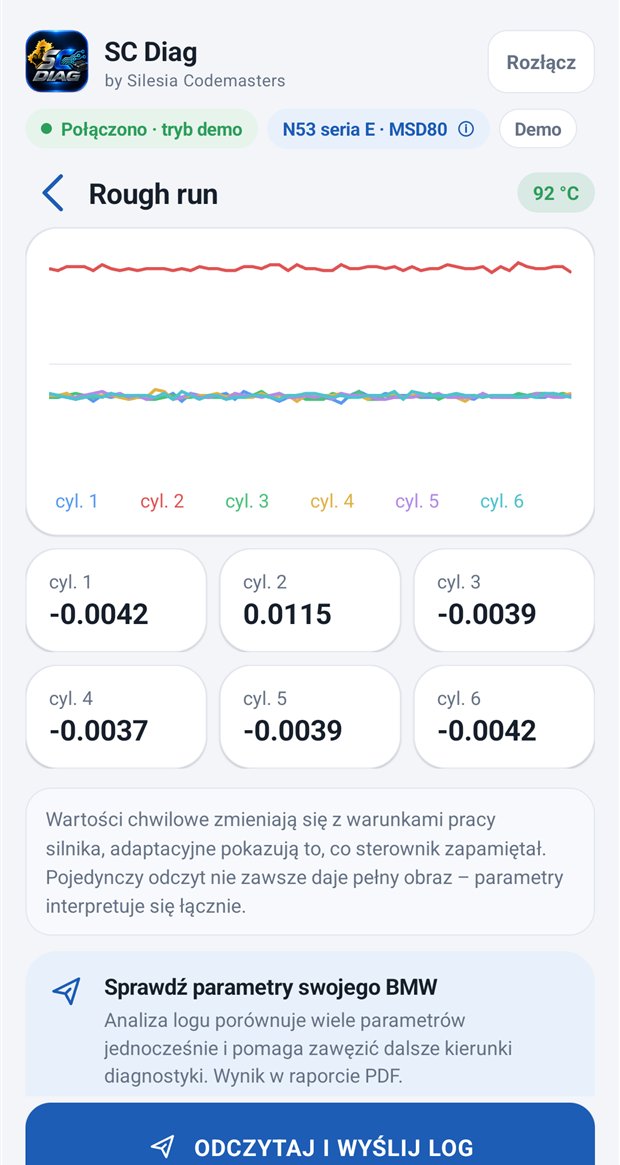
Rough run in SC Diag. Demo mode, simulated data, cylinder 2 stands out from the others.
A reading before replacement is not a ceremony. It is a step that usually narrows the suspicion from "something in the fuel" to one particular cylinder or one particular system. Below: what we check on the N43 and N53 and when replacing an injector actually makes sense. The example is a scenario on demo data, not an account of a repair.
The short answer: before replacing an injector, check three things: whether one cylinder stands out (trims, rough run), whether the misfire counters rise in the same place, and whether the fuel pressure is stable. Then swap coils or spark plugs between cylinders. If the fault stays with the cylinder and everything else is clean, the injector becomes a sensible suspect.
Three readings before you reach for the spanner
Injector trim. The control unit keeps separate corrections for each cylinder. A cylinder that clearly differs from the others is a lead, but only a lead: the same number appears when ignition or fuel supply is failing (how to read the trims). We give no thresholds, because they depend on the engine and the temperature. You compare the cylinder with the others and check whether the result returns in the next reading.
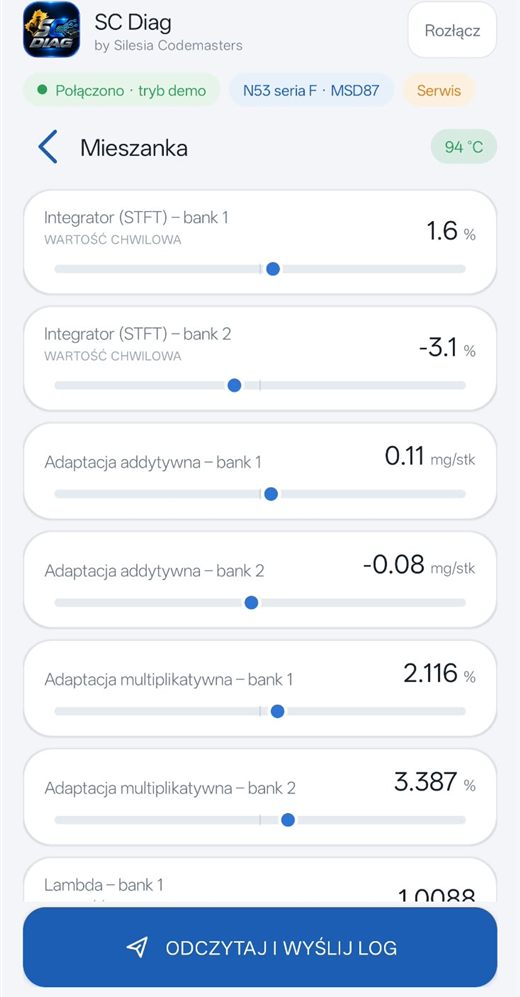
Mixture trims for both banks. Demo mode, simulated data.
Misfire counters and rough run. The counters since new show history, the live increase shows what is happening now. Rough run draws all the cylinders on one chart. Two screens pointing at the same cylinder are a stronger lead than one (misfires in SC Diag).
Fuel pressure. Our workshop criterion for the N43 and N53 is around 5000 hPa of low pressure, every reading within ±100 hPa, depending on the engine and the measuring conditions. You judge the rail pressure in a drive log, not at standstill (fuel pressure).
Scenario: cylinder 2 higher than the rest
In the demo data on the rough run chart, five lines lie close together and the line for cylinder 2 runs clearly higher. That is what an outlying cylinder looks like. The next step is the misfire counter: does the same cylinder collect misfires live as well?
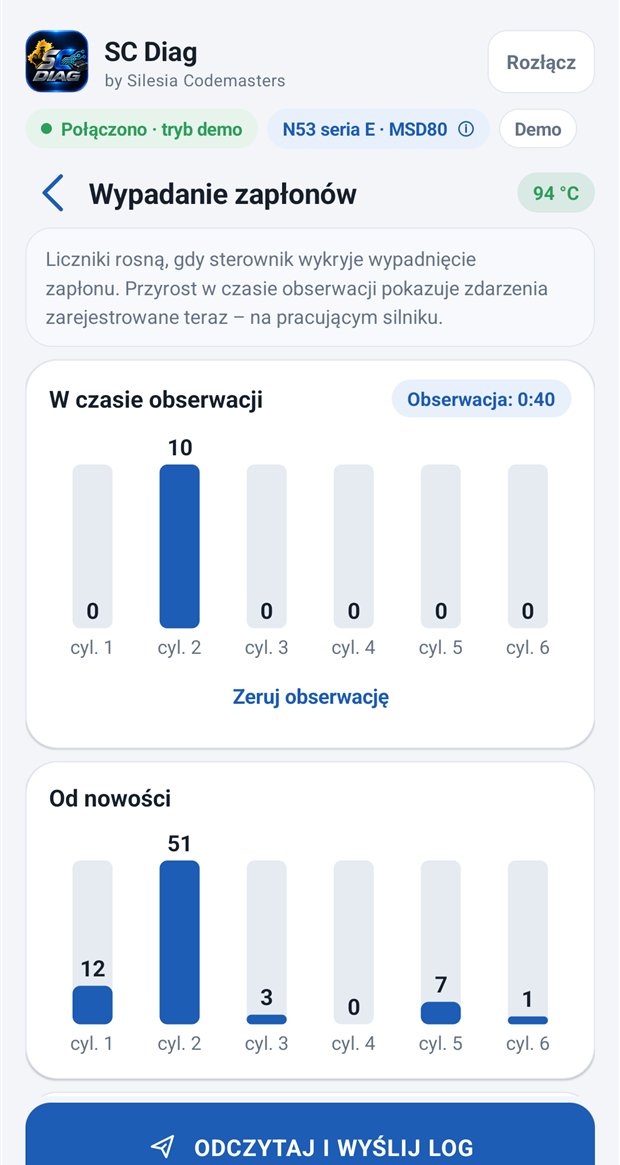
Misfire counters in demo data: cylinder 2 has the most, both during the observation and since new. Demo mode, simulated data.
In the scenario the counter since new and the increase during the observation both point to cylinder 2. That is a consistent picture, but still not an injector. The screenshots are simulated, so the numbers prove nothing. They show the order of the questions.
What looks like an injector but is not
- Coil or spark plug. Misfires change the lambda signal, and the control unit can "write them off" to an injector (coils, spark plugs).
- Fuel supply. Unstable low pressure or no rail pressure under load usually affects several cylinders at once (high-pressure pump: replace or not).
- Air and mixture. When the trims of a whole bank are shifted, not those of one cylinder, we suspect the intake, the sensors or a leak instead (sensors and mixture on the N53).
- NOx system and operating mode. According to descriptions online, a locked stratified mode can also produce trims that look like faulty injectors, but the descriptions differ (the NOx system step by step).
- Crankcase ventilation. A fault there causes uneven running that is easily mistaken for an injection problem (N53 crankcase ventilation).
The swap test: the cheapest step that gives an answer
Swap the coil and spark plug from the outlying cylinder with those of a neighbour and repeat the reading. In SC Diag the "Reset observation" button starts the measurement of the increase afresh. If the fault followed the coil or spark plug, the injector was not to blame. If it stayed with the cylinder, the suspicion on the injector grows.
A note on numbering: cylinder 2 in the app is sometimes counted differently from the repair description. Before you undo anything, confirm the cylinder a second way, for example with that very coil swap.
When replacing an injector makes sense
Direction only, not a verdict. Replacement becomes justified when all of these hold together:
- the same cylinder stands out in the trim, rough run and counters, over several readings,
- swapping coils and spark plugs did not move the fault,
- the low pressure is stable and there is no shift common to the bank's trims,
- the NOx system, the mixture and the crankcase ventilation do not explain the symptom.
When buying, check where the part comes from, because the aftermarket knows counterfeits. BMW's service instructions for the N53 require the new injector's data to be assigned to the cylinder after replacement, so that has to be planned too. After the repair, take a second reading in the same conditions and put it next to the first (readaptation).
What a reading will not settle
A cylinder stands out. Why, you cannot read from the numbers, because a spark plug, a coil, compression and fuel supply give a similar picture. The sign of a trim depends on how a given control unit defines it, and right after a repair or after adaptations are cleared the values are still learning, so we judge the first reading more cautiously. A reading narrows the checks, and an inspection in the workshop closes them.
How we can help
The first step you can take yourself. SC Diag runs on Android and on Windows (separate licences): from €9.99 for 30 days, €29.99 for a year, €69.99 for 2 years with the Service option. Demo mode shows the screens without a car. The N43 and N53 have the fullest coverage, and a reading narrows the checks and does not replace an inspection (features, SC Diag for Windows).
The second route is N53 diagnostics or N43 diagnostics with us, in the workshop in Silesia, we can come to you or work remotely. We agree the scope by phone: 570 341 744.
Frequently asked questions
First check whether that cylinder stands out in the trim, rough run and counters, then swap the coil and spark plug between cylinders. An injector is suspected when the fault stays with the cylinder.
It shows the cylinder that stands out, its trims, rough run and the misfire counters. It does not show the cause, because a coil, a spark plug, compression and fuel supply give the same picture.
We do not give a number. The range depends on the engine, the control unit and the temperature, and what counts is the deviation from the other cylinders and how repeatable it is.
BMW's service instructions for the N53 require the new injector's data to be assigned to the cylinder in the control unit. How that is done depends on the engine and the tool.
Because it shows whether the injector, the ignition or the fuel supply is to blame before you buy the part. A mistake costs the part and the time in which the symptom stays.
Injectors to check?
A reading in SC Diag shows the cylinders side by side and the fuel pressure before you buy the part. We arrange diagnostics with us by phone.
Order SC Diag