"It jerks when cold", "it cranks for a long time", "the warning light came on". That is how a conversation about the N43 and N53 usually starts, and the app has dozens of screens. This article pairs the symptom with the screen: what the driver says, where in SC Diag to look for a trace, and which article to read next.
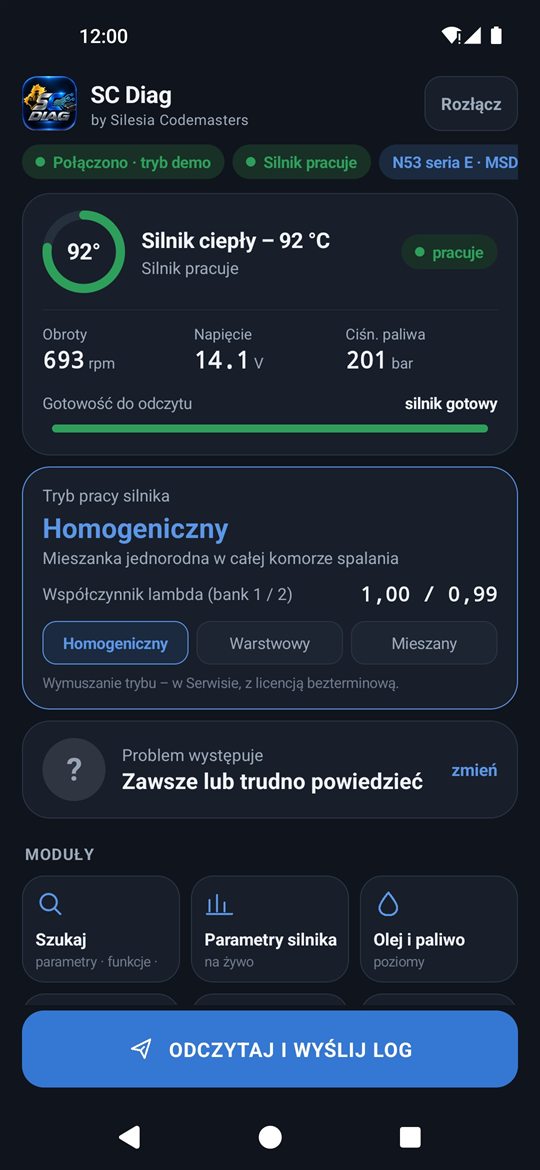
The SC Diag dashboard with the operating mode and the lambda of both banks. Demo mode, simulated data.
The examples are scenarios, not accounts of repairs. The screenshots come from demo mode and use simulated data, so the numbers on them prove nothing.
The short answer: first establish when the symptom occurs, on a cold or a warm engine. Then open the screen that fits the symptom: Rough run and the misfire counters for jerking, fuel pressure and a drive log for cranking and power loss, DME faults for the warning light, the operating mode and the mixture for fuel use. Each screen narrows down the checks, and none points to a part to replace.
One question before everything else
After connecting, the app asks when the problem occurs: on a cold engine, on a warm one, always or hard to say, and the fourth answer means no symptoms, just a check. This is not a formality. The answer decides how the app guides the reading and what goes into the log, and "only after a night" and "only after an hour's drive" lead in different directions.
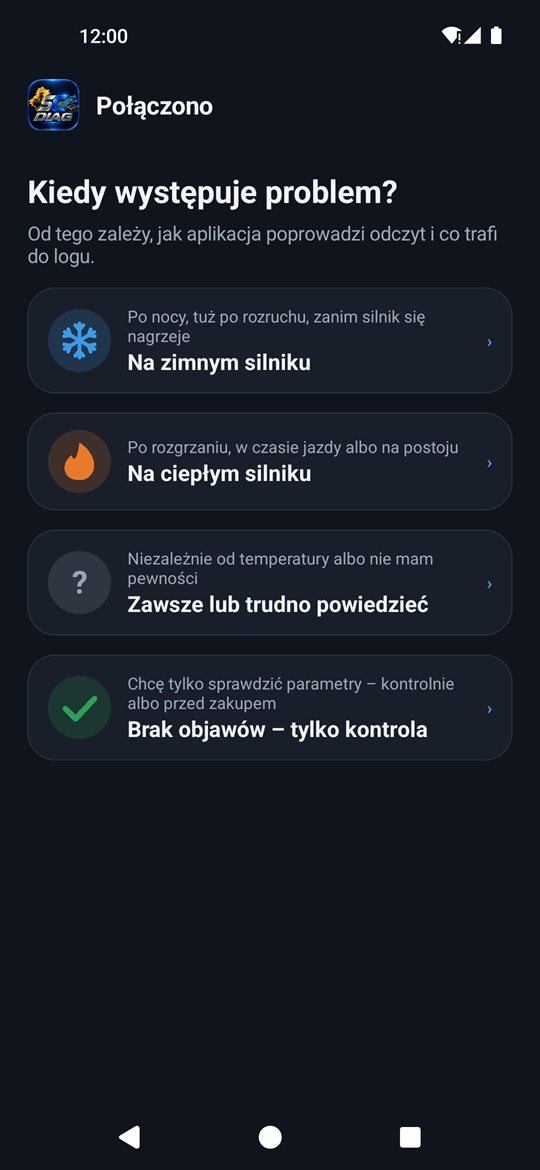
The symptom selection screen. Demo mode, simulated data.
Rough running and jerking
Rough run draws how each cylinder works on one chart. When one line stands out, you look at that cylinder, and when all of them drift apart, you look for a common cause. The Misfires screen adds the counters since new and the increase on a running engine. In the demo data cylinder 2 clearly stands out.
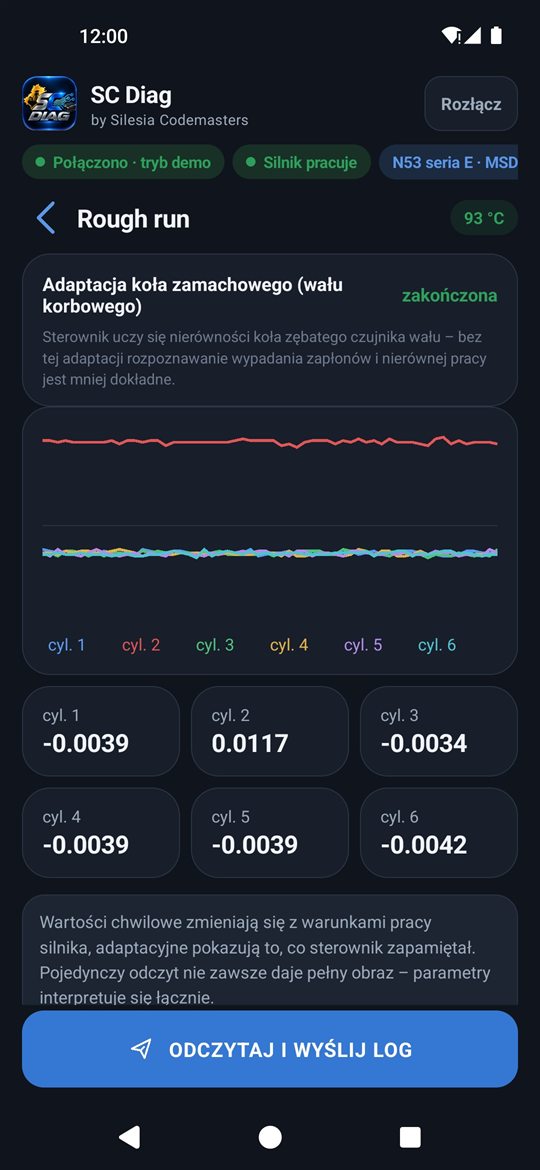
Rough run in SC Diag on Android: in the demo data cylinder 2 stands out. Demo mode, simulated data.
It is the quickest way to separate "one cylinder" from "the whole engine". When one stands out, swapping the coils around is a cheaper test than a new part, as we describe in the article on ignition coils. If the symptom is only there when cold, take a reading from the start and compare it with a warm one, and the order of checks is described in the article on jerking when cold.
Long cranking and loss of power
Both symptoms often point towards the fuel, but nothing follows from the symptom alone. A leaking injector also lengthens cranking. With long cranking, start from a cold-engine reading and from the low pressure in Engine parameters. With power loss, record a log from a drive: Dynamic logs have charts of engine speed, rail, lambda, VANOS, ignition, knock and several other quantities.
How to read the pressures is explained in the articles on the high-pressure pump and the low-pressure pump, and which parameters are worth recording in the article on logging while driving.
Engine warning light and limp mode
The warning light is a result, not a fault. In DME faults every entry has a status (current, stored or warning light) and a description in plain language, and a click opens the freeze frame with the conditions in which it was stored. We look for the causes of limp mode in the engine's entries and, when needed, in the other modules: the map shows them in colours, from "no entries" to "current fault".
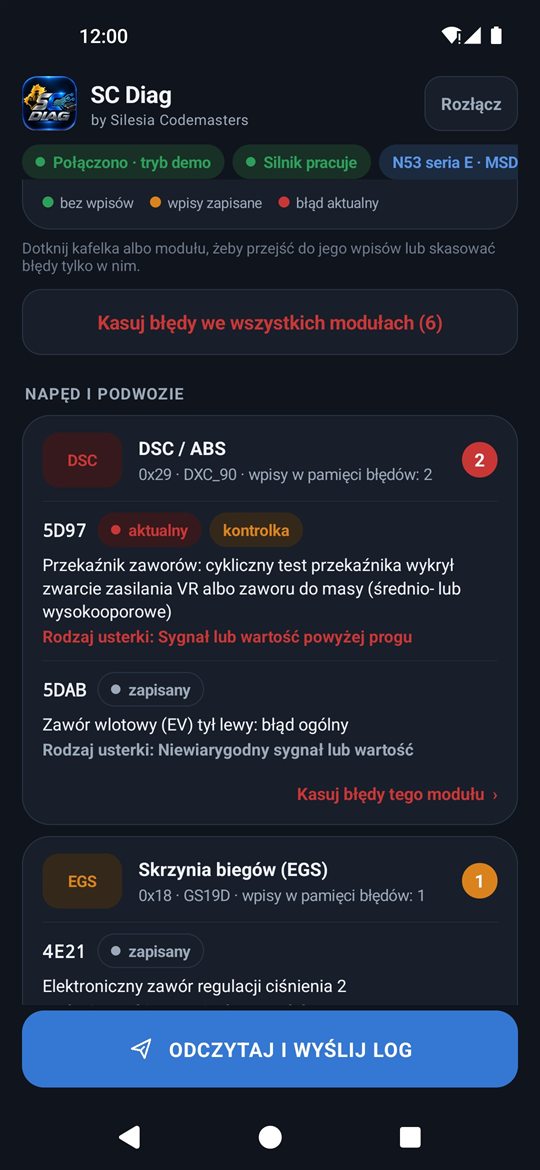
The map of the other modules with status colours and entries described in plain language. Demo mode, simulated data.
We do not clear faults before the measurements are finished, because the freeze frame disappears with the entry. Clearing makes sense only after the repair. More in the article on interpreting fault codes.
Higher fuel use
The dashboard shows the engine operating mode (homogeneous, stratified, mixed) and the lambda of both banks. When the engine has run purely in homogeneous mode for a long time and fuel use is rising, look at the Mixture screen and at the NOx system. Mixture shows the control integrators (STFT) and the additive and multiplicative adaptations separately for bank 1 and 2, so you can see whether the control unit adds fuel on one side of the engine or on both. The direction of the checks is described in the articles on operating modes, on stratified mode after a repair and on the NOx sensor. Switching off or bypassing emission systems is not a service we offer (terms and conditions, §3 para. 3).
Map: symptom, screen, article
- Rough running when cold: a "cold engine" reading, Rough run. Read: jerking when cold.
- Jerking, misfires: Rough run, Misfires. Read: rough run and misfire counters.
- Long cranking: a cold-engine reading, Engine parameters. Read: fuel pressure.
- Power loss: Dynamic logs. Read: HPFP and LPFP.
- Engine warning light: DME faults with the freeze frame. Read: BMW fault codes.
- Limp mode: DME faults and the other modules. Read: interpreting fault codes.
- Higher fuel use: the dashboard with the operating mode, Mixture, NOx system. Read: operating modes.
What a reading will not replace
None of these screens settles anything on its own. They point to a probable direction, and inspection and measurements in the workshop give the answer. Compression, intake leaks and the condition of the mechanics cannot be judged from a reading. A flashing engine warning light means misfires, so do not carry on with test drives.
SC Diag shows what the control unit supplies. The N43 and N53 are covered most fully, and on other engines the scope depends on the control unit's data. Start with the N53 guide or the N43 guide.
How we can help
You can take the reading yourself. SC Diag runs on Android and on Windows (separate licences): from €9.99 for 30 days, €29.99 for a year, €69.99 for 2 years with the Service option. Demo mode shows the screens without a car, and you can send the log for analysis. An overview of the functions is on the app features page, and the laptop version on the SC Diag for Windows page.
The second path is diagnostics with us: N53, N43, in the workshop in Silesia, with a call-out or remotely. We agree the scope by phone: 570 341 744.
Frequently asked questions
With the answer to when it happens, and then with the Rough run screen and the misfire counters. They show whether one cylinder stands out or the whole engine.
DME faults. Every entry has a status and a description in plain language, and a click opens the freeze frame with the conditions in which it was stored. The entry points to a trail, not to a part to replace.
It narrows down the search: it shows entries in the engine and in other modules together with the conditions in which they were stored. The cause is confirmed only by a check in the workshop.
No. A similar symptom comes from a leaking injector, the pump's supply or a pressure sensor. That is why we look at low pressure, high pressure and how the cylinders run together.
Not always. A fault that shows only after a night may not appear on a warm engine, so with such a symptom we take a reading cold and warm and compare them.
Start with a reading
SC Diag will show which screen fits the symptom of your N43 or N53 before you buy a part. We agree the scope of diagnostics at our workshop by phone.
Order SC Diag