"The fuel pump needs replacing" is heard about the N53 as often as "it must be the injectors". Yet the low-pressure circuit can be judged earlier and more cheaply than the pump on the engine. This article shows where SC Diag keeps the low pressure, how to read it and what follows from it.
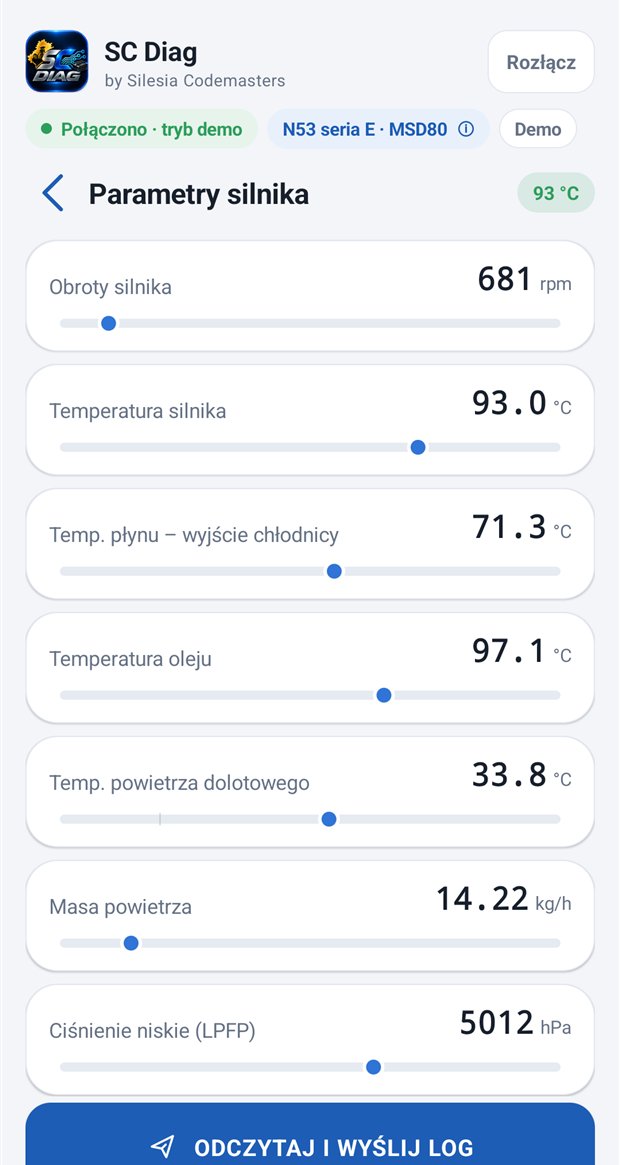
The Engine parameters screen with the "Low pressure (LPFP)" item. Demo mode, simulated data, the number is not a benchmark.
We rely on an example. It is a scenario, not an account of a real repair: an N53 that loses power under higher load and cranks for longer after a night. The screenshots come from demo mode with simulated data. We have no screenshot with an abnormal low pressure, so we only show where the value sits in the app and how it is judged.
The short answer: in our workshop criteria for the N43 and N53, low pressure is about 5000 hPa, and every reading should stay within ±100 hPa. SC Diag shows it on the Engine parameters screen and on a chart in the drive log. A wider spread means an unstable circuit, but it does not say whether the pump, the filter or the supply is to blame.
Two pumps, one order of checks
The low-pressure pump sits in the tank and feeds the high-pressure pump on the engine. Only the second one builds the pressure in the rail. That is why we start with the low-pressure circuit: when it is unstable, judging the high-pressure pump makes no sense.
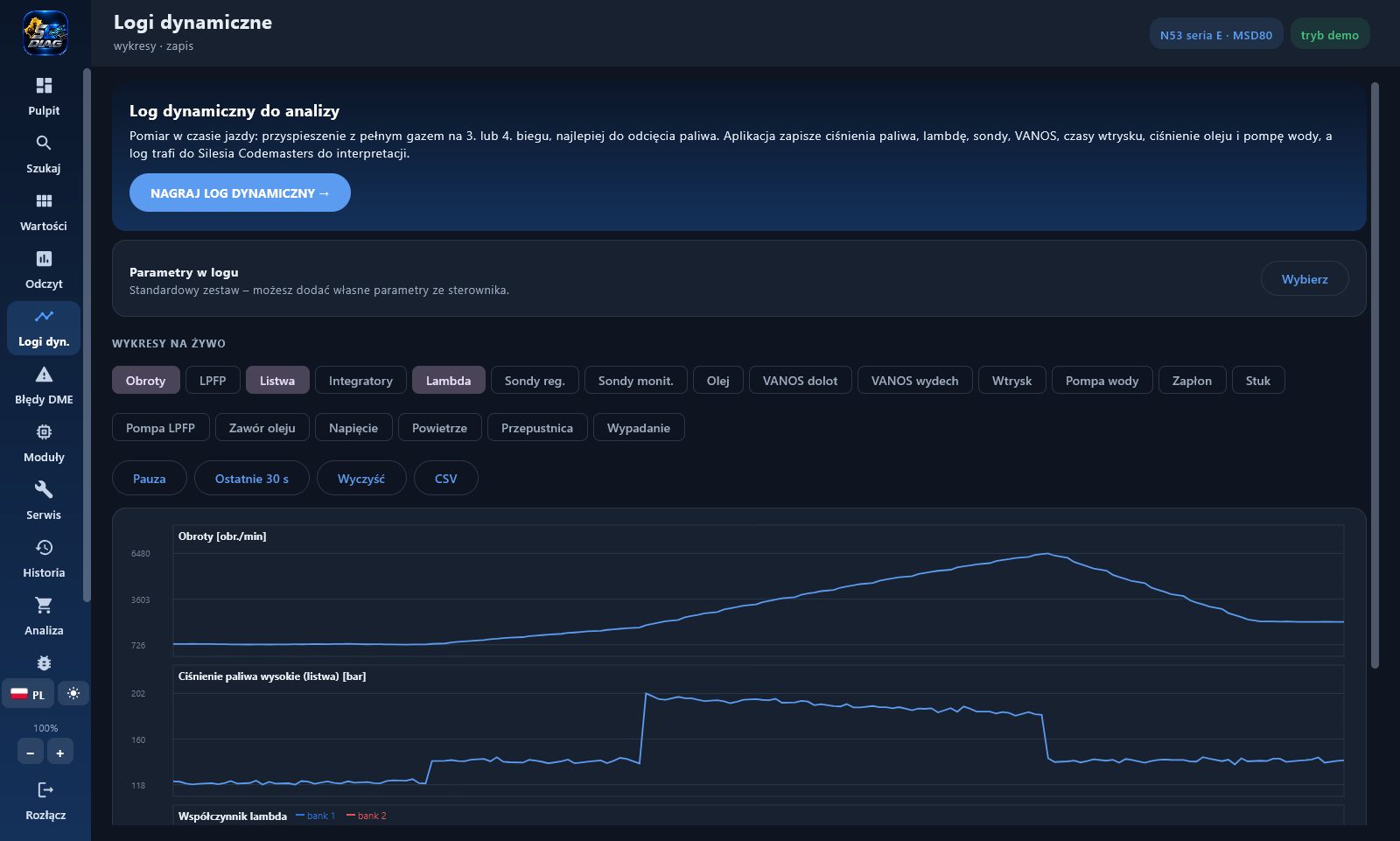
Dynamic logs in SC Diag on Windows, with the LPFP and LPFP pump buttons. Demo mode, simulated data.
The symptoms can look alike but they are spread differently. With the low-pressure pump, a loss of power at higher load, harder starting after a long stand and a buzzing near the tank are described. With the high-pressure one, more often rough running under load and a hard cold start. None of these symptoms is proof. Only the numbers tell them apart.
On a cold start the control unit enriches the mixture, so a weakness in the fuel system shows up exactly then. That is why, with such a symptom, we take a reading from the very start and not only on a warm engine.
Where the low pressure sits in the app
Three places. The first is the Engine parameters screen, with the "Low pressure (LPFP)" item in hPa, as in the photo. The second is Dynamic logs: the LPFP and Rail buttons switch on charts of low and high pressure over time. Next to them is a separate LPFP pump button. The app also gives the fuel pump control, so the pressure can be set against how the control unit drove the pump.
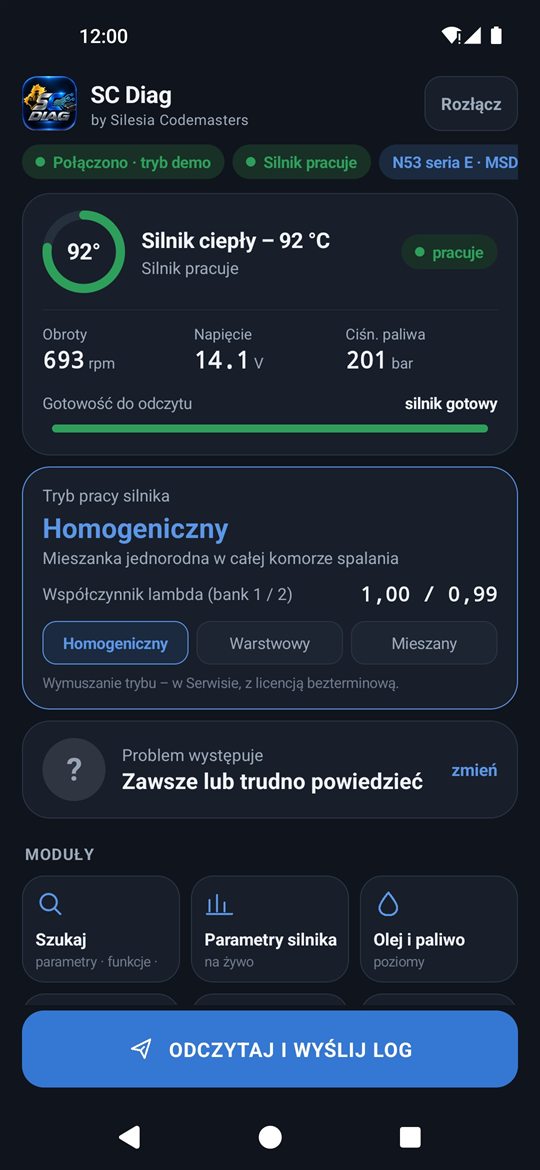
The dashboard with the "Fuel pressure" tile: one number, in bar in the demo. Demo mode, simulated data.
The third place is the "Fuel pressure" tile on the dashboard, but that is a single number. In the demo it has a different unit from the low pressure, so it is not the same quantity. To judge the low-pressure circuit we take the value from Parameters or from the chart.
How to read the number so you are not misled
Our criterion for the N43 and N53 is about 5000 hPa, that is about 5 bar, and every single reading within ±100 hPa. It is a workshop criterion, depending on the engine and the measuring conditions, not a manufacturer's value. For other engines it has to be established separately.
Two things mislead most often. First, you judge every reading, not the average. An average can look fine despite a few jumps, and the circuit is unstable all the same. Second, right after a cold start the pressure can briefly jump higher, so we ignore the first seconds. Stability after those seconds says more than a peak at the start.
An example: power drops under load
Back to our N53. We take three steps.
- A "cold engine" reading from the start, and then the same on a warm engine. We look at whether the low pressure holds steady after the first seconds, and whether it behaves differently when warm.
- A log from a drive with the LPFP and Rail charts switched on. The log screen describes the run: acceleration at full throttle in 3rd or 4th gear. Do it only where it is legal and safe.
- A comparison of the two charts. If the low pressure jumps before the high pressure starts to collapse, the trail lies on the supply side. If the low pressure is steady and the high one drops, we move on to the pump on the engine and to the cylinders, as in the article on piezo injectors.
It is worth saving the whole log to a file or sending it for analysis. One drive is a snippet, several in similar conditions are already a picture.
After a repair you repeat the same test in the same conditions and compare it with the log from before. After a part has been replaced, a readaptation is sometimes needed, and the log shows whether the values have returned to normal.
What the screen will not show
A number from a sensor does not say why the pressure jumps. The same picture comes from the fuel filter, the pump's supply (the control module and the wiring fail more often than people assume), the pump itself, air in the circuit and a faulty sensor. The reading narrows down the checks. Measuring the pump's supply and inspecting it are done in the workshop.
We also do not give part prices or repair times, because they depend on the car and on what is really failing. We write about the logic of the whole fuel system in the article on fuel pressure on the N43 and N53 and on the HPFP and LPFP.
How we can help
You can take the reading yourself. SC Diag runs on Android and on Windows (separate licences): from €9.99 for 30 days, €29.99 for a year, €69.99 for 2 years with the Service option. In demo mode you can look at the screens without a car. The N43 and N53 are covered most fully, and on other engines the scope depends on the control unit's data (list of control units).
The second path is N53 diagnostics with us: in the workshop in Silesia, with a call-out or remotely. We agree the scope by phone: 570 341 744.
Frequently asked questions
In our workshop criteria, about 5000 hPa, with every reading within ±100 hPa. The value depends on the engine and the measuring conditions and does not come from the manufacturer.
On the Engine parameters screen as "Low pressure (LPFP)" and on the LPFP chart in Dynamic logs. The scope depends on the data the control unit supplies.
Not necessarily. Right after a cold start the pressure can briefly jump, which is why we ignore the first seconds and judge the stability after them.
No. The same picture comes from the filter, the pump's supply, the wiring, air in the circuit and the sensor. The reading points to a direction, and the decision is made after a check in the workshop.
Usually not. Supply faults show up under load, so you need a log from a drive, ideally several runs in similar conditions.
Check the low pressure on your N53
In SC Diag you will see it in the parameters and on the drive chart before you buy a pump. We agree the scope of diagnostics at our workshop by phone.
Order SC Diag