The engine runs unevenly after a night, uses more fuel than a year ago, and the control unit shows a code that tells you little. “N43 problems” is typed by people who want to know what usually fails and whether it can be detected before they buy a part.
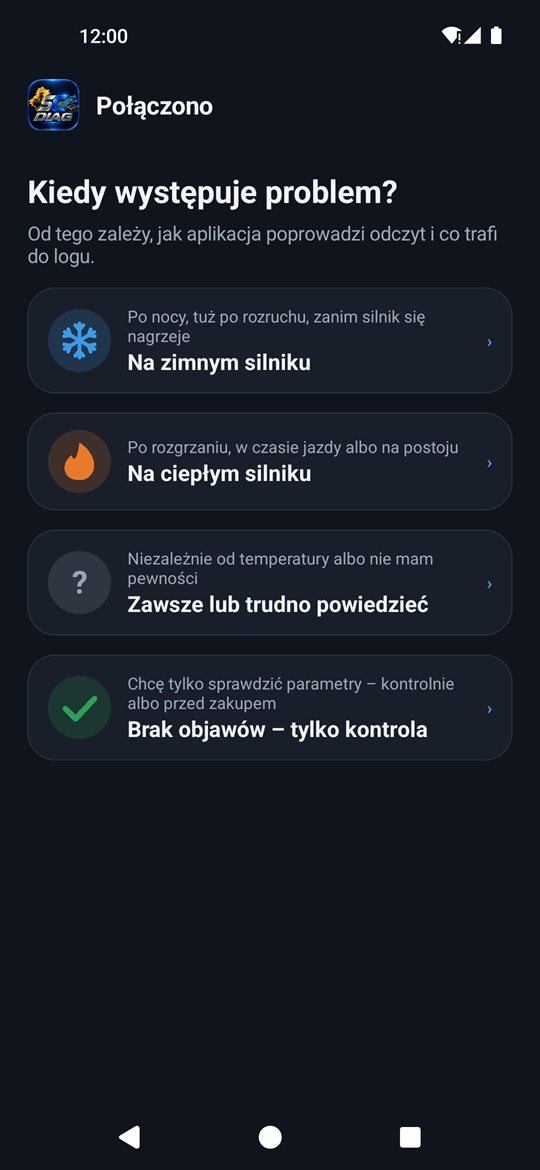
A reading starts with the question of when the problem occurs. Demo mode, simulated data.
The N43 is a four-cylinder petrol engine with direct injection, piezo injectors and a stratified mode, with an MSD80 or MSD81 control unit. You will not find failure statistics here, because we have no reliable data. What you get is an overview of the areas we return to most often in the workshop, with the emphasis on what shows in a reading before a part is replaced.
The screenshots come from demo mode with an N53 engine, and the situations described are scenarios, not accounts of repairs. The layout of the screens on the N43 is similar, the graph covers four cylinders, and the range of values depends on the control unit.
The short answer: on the N43 people most often check ignition and the piezo injectors, fuel pressure, the NOx system that blocks stratified mode, the intake with crankcase ventilation, and VANOS and oil. A lot of this shows in a reading before any part is replaced: in the misfire counters, corrections, pressures and fault codes with freeze frames.
Why N43 symptoms are so easy to confuse
Stratified mode is a very lean mixture concentrated around the spark plug. It works only when ignition, fuel, sensors and temperature all agree at once. When one element is off, the control unit returns to homogeneous mode: the engine runs, but uses more fuel and runs less smoothly. “It will not enter stratified mode” is therefore a symptom, not a diagnosis (operating modes).
Ignition: spark plugs and coils
The misfire counters in SC Diag show the history since new and the live increase, while rough run shows the unevenness of each cylinder. When both point to the same cylinder, we start with the spark plug and coil, swapping them between cylinders. A flashing engine warning light means unburnt fuel is reaching the catalytic converter, and then we do not carry on with a test drive. Lifetime counters can be misleadingly high, so on their own they do not justify buying parts (misfires in SC Diag, coils, spark plugs).
Piezo injectors: four cylinders, eight values
The small-quantity adaptations give each injector a cold and a warm row. With four cylinders the comparison is simple: three injectors testify against one. You look at whether one stands out, whether the cold and warm rows say the same thing and whether the result returns in a second reading. We do not quote thresholds, because they depend on the engine, the control unit and the temperature. A cold reading only makes sense on an engine that has stood for several hours, and a second one, warm, shows whether the cylinder stands out all the time or only in the morning.
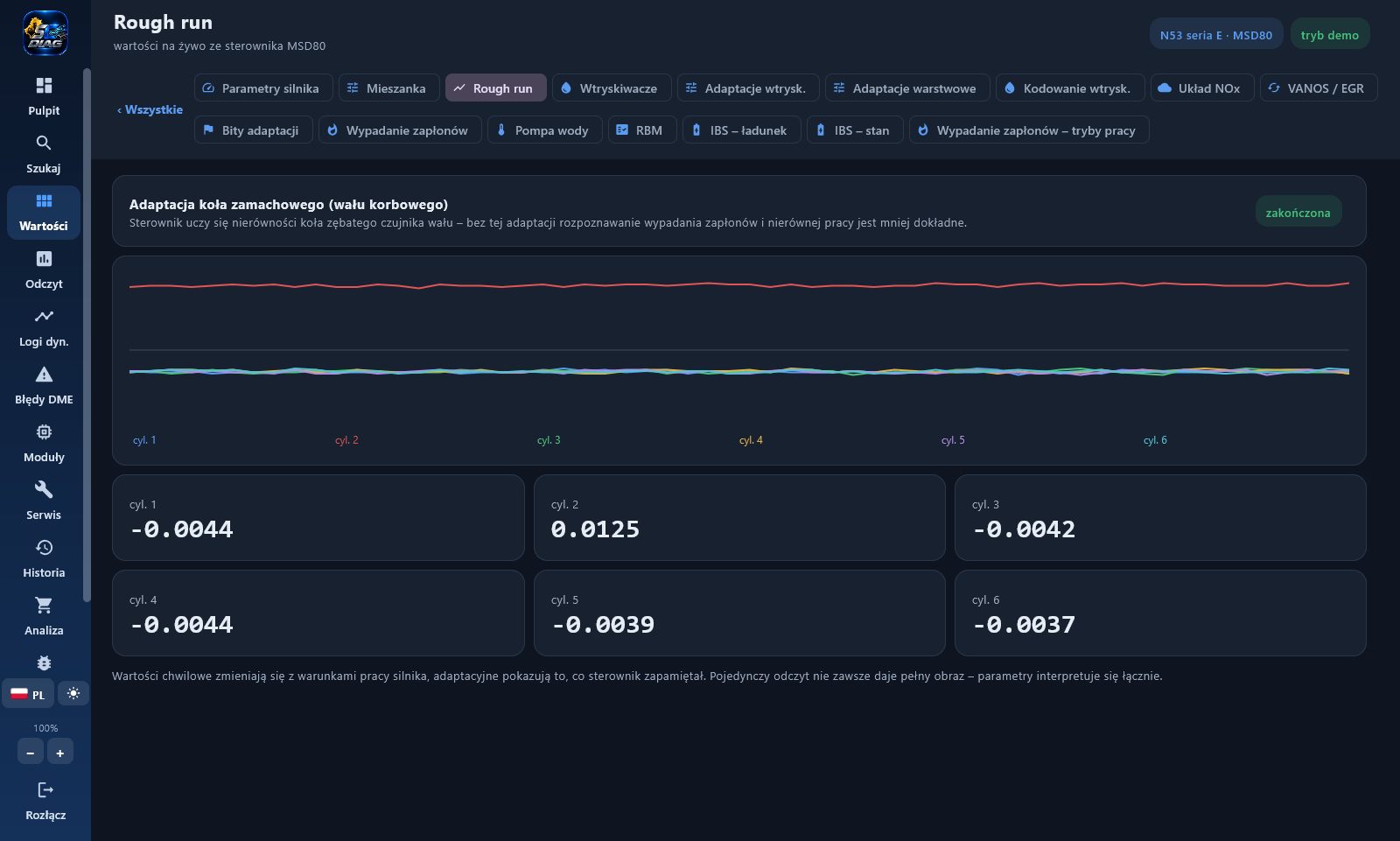
Injector tabs next to rough run in SC Diag on Windows (screenshot from a six-cylinder engine). Demo mode, simulated data.
The details are in the articles on injector corrections on the N43 and N43 injectors in SC Diag. Before you buy a set, check where it comes from (counterfeits).
Fuel pressure: low pressure first
A low rail pressure code only says the control unit is not reaching the target value. The same code comes from the high-pressure pump, a leaking injector, the filter and an air-locked low-pressure circuit. So we start with the low-pressure circuit, on the move, because at idle many faults are not visible. Our workshop criteria are about 5000 hPa with a spread of up to ±100 hPa, depending on the engine and measuring conditions (fuel pressure, HPFP and LPFP).
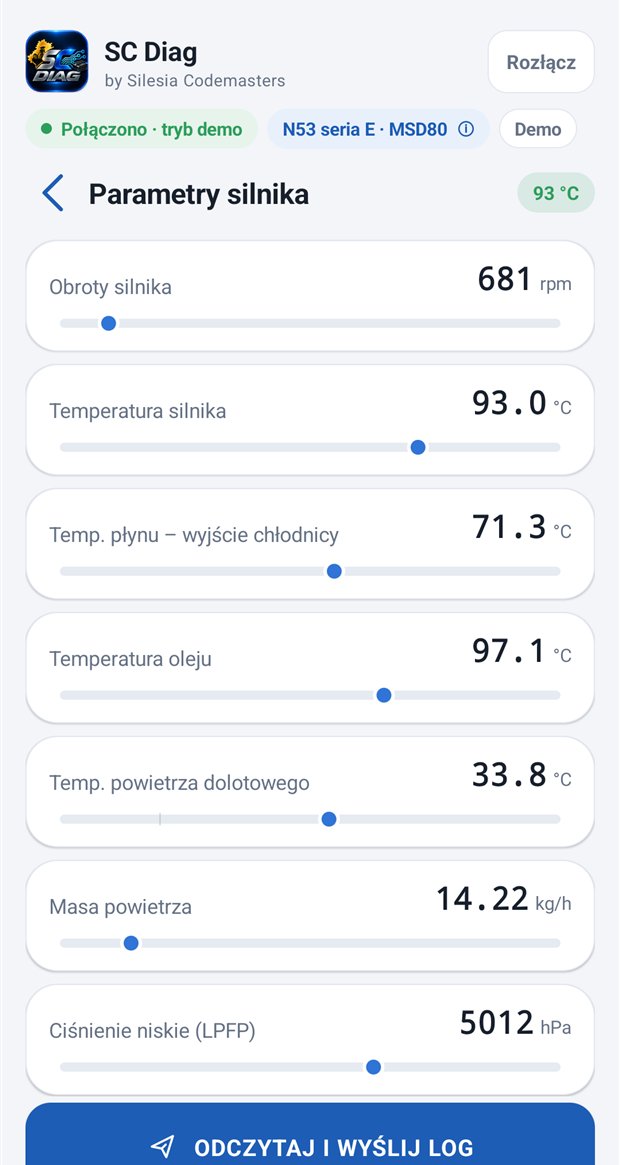
Engine parameters, including the low pressure (LPFP). Demo mode, simulated data.
NOx system and operating mode
Higher consumption with an evenly running engine often leads to the NOx sensor. The order is fixed: the sensor and its data, then lambda and leaks, the catalytic converter last. In SC Diag you look at the operating mode on the dashboard and at the NOx system tab (NOx sensor, stratified mode after a repair).
Intake, ventilation and deposits
The N43 guide lists the intake and ventilation among the main areas. Direct injection does not wash the intake valves, so deposits build up slowly: less power at low revs, uneven running, gradually higher consumption (deposits on the valves). We describe ventilation using the N53 as the example (crankcase). Tightness and vacuum are checked in the workshop, and a reading only sees the effect in the mixture corrections.
VANOS, oil and temperature
Rattling at a cold start, loss of torque in the mid range and a valve timing code point to the target and measured VANOS angle. An oil pressure message can be the sensor's fault or a real drop, and a mechanical gauge settles it. Stratified mode that appears and disappears also means a look at the operating temperature (VANOS, oil pressure, thermal management).
What a reading shows before you replace a part
- Fault codes with freeze frames: revs, load and temperature at the moment of storage (how to read them).
- Misfire counters and rough run: which cylinder, since when, whether it is growing.
- Injector adaptations and mixture: one cylinder or all of them.
- Fuel pressures: low before high.
- Operating mode and NOx sensor data on a warm engine.
After the repair take a second reading and put it next to the first. If the deviation has moved to another cylinder or shrunk, something has changed. If it stayed where it was, the part may not have been the cause. Readings stay in the history on the device.
A reading will not show compression, mechanical condition, deposits on the valves or the tightness of the ventilation. It narrows down the checks and does not replace an inspection in the workshop. When buying a car, this list is a checklist (pre-purchase check).
How we can help
You can do the first step yourself in SC Diag, on Android or Windows (Windows version). These are separate licences: €9.99 for 30 days, €29.99 for a year, €69.99 for 2 years (with the Service option). The N43 has the fullest coverage.
The second path is N43 diagnostics with us: in Silesia, on site or remotely. We agree the scope by phone, 570 341 744. When you order a diagnostic, one-off access to the app is free of charge.
Frequently asked questions
Most often people check ignition, the piezo injectors, fuel pressure, the NOx system, the intake with ventilation, and VANOS and oil. Which area is behind a symptom is established by a reading, not by the symptom alone.
We have no statistics, so we will not put forward such a claim. It is an engine in which many systems must work together at once, which is why a diagnosis based on data before replacing parts matters a great deal here.
The cylinder that stands out in the counters and rough run, a divergence in the injector adaptations, the state of the fuel pressures, the operating mode and the conditions in which faults were stored. It will not detect compression or deposits.
Often because the control unit does not allow stratified mode. The first step is the NOx sensor and its data, only then the catalytic converter.
No. It is demo mode with an N53 engine and simulated data, and the descriptions are scenarios.
N43 to check before replacing parts?
A reading in SC Diag shows what is going on before you buy a part. We agree the scope of a diagnosis with you by phone.
Order SC Diag