On the N43 you have four cylinders, so a reading shows four injectors and four sets of numbers. Three look alike, the fourth stands out. This is the moment when people most often ask whether to buy an injector. First you need to know what you are looking at.
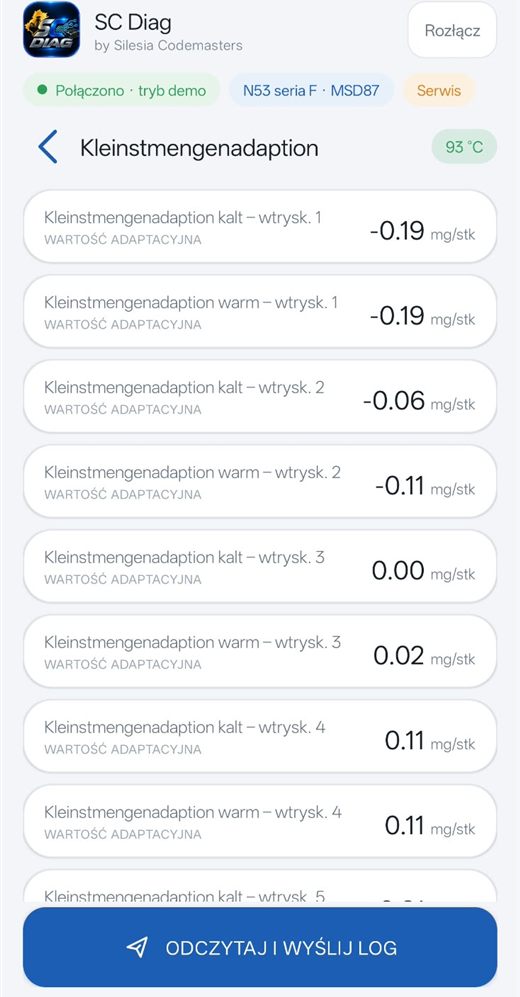
Small-quantity adaptations, separately for a cold and a warm engine. Demo mode, simulated data; the demo engine is an N53, and the set of values on the N43 depends on the control unit.
This article concerns the N43 specifically. A general description of why the control unit keeps corrections is in the article on injector corrections in petrol BMWs. Here we focus on how to read an N43 result and what to do with it. An index of the whole engine is in the N43 guide.
The short answer: we judge injector corrections on the N43 by comparing the cylinders with one another and a cold reading with a warm one, not by looking for one “good” number. An outlying cylinder is a reason for further checks: rough run, ignition, fuel pressure. Whether it is the injector comes from those checks, not from the correction alone.
What the control unit stores for each injector
The N43 has piezo injectors, fast and precise. With very short pulses, as needed at idle and in stratified mode, the differences between individual units are greatest. So the control unit corrects the quantity for each cylinder separately and keeps part of the corrections as adaptations.
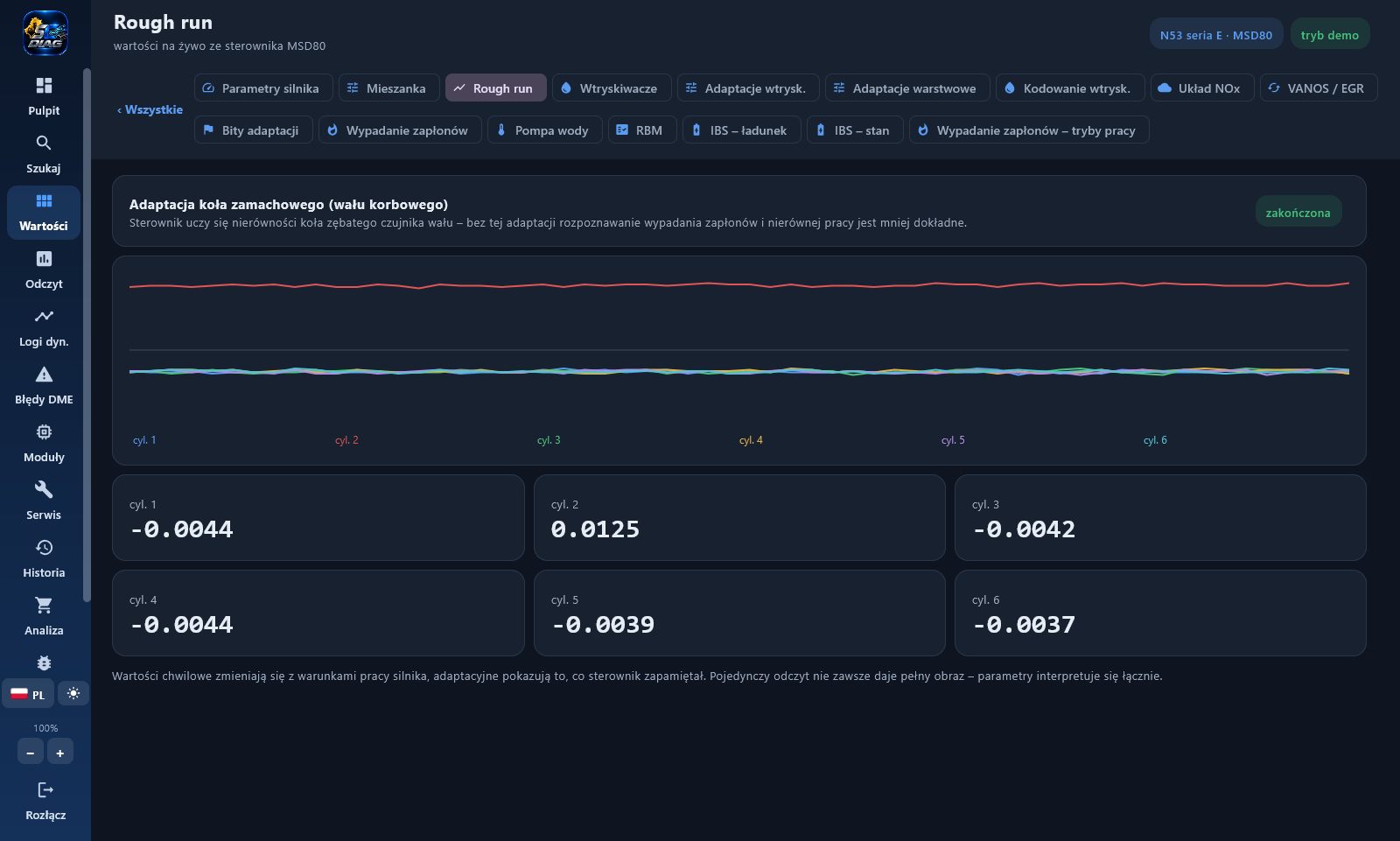
The injector tabs next to rough run in SC Diag for Windows. Demo mode, simulated data.
In SC Diag on the N43 you can read, for each cylinder, the injection time, the CILC correction, small-quantity adaptations (cold and warm separately), the piezo injector voltage and the coding stored in the control unit. Alongside are the mixture corrections of both banks, rough run and misfire counters. Not every control unit supplies everything, so you see what the particular car provides.
How to read the spread between four cylinders
We do not give “good, bad” thresholds here. The permissible range depends on the engine, the control unit version, the temperature and the operating mode, and numbers from forums are not manufacturer documentation. Three things count.
First, the deviation of one cylinder from the others. When four values lie close together and one is far off, that is a lead. When all of them are shifted the same way, we look rather at the mixture, the intake or the fuel, not at a single injector.
Second, repeatability. A reading that returns in later measurements with the same cylinder weighs more than a single result.
Third, the sign. Plus or minus depends on how a given control unit defines the correction, so the parameter description has to be read before drawing a conclusion. Cylinder numbering can also mislead; the details are in the article on injector corrections.
Cold and warm: two columns, one question
Small-quantity adaptations are stored separately for a cold and a warm engine. The difference between them says more than a single value. A cylinder that stands out only when cold makes you think of injector leakage or of starting. One that stands out when warm looks more like an ignition problem or a problem under load.
That is why in SC Diag the reading is guided on a cold and on a warm engine, rather than being a single measurement on a warmed-up one. How this works in practice is described in the article on judder when cold.
When the numbers mislead
Straight after a repair or after clearing adaptations, the values are still settling. We judge the first reading with caution and repeat it after a drive. After an injector is replaced, the data of the new unit has to be assigned to its cylinder in the control unit. If this is done wrongly, according to descriptions online, the adaptations may fail to settle and the spread remains although a part is new. This describes the principle, not instructions: the method depends on the tool, and in SC Diag you see the stored coding as a reading.
There is one more trap. According to service descriptions, the control unit carries out part of its injector assessment in stratified mode. If the NOx system blocks that mode, an injector problem may remain undetected. Descriptions online differ, so we treat this as a reason to check the operating modes and the NOx sensor as well.
How to record the result so that it has something to be compared with
One sheet of paper with four numbers gives little. It is worth noting the cold and warm reading, the date, the mileage and what has changed in the car since last time: refuelling, spark plugs, coils, an injector. In SC Diag the readings stay in the history on the device, so after a repair you take a second one and put it next to the first. If the deviation has moved to another cylinder or got smaller, that is an important clue, because you know the change did something. If it stayed exactly where it was, the part was not the cause or something was missed.
What we do with an outlying cylinder
- We put it next to rough run and the misfire counters.
- We check the fuel pressure. In our workshop criteria, low pressure holds at about 5000 hPa, each reading within ±100 hPa, depending on the engine and the measuring conditions.
- We swap coils or spark plugs and see whether the fault follows them (coils, spark plugs).
- Only then do we decide about the injector. When buying a new one we watch out for counterfeits.
A reading in SC Diag or a diagnostic with us
You can take the reading yourself in SC Diag on Android or Windows (separate licences): from €9.99 for 30 days, €29.99 for a year, €69.99 for 2 years with the Service option. The range depends on the data the control unit supplies, and a reading does not replace inspection in the workshop.
If you would rather we looked at it together with the engine, there is N43 diagnostics: in Silesia, on site or remotely. We agree the scope by phone, 570 341 744.
Frequently asked questions
We do not give a single number, because the range depends on the control unit, the temperature and the operating mode. We compare the cylinders with each other and check whether the deviation repeats.
Not necessarily. Ignition, fuel pressure and compression give the same picture. A correction points to the cylinder that needs attention, not to the cause.
The control unit stores small-quantity adaptations separately for the two conditions. A cylinder that stands out only when cold points to different leads than one that stands out when warm.
According to descriptions, the data of the new injector is assigned to its cylinder. Only for the cylinders where an injector was changed, and the method depends on the tool.
Yes, within what the control unit supplies: injection time, CILC, small-quantity adaptations and the stored coding. A reading narrows the checks, but does not replace inspection.
Check the corrections on your N43
A reading in SC Diag will show four cylinders side by side, on a cold and a warm engine, before you buy an injector.
Order SC Diag