You have been told: "the high-pressure pump needs replacing". How do they know? If the answer is "because there is a low rail pressure entry", that is not yet a decision, only a suspicion. On the N53 it is mistakes in the order of checks that cost the most.
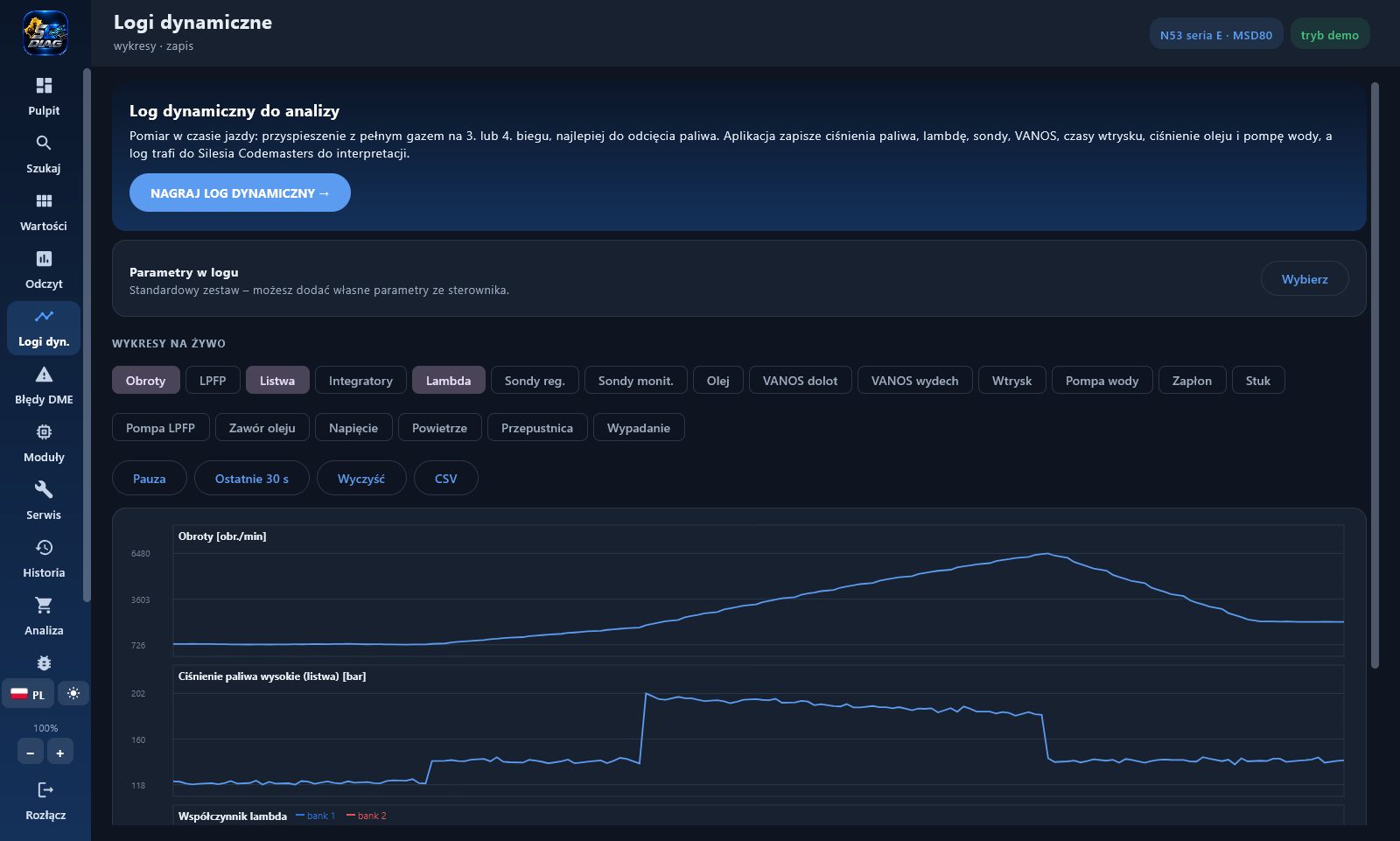
Dynamic log in SC Diag on Windows. Demo mode, simulated data, the shape of the curves is not a benchmark for a pump.
Below is a list of questions to answer before you buy the part. The SC Diag screens where this shows up are described separately, in the article on the high-pressure pump in SC Diag. Here we stay with the decision itself: what to check, in what order, and what follows from it.
The examples are scenarios, not accounts of repairs. The screenshots come from demo mode with simulated data and prove nothing.
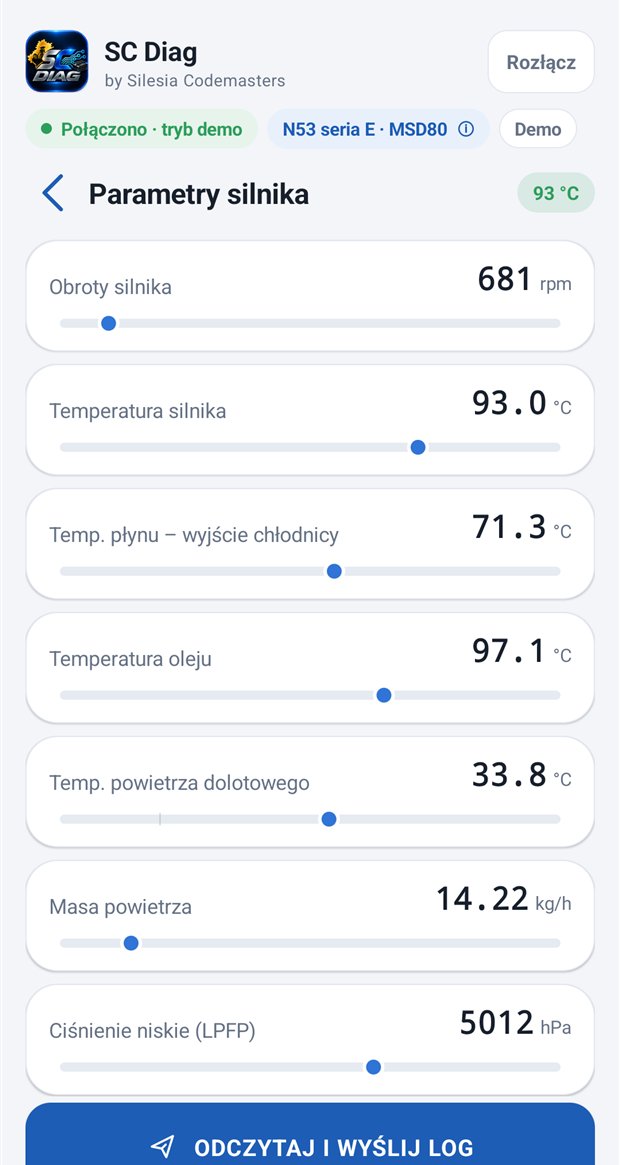
Low pressure (LPFP) on the Engine parameters screen. Demo mode, simulated data.
The short answer: the N53's high-pressure pump should not be replaced on the strength of a low rail pressure entry alone. First check the low pressure and the supply to the pump, then how the cylinders run, and finally how the pressure behaves under load over several runs. When those steps are clean and the pressure still cannot keep up, the pump becomes the main suspect.
What a low rail pressure entry actually means
Only that the control unit did not reach its target value. Why, the entry does not say. The same message comes from the high-pressure pump, a leaking injector, a clogged filter, an air-locked low-pressure circuit and a faulty sensor on the rail. All these causes sit in one chain, so we start at its beginning, not in the middle.
Five questions before you buy a pump
- Is the low pressure stable? Our workshop criterion for the N43 and N53 is around 5000 hPa, with every reading within ±100 hPa, depending on the engine and the measuring conditions. We ignore the first seconds after a cold start.
- Does the in-tank pump have a supply, and is the filter clear? The pump's control module and wiring can fail before the pump itself does.
- Do all the cylinders run evenly? Rough run and the misfire counters show whether one stands out.
- Does the rail pressure keep up under load, over several runs rather than one?
- Does the description of the symptom fit the pump? Uneven running on a warm engine or jerking can have another source, for example the crankcase ventilation.
The fifth question looks the least technical, yet it can decide everything else.
How to read the results together
You weigh the results against each other. You do not read them one by one like a shopping list.
- Low pressure jumps around: there is no point judging the pump on the engine. You look at the tank, the filter and the supply to the pump.
- Low pressure stable but one cylinder stands out: the direction points to the injector or ignition of that cylinder, not to the pump (N53 injectors in SC Diag).
- Low pressure stable, cylinders even, rail pressure lagging over several runs in similar conditions: only then do the high-pressure pump and its valve move to the top of the list.
- Long cranking after standing, with good low pressure: a leak on the high-pressure side is more likely than the pump itself. That is, however, a symptom described by the driver, not a number on the screen.
None of these patterns is a verdict. It is an order of checks.
Why one drive is not enough
At idle the pump has it easiest. The log screen describes the run: acceleration at full throttle in 3rd or 4th gear, ideally up to fuel cut-off, only where that is legal and safe. On the chart, next to engine speed, you see the rail pressure. You ask one thing: does it keep up, and does it drop in the same places on every run?
The app shows the target value where the control unit supplies it. When it is not there, you compare several runs with each other. The record goes to a CSV file, so logs can be set side by side or sent for log analysis. More on the numbers themselves: rail pressure, target and actual.
What a reading will not settle
Actual pressure is a sensor reading, not a gauge measurement. A faulty sensor will show a believable number, because the control unit regulates to whatever the sensor tells it. You will not spot that from the screen alone. Likewise you will not see the supply to the pump or the state of the filter: that is inspection and measurement in the workshop.
Replacing it "to see" is often a mistake: when an injector or the crankcase ventilation was to blame, the symptom comes back (HPFP and LPFP, when the pump is really at fault). If the pump has already been replaced, repeat the same log in the same conditions and compare it with the earlier one. Readaptation may be needed after the repair.
When the list settled nothing
It happens that the low pressure is stable, the cylinders are even, and the rail pressure fails one time and not the next. Then you do not buy a part, you collect more data: a reading on a cold and on a warm engine, a log in different conditions, and a precise description of when the symptom appears. That set shows a pattern a single run cannot.
The last step before the decision is a workshop measurement independent of the rail sensor. Only a result that agrees with the log gives grounds for replacement. Until then the pump is a suspect, not the culprit.
How we can help
You can answer questions 1, 3 and 4 yourself. SC Diag runs on Android and on Windows (separate licences): from €9.99 for 30 days, €29.99 for a year, €69.99 for 2 years with the Service option. Demo mode shows the screens without a car. The scope depends on the data the control unit supplies, and the N43 and N53 are covered most fully (app features, SC Diag for Windows).
The second path is N53 diagnostics with us, in the workshop in Silesia, on site or remotely. We agree the scope by phone: 570 341 744.
Frequently asked questions
Not from the error alone. The same entry comes from an injector, the filter, the supply to the pump and the sensor. First you check the low pressure, the cylinders and the pressure under load.
With the low pressure. If it is unstable, the high-pressure pump cannot be judged reliably on the engine.
It shows the low pressure, the rail pressure in a drive log and how the cylinders run. That narrows the checks but passes no verdict on the pump.
We do not give a number. It means several runs in similar conditions, so you can see whether the pressure fails in the same places.
No. If an injector, the supply, a sensor or the crankcase ventilation was the cause, the symptom can return. That is why the same test is repeated after the repair and compared with the log from before the replacement.
Before you buy the pump
In SC Diag you see the low pressure and the rail pressure from a drive before you spend money on the part. We arrange diagnostics with us by phone.
Order SC Diag