A message about the electric drive system or the high-voltage battery has appeared on the dashboard, perhaps together with a warning light. The car either still runs or it does not, and you do not know whether it is a minor thing or a job for the recovery truck.
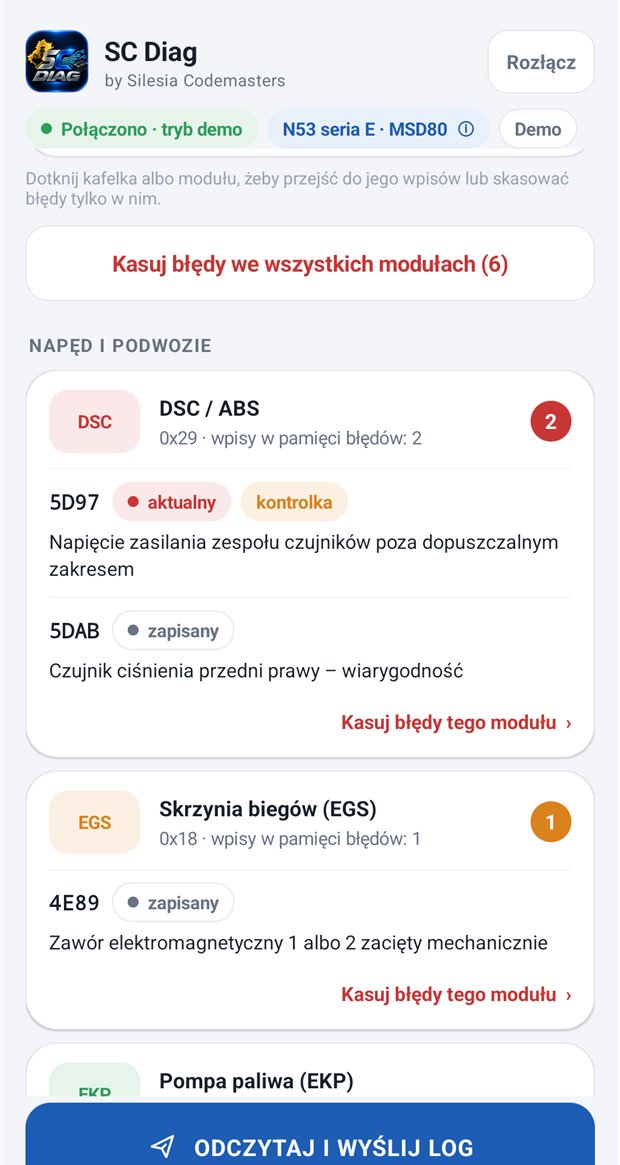
The list of entries in the SC Diag module overview. Demo mode, simulated data; the screenshot shows modules of a series E car with a combustion engine and only illustrates how entries are presented: code, status and description.
This page is not a repair guide. We do not describe work on the high-voltage system, because only people with the proper qualifications carry it out. We write about how to behave, what an ordinary owner can do and what reading the fault memory is good for.
The short answer: when the car signals a high-voltage system fault, do not carry on driving and contact a workshop. Do not take anything apart and do not touch the installation. Reading the fault memory, for example in SC Diag, will show the entries of the electric drive modules and give the workshop a starting point, but it will not settle the fault on its own.
Let us start with what matters in the first minutes, because that is where mistakes are easiest to make.
The first minutes after the warning
Treat a high-voltage system warning more seriously than a bulb warning light. If the warning light is red, or the message tells you to stop, do not carry on driving. Stop the car in a safe place, following the owner’s manual, and contact a workshop or breakdown service.
Before anything disappears from the screen, write down the exact wording of the message or take a photo of the dashboard. A workshop will ask about it first.
What not to do
The list is short and not up for negotiation:
- do not touch or open any part of the high-voltage system, even if a video online shows that “it is easy”,
- do not try to check or repair the battery yourself,
- do not ignore the warning just because the car still drives,
- do not clear entries from the fault memory before the workshop visit, because the workshop loses the trail it would like to start from.
Each of these points has one reason: the high-voltage system is dangerous for people without training, and its faults can be expensive.
What can be behind the message
“High voltage battery fault” is not one fault but a catch-all for several quite different things. In general, entries in this area concern communication with the battery module, its power supply, sensors and measuring circuits, the protection of the high-voltage system, or cooperation with charging. Some of them have mundane causes, some need a specialist.
We do not give codes or thresholds. Their meaning depends on the model, the model year and the software version, and a number alone does not tell you whether it is a harmless loss of communication or something serious. Many entries in many modules at once are often a sign of a power supply problem rather than of many separate faults. Telling them apart is only possible from data.
What reading the fault memory gives you
SC Diag checks the high-voltage battery module in the “Other modules” overview and, when that responds, also the drive, the charger and, if the car has one, the range extender. The modules that report in go into the “Electric drive and charging” group, and the module map shows the ones that responded and the colour of their entries. You get concrete information on which modules have something stored, instead of just the message from the dashboard.
A reading does not settle anything. It will not say whether the battery is faulty, or what has to be repaired and at what cost. The app does not show battery health, its capacity or cell voltages. The function is in versions 1.0.9 on Android and 1.0.33 on Windows (from 22 November 2026), and its scope on real electric cars is still being checked, so the result depends on the model, the model year and the adapter. We describe all of it on the page on electric cars and hybrids in SC Diag.
Well-read entries shorten the conversation with a workshop. An authorised or specialist workshop gets a starting point and does not begin by asking what happened in the first place.
What to take to the workshop
Prepare a short note:
- the exact wording of the message and the colour of the warning light, preferably a photo,
- the circumstances in which it appeared: while driving, after standing, when trying to start,
- whether the fault went away or is still there,
- which modules responded in the reading and what entries they have (a screenshot of the module map is enough),
- the model year and version of the car, if you know them.
Such a list saves time, and when in doubt it is better for the workshop to see the car than for you to guess the cause from a forum.
Safety of the high-voltage system
Work on the high-voltage system may only be carried out by people with the proper qualifications. SC Diag only reads the fault memory and does not require touching the high-voltage installation. If a high-voltage warning light comes on, or a “stop” message appears, do not carry on driving and contact a workshop.
How we can help
You can take the fault memory reading yourself in SC Diag, and prices and licences are collected on the SC Diag order page. We describe the functions in the overview of functions, and the change history shows when we added reading of the electric drive modules.
If the problem concerns the combustion engine in a hybrid, we will check it as part of engine diagnostics (N53 diagnostics), and for a particular car we agree the scope by phone. When buying a car, the text on pre-purchase diagnostics is useful. Repairs of the high-voltage battery are not covered by this page.
Frequently asked questions
It is a message about a problem in the electric drive system, which can have very different causes, from a loss of communication with a module to more serious faults. The message alone cannot settle it; a reading and a specialist’s assessment are needed.
When the warning light or message tells you to stop, do not carry on driving and contact a workshop. Treat warnings from this system seriously, even if the car still drives.
No. SC Diag reads the fault memory of the electric drive modules and shows which ones responded and what they have stored. It does not give battery health and does not point to the faulty part; the workshop does that.
It is better not to do that before the workshop visit. The entries are the trail the workshop starts from, and clearing them does not remove the cause.
No. You plug the adapter into the diagnostic socket, and work on the high-voltage system may only be carried out by people with the proper qualifications.
Does your car report a high-voltage system fault?
Safety and the workshop come first. A fault memory reading in SC Diag gives you a starting point for the conversation, provided the car responds.
See SC Diag