You have a plug-in hybrid or an electric BMW and wonder whether a phone and an adapter can get anything out of it. Until now SC Diag was known for combustion engines. From version 1.0.9 on Android and 1.0.33 on Windows (22 November 2026) it also reads the fault memory of the electric drive modules.
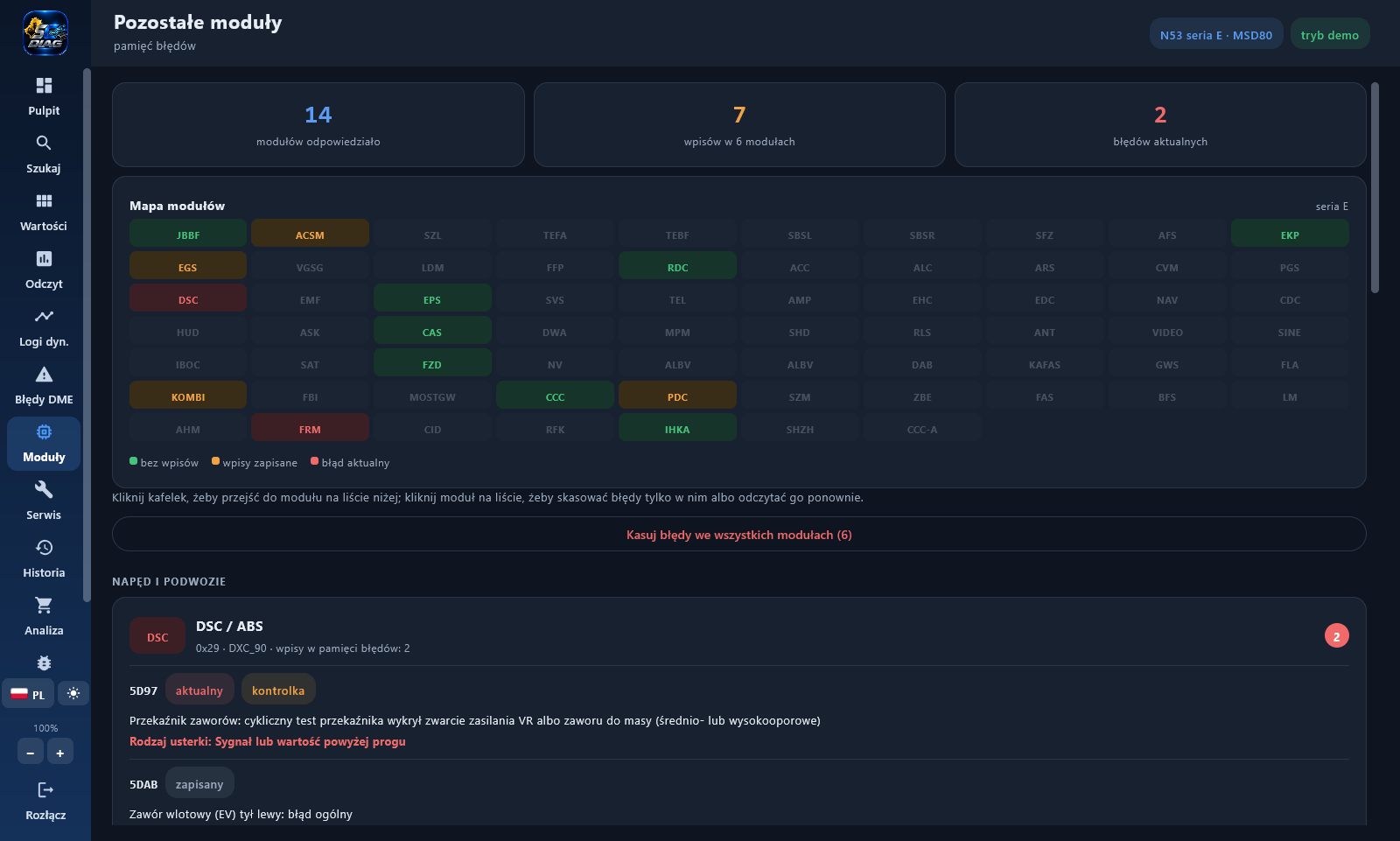
The module overview in SC Diag for Windows. Demo mode, simulated data; the screenshot shows a series E car with a combustion engine and is only there to show what the module map and the list of entries look like.
Below we explain what this means in practice: where these modules appear in the app, what the map shows and where the role of a reading ends. This is the main page on the subject; for two typical situations see the texts on a high-voltage battery fault and on the plug-in hybrid.
The short answer: SC Diag reads the fault memory of the electric drive modules in BMW hybrids and electric cars: it checks the high-voltage battery module and, when that responds, also the drive, the charger and the range extender if the car has one. In hybrids it still reads the combustion engine. It does not show battery health or live drive data.
The scope on real electric cars is still being checked. The result depends on the model, the model year and the adapter, so we do not promise that every car will respond the same way.
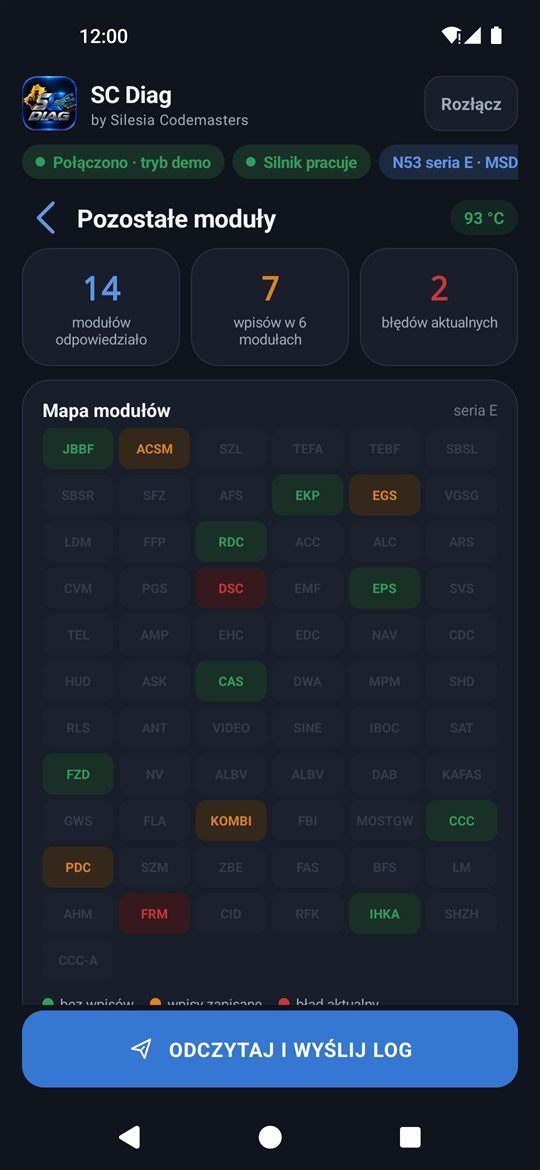
The same map on a phone. Demo mode, simulated data; a series E car with a combustion engine.
Where the electric drive modules appear in the app
The reading is part of the “Other modules” overview, the place where the app asks the other control units in the car one by one and draws the module map. In a car with an electric drive there is one extra step. SC Diag first checks the high-voltage battery module. If it responds, the app goes on to ask for the drive, the charger and, if the car has one, the range extender.
The modules that have responded end up in a separate group, “Electric drive and charging”. The module map shows the ones that responded, in three colours: no entries, stored entries and active fault. Tapping a tile opens the list of entries for that module.
What you see after a reading
For each module in the group you get its fault memory, just as for the other control units in the car. The counters at the top of the screen tell you how many modules responded, how many entries there are and how many of them are active faults. How an entry is described depends on what the app can assign to a given code in a given module.
A module that does not respond does not have to mean a fault. The car may simply not have that module, or the adapter or configuration may not allow it to be queried. If the battery module does not respond, the “Electric drive and charging” group does not appear, and you read the rest of the car as before.
Hybrids: we read the combustion engine as always
In a hybrid with a combustion engine SC Diag still reads the engine control unit, petrol and diesel, within the scope described on the page of all supported engines. The list of control units also includes ones marked as hybrid. So you get the dashboard, engine faults with a freeze frame, rough run and logs from driving, as far as the control unit provides them. How this looks is described in the overview of functions.
You read both in one app. How to put the results from the engine and from the electric drive modules side by side is shown in the text on the plug-in hybrid.
What SC Diag does not do with electric cars
The limits are simple, and we prefer to state them plainly:
- it reads the fault memory, it is not coding and not the manufacturer’s service procedures,
- the app does not show battery health, its capacity or cell voltages,
- it does not show charging, range or live drive data,
- it does not decide what is faulty: an entry in the fault memory is a lead for further checks, not a diagnosis.
We also do not publish a list of supported models. We do not confirm such a list, because the scope depends on the particular car.
Safety around the high-voltage system
Work on the high-voltage system may only be carried out by people with the proper qualifications. SC Diag only reads the fault memory and does not require touching the high-voltage installation: you plug the adapter into the diagnostic socket, as in any other car.
If a high-voltage warning light comes on, or a “stop” message appears, do not carry on driving and contact a workshop. The reading can wait.
How we can help
There are two ways. The first is the app itself: SC Diag runs on Android and on Windows (separate licences), and on Windows for electric cars you connect via ENET. The 30-day licence costs €9.99, the annual one €29.99 and the two-year one with the Service option €69.99. You can order it on the SC Diag order page, and what has changed in recent releases is in the change history.
The second way concerns the combustion engine, also in a hybrid. We carry out engine diagnostics at our workshop, and for a particular car we agree the scope by phone before the visit, for example for the N53 engines. A value from a reading says little without context, which is why we have also described how to read live engine parameters and how to record a log for analysis. This page does not cover work on the high-voltage battery.
Frequently asked questions
It reads the fault memory of the electric drive modules: the high-voltage battery module and, when that responds, also the drive, the charger and the range extender. The scope on real electric cars is still being checked and depends on the model, the model year and the adapter.
No. The app reads the fault memory of the modules and does not give battery health, capacity or cell voltages. You cannot read such values with SC Diag.
Yes, in two parts. We read the combustion engine as in any other car, within the scope the control unit provides, and the electric drive modules appear in the “Electric drive and charging” group if they respond.
No. You plug the adapter into the diagnostic socket and the app only reads the fault memory. Work on the high-voltage system may only be carried out by people with the proper qualifications.
We do not publish such a list, because the scope depends on the particular car, model year and adapter. It becomes clear during the reading: the modules that respond appear on the module map.
An electric car or hybrid BMW to read?
SC Diag reads the fault memory of the electric drive modules and, in hybrids, the combustion engine as well. The scope depends on the car.
See SC Diag and pricing