Someone is looking at an N53 advert and asking what everybody asks: will it fall apart? We have no percentages and no mileage limits for you, because we have no reliable data, and the figures on forums contradict each other. What we do have is experience from readings and from the workshop, and it points to something simpler.
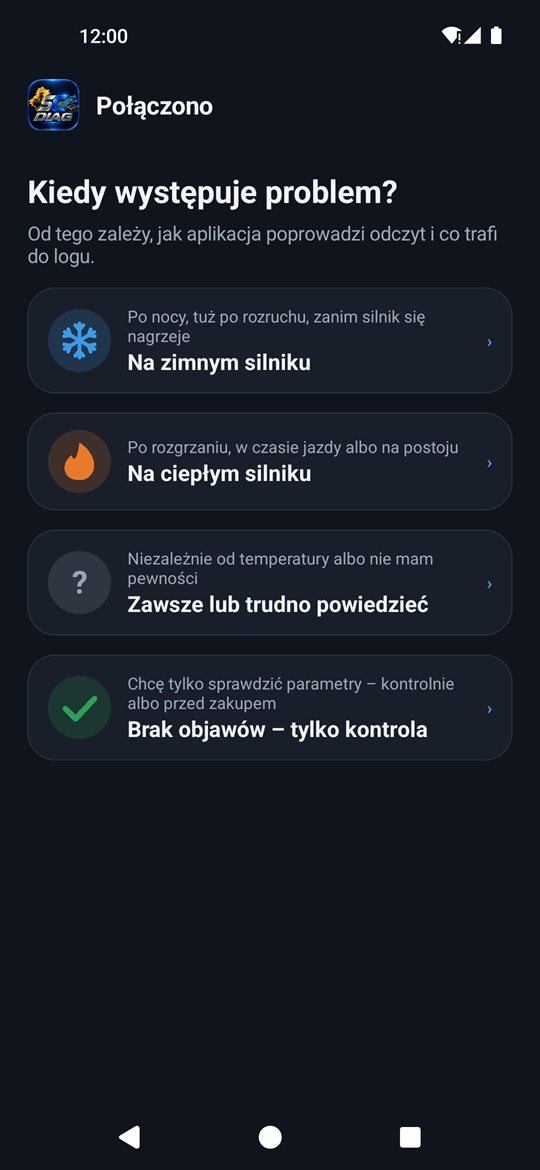
Choosing "No symptoms, just a check" in SC Diag is meant for checking a car before purchase as well. Demo mode, simulated data.
The N53 is an engine to look after, if someone has looked after it and if you buy it with a reading rather than on trust. Below: what speaks for it, what usually goes wrong, and what the control unit will tell you before you sign. The examples are scenarios, not accounts of particular cars.
The short answer: the N53 can be a good buy, but you have to check the individual car, not the reputation of the model. Pay attention to the piezo injectors, the high-pressure pump, the NOx system and the crankcase ventilation. An engine reading shows fault entries with freeze frames, misfire counters, trims and fuel pressure, but it does not replace an inspection or the service history.
Who the N53 makes sense for
For someone who treats a car as something to keep an eye on. The N53 is a six-cylinder petrol engine with direct injection and piezo injectors. It is well documented, we know its weak points and how to catch them in a reading. That is a strength: a fault can often be seen before it becomes expensive.
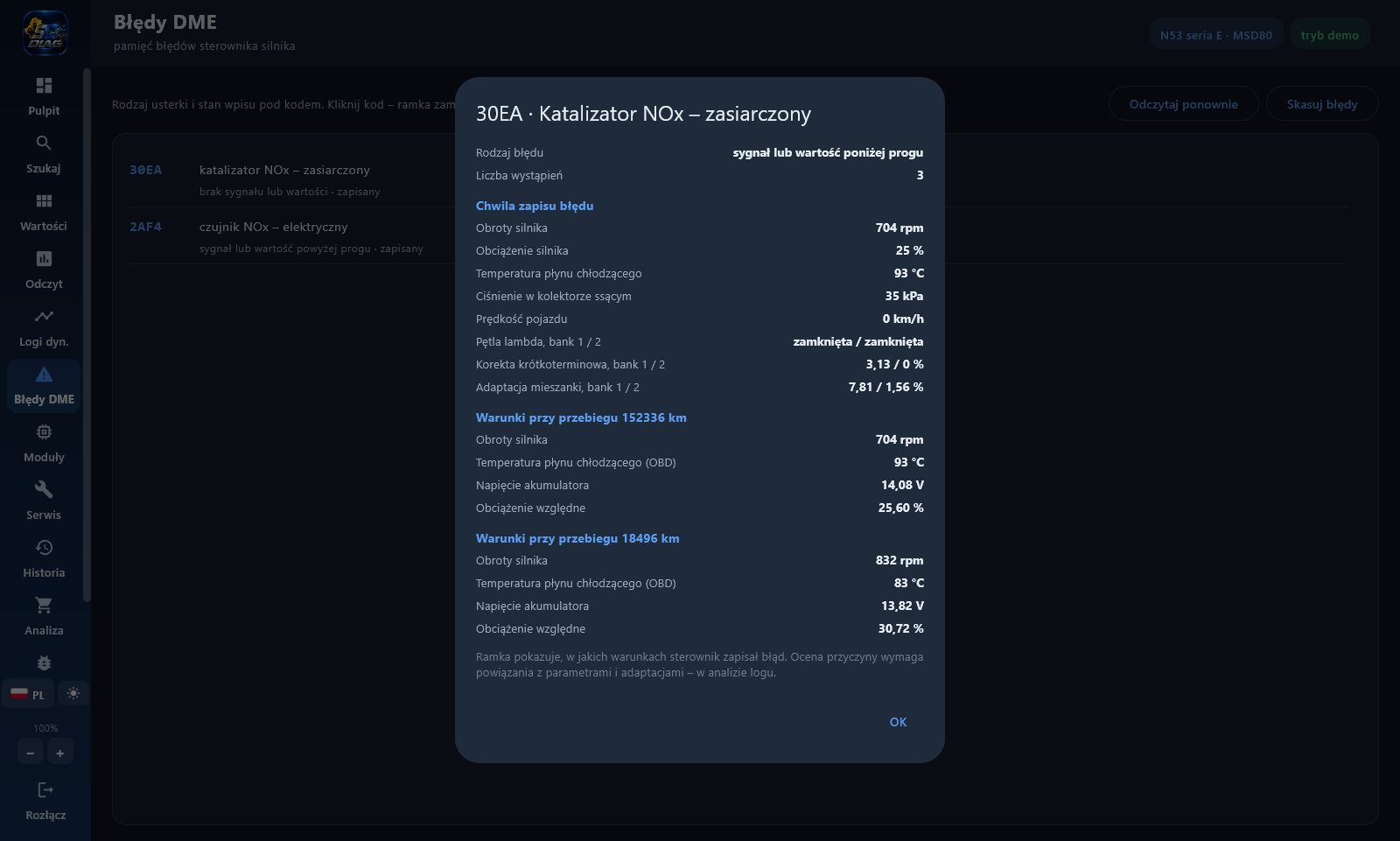
Fault entry with a freeze frame. This is a demo entry, used only to show the screen layout.
It makes less sense for someone who wants to buy and never look under the bonnet, with no plan for diagnostics. A direct-injection engine reacts to neglect in the fuel system and the mixture. That is no criticism of the design, only a reason to keep an eye on it.
What usually causes trouble
Four places where the N53 usually shows its age. We describe them in our guides, here only the direction.
- Piezo injectors. They show up as uneven running of one cylinder, long cranking and misfires. With a used car, ask whether they were replaced and where the parts came from, because the aftermarket knows counterfeits.
- High-pressure pump. Often suspected, not always at fault (what to check before replacing it).
- NOx system and operating mode. When the control unit does not trust the sensor or the catalyst, the engine stays in homogeneous mode and uses more fuel (the NOx system step by step).
- Crankcase ventilation. A fault there causes uneven running that is mistaken for an injector problem (N53 crankcase ventilation).
What a reading shows before you buy
In SC Diag you choose "No symptoms, just a check" or, if the seller mentions jerking in the morning, the "On a cold engine" reading first. You look at five things.
- The fault memory with freeze frames. An entry from a large number of kilometres ago is a different matter from one made in recent days.
- Misfire counters since new and the live increase. The cylinder in the lead is a lead to follow up.
- Rough run: whether the cylinders run evenly, provided the flywheel adaptation is complete.
- Low pressure. Our workshop criterion is around 5000 hPa, every reading within ±100 hPa, depending on the engine and the measuring conditions.
- Mixture trims and adaptations, together with the operating mode and the NOx system data.
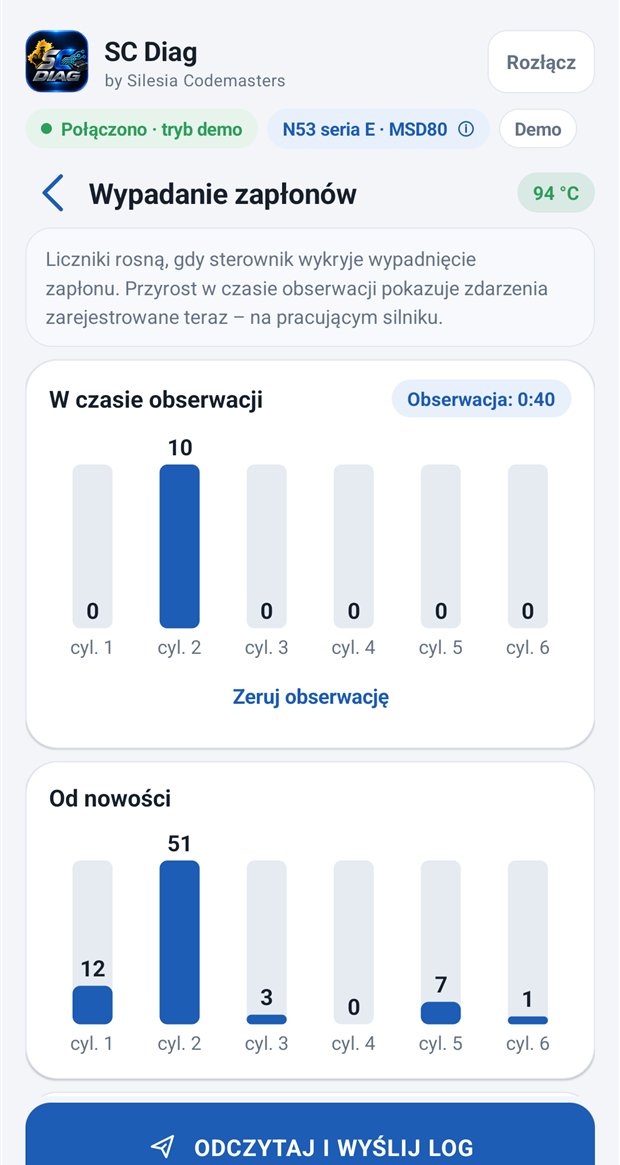
Misfire counters in demo data: cylinder 2 has the most, both during the observation and since new. Demo mode, simulated data.
On the demo screenshot cylinder 2 has the most misfires. The data is simulated, but it shows what you read from the counters: which cylinder, and whether it is history or an increase right now. How to put it all together is described in the article on the pre-purchase check and in the one on five parameters before buying.
What a reading will not show
Faults can be cleared and adaptations reset, and a freshly wiped memory looks like a healthy engine. That is why we also look at the counters since new and at how evenly the cylinders run, and we never clear faults in front of the seller. You may compare the mileage stored in the control unit with the odometer, but a discrepancy is a signal for further questions, not proof.
A reading does not assess the bodywork, the suspension, traces of earlier repairs or the service history. Nor is it a survey or a guarantee that there are no defects. It narrows the list of risks and gives you an argument in the price talk.
Questions for the seller and conditions for the reading
Arrange it so that the engine is cold when you arrive. A warmed-up car takes away the moment when many faults are visible. Ask whether the injectors, the pump or the NOx sensor were replaced, who did it and whether there are documents. Save the reading before the negotiation, not after.
We cannot tell you the repair cost in advance. Get it from your own mechanic for the specific entry, and only then negotiate the price or walk away.
How to turn the results into a decision
A reading does not say "buy" or "don't buy". It helps you lay out scenarios.
- Faults and counters quiet, cylinders even, pressure stable, repair history documented: a sensible candidate, provided the inspection also goes well.
- One cylinder stands out or the low pressure jumps around: an argument in negotiation or a reason to walk away, depending on what it costs to remove the cause.
- The seller does not agree to a reading or arrives with a warmed-up car: that is information too.
If you cannot check the car yourself and it is far away, have someone on the spot take the reading and send us the log.
How we can help
The first step you can take yourself. SC Diag runs on Android and on Windows (separate licences): from €9.99 for 30 days, €29.99 for a year, €69.99 for 2 years with the Service option. Demo mode shows the screens without a car, and you can send a log for analysis. The N43 and N53 are covered most fully (app features).
The second route is a pre-purchase diagnostic with us: in Silesia, we can come to you or work remotely. We agree the scope by phone: 570 341 744.
Frequently asked questions
It can be a good buy if that particular car has been looked after and you check it with a reading and an inspection. The reputation of the model decides nothing, what counts is the condition of the car and its repair history.
We do not give statistics, because we have no reliable data. We know the typical weak points: piezo injectors, the high-pressure pump, the NOx system and the crankcase ventilation.
Yes. SC Diag has a "No symptoms, just a check" reading and runs on Android with an ELM327 adapter or a cable. For E-series cars a K+DCAN cable is best.
Not always. Faults can be cleared and adaptations reset. That is why we also check the misfire counters since new, how the cylinders run and the fuel pressure.
No. A reading shows what the engine control unit supplies. The bodywork, the suspension and the documents have to be checked separately.
Buying a BMW with an N53?
A reading in SC Diag before purchase shows faults, misfires and pressure before you sign the contract. We agree a pre-purchase diagnostic with us by phone.
Order SC Diag