Someone types “BMW diagnostic computer”, “what to buy for a BMW” or “how much does this software cost” into a search engine and lands on dozens of listings for cables that look alike and do different jobs. The first thing to settle is which car it is and what you actually want to read from it. A cable shows nothing by itself; it is just a pipe between the car and the software.
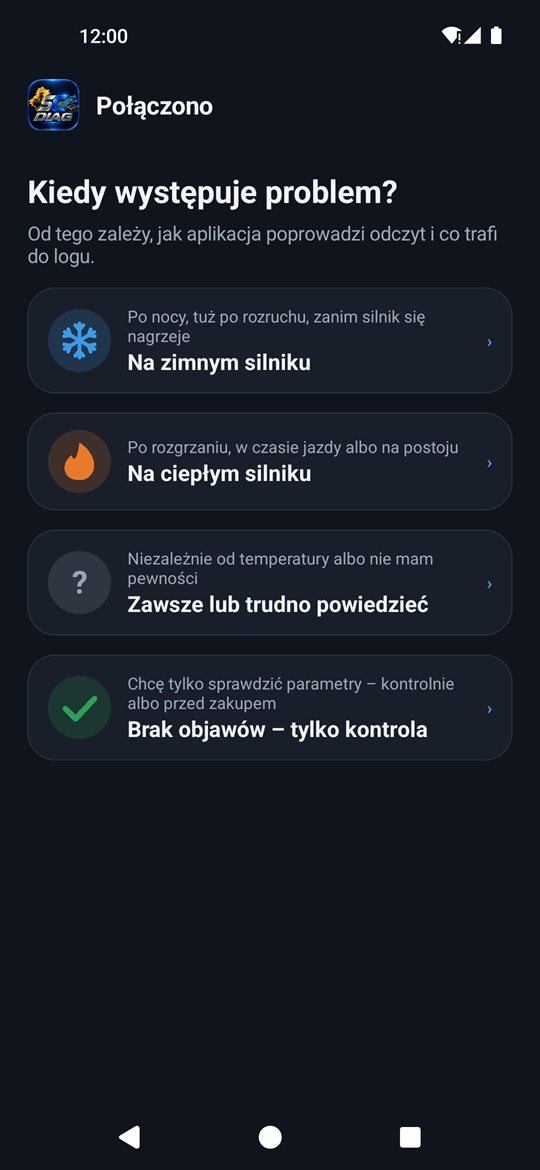
SC Diag read-out selection screen — screenshot from demo mode (simulated data).
In short: for E-series BMWs you would normally pick a K+DCAN cable, for F and G series an ENET cable, and a plain ELM327 adapter with a phone is enough for read-outs only. None of them codes or programs control units without suitable software. For the engine, an app that shows the control unit's data is enough; for the rest, call a workshop.
Software first, cable second
“Which adapter?” only makes sense once you know what you want. A generic OBD code reader with a cheap app will show emissions-related faults and a dozen or so values that every car has. That is not BMW diagnostics. A BMW engine control unit has its own, much richer set of data: adaptations, misfire counters, readings from the NOx sensor, pressures in both fuel circuits. To see them, the software has to know the protocol of that particular control unit, and the adapter has to carry it across without dropping frames.
So it makes sense to buy in this order: I know the car, I know which software I will use, and only then I pick the interface. The other way round ends with a cable in a drawer that fits nothing.
E-series: the K+DCAN cable
Older BMWs, from the E46 to the E9x and related models, most often talk to diagnostics through a K+DCAN cable on USB. It plugs into the OBD socket, and at the other end is a Windows computer, or a phone if the software supports it. It is cheap compared with workshop interfaces and is enough to read the engine, fault codes and live values.
There are two things nobody mentions when you buy one. Some cables have a mode switch, others have a chip that needs the right driver on the computer. If the software “can't see” the car while the cable lights up, the culprit is usually the COM port or its setting. The second point: this cable does not mean you can do everything. Reading the engine is one thing; coding is an entirely different category of job, with its own risks.
F and G series: the ENET cable
Newer cars communicate over Ethernet, so an ENET cable is used: an OBD plug on one end, RJ45 on the other. It is fast, stable and in practice the standard for F and G series. It needs a computer with a network socket or an adapter, and setting up the network card correctly is often the first small headache.
ENET is also usually the choice for longer operations, because the connection is simply more dependable than a wireless one. You can read the engine in an F or G series car through it without trouble, but that does not mean every program will get the same data out of that control unit. The range of data depends on the software and on the control unit itself.
ELM327 from a phone: convenient, but limited
An ELM327 adapter on Bluetooth or Wi-Fi is the cheapest and handiest route: the phone is in your hand and nothing needs setting up. For read-outs alone it is perfectly adequate, as long as the software can speak BMW with it. With a generic OBD app you will see little. With a program written for specific control units, such as SC Diag, you will see as much as that control unit provides.
There is one warning, but a serious one. The quality of these adapters is very uneven, and many are clones with varying compatibility with the original chip. I will not give percentages, because nobody has measured them properly. The symptoms are, however, familiar: dropped connections, slow responses, truncated frames, and sometimes no communication with some control units. If a read-out keeps hanging, before you suspect the car, try a different adapter and test again.
The power supply you forget about
During a short read-out with the engine running there is no need to worry about the battery; the alternator charges it. It is different when a session runs long with only the ignition on: the car's consumers draw current and the voltage drops. For a read-out it is enough to notice that and start the engine or connect a charger. For operations that write anything into a control unit, a voltage drop in the middle of the write is a real risk of a damaged module. That is why such work is done with a stabilised power supply, not “on the battery, which has seen better days”. In the SC Diag dashboard the voltage is visible all the time, so a drop shows at once.
What the software costs
We do not quote cable prices because they change too often. Our own app SC Diag, however, has a fixed price list. A one-off read-out when you order a diagnostic from Silesia Codemasters is free of charge. A 30-day licence costs €9.99, an annual one €29.99, and the two-year one with the Service tab €69.99. Android and Windows are separate licences. The details are in the SC Diag price list.
The limits: SC Diag is engine diagnostics for BMW and MINI, 97 control units from the E46 to the G series. It does not code, it does not replace ISTA in dealer procedures, and it does not cover every body module. It shows what the engine control unit provides, and what the unit does not provide, it simply does not make up. The full description is on the app features page.
When a read-out of your own is enough, and when to call
A read-out of your own is enough when a warning light is on and you want to know which code is behind it, when you are buying a car and want to look into the fault memory, or when you are checking after a repair that the fault has not come back. In these cases the data does the job and the decisions stay with you.
Call a workshop when the engine hesitates and there are no fault codes, because then rough run and adaptations have to be interpreted, not just displayed. Call also when you want to code, replace a module, update software, or when a code clears and returns. A read-out of your own will not settle whether the fault comes from the pump, an injector or a sensor; it gives the facts from which that follows, but someone has to put them in order. If the car is far away, remote diagnostics can help, and the pattern of uneven running is described under rough run.
Frequently asked questions
For read-outs only, yes, as long as the software knows the protocol of the BMW engine control unit. A generic OBD app will show only part of the data. Clone quality is uneven, so if the connection keeps dropping, first try a different adapter.
Usually not. These cars use Ethernet, so you need an ENET cable. K+DCAN is intended mainly for older models, the E-series.
The cable itself codes nothing. Coding needs separate software and proper power supply, and SC Diag is for engine diagnostics, not coding.
A one-off read-out when you order a diagnostic is free. A 30-day licence is €9.99, annual €29.99, two-year with Service €69.99. Android and Windows are separate licences.
Yourself: checking a code, a pre-purchase check, verification after a repair. At a workshop: hesitation with no fault codes, codes that keep coming back, coding, and anything that writes data into a control unit.
BMW engine read-out
Order a diagnostic and you get a one-off read-out in the SC Diag app free of charge.
See SC Diag