Automotive technology changes fast. New control units, new protections and new ways of working appear every year, so at Silesia Codemasters we train regularly. This time we travelled to a chip tuning course in Warsaw, at MS Group. Below we describe what you can see in the photo and why we think continuous development is a real benefit to customers.
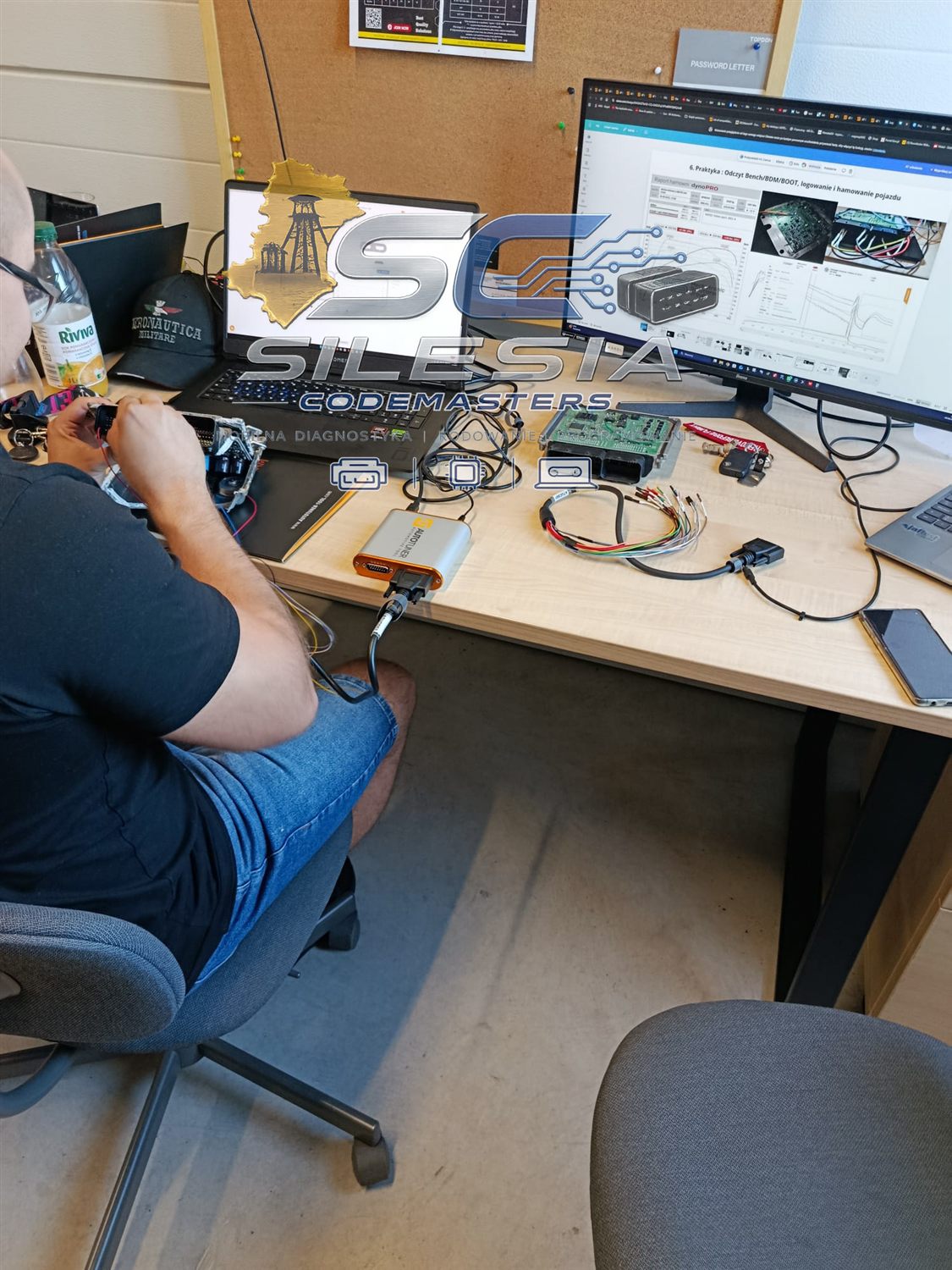
The training station in Warsaw: a slide on practical work on the monitor, an Autotuner and a control unit on the desk.
The photo shows the training station: a laptop, a monitor with the course materials, an Autotuner programmer, a control unit with its wires lying on the desk and a participant at work.
What you can see in the photo
The monitor shows a slide from the practical part of the course. The topic is Bench/BDM/BOOT reading, data logging and dyno running of the vehicle. Next to the slide there is a dyno report. On the desk you can see an Autotuner, an engine control unit with wires and a laptop. For us this is directly connected with our daily work: this is what the station looks like where we learn better methods of reading and verifying results.
We do not describe the course programme or any details: we publish only what is visible in the photo, namely that such topics were part of the practical session.
Why we keep training
Engine control units differ between platforms and model years, and the ways of working with them keep changing. Training helps us to:
- learn and organise the methods of reading control units,
- organise our knowledge of logging parameters while driving or working on the dyno,
- see how other specialists solve similar problems,
- keep our skills up to date as control units change.
For the customer this means a simple gain: we work with knowledge that does not stand still. We do not promise any certificates or qualifications here – we are only saying that we learn and develop.
Chip tuning: how we approach it
For us, Stage 1 and Stage 2 chip tuning is more than loading a file. Before it come diagnostics and an assessment of the car's condition, and after programming we verify the effect. We describe this on the page about Stage 1 and Stage 2 chip tuning for BMW. The map is adjusted to the individual car, not copied from a ready-made database.
We confirm the power gain with a dyno measurement, so that the customer sees a chart and not just a claim. You can read about how the measurement itself works on the page about power measurement on a mobile dyno in Silesia. If you are wondering what to realistically expect from the first stage, read the article Stage 1: how much power you really gain.
Knowledge from training makes the work more confident, but it does not replace diagnostics of the specific car. We assess each car separately.
Control unit reading and file service
Reading and writing control units is work in which method matters: the right mode, a backup of the original and verification. Training helps us to refine this process. If you are interested in the file-work service itself, we describe it on the File Service page.
Development as part of trust
When choosing a workshop, it is worth knowing whether it keeps developing. Cars are changing faster than before, and so are the equipment and methods for working on them. That is why we treat training as a permanent part of running the business, just like updating our tools and testing new solutions at our own station.
Frequently asked questions
In Warsaw, at MS Group. We do not give details of the programme or the trainers: we publish only what is visible in the photo from the course.
The slide in the photo shows the practical part: Bench/BDM/BOOT reading, data logging and dyno running of the vehicle.
We do not talk about certificates or qualifications. We train in order to develop our knowledge and methods of working.
Yes, we confirm the power gain with a dyno measurement, and the customer receives a chart with the result.
Stage 1 and Stage 2 chip tuning
Find out how we carry out chip tuning and how we confirm the result with a measurement.
See chip tuning